

120
S. Krishnia and W. S. Lew
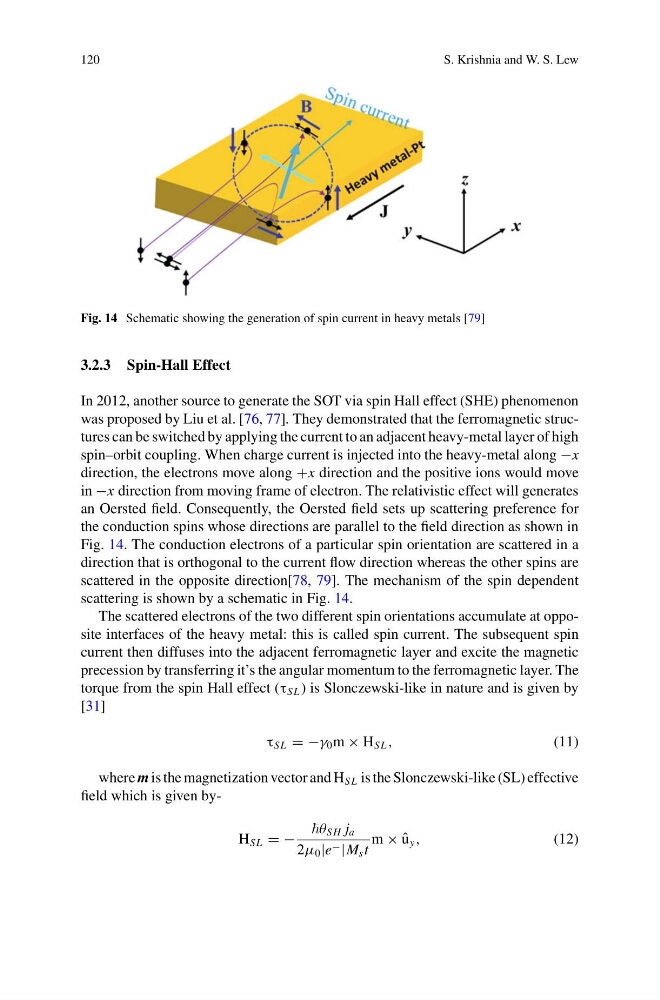
Fig. 14 Schematic showing the generation of spin current in heavy metals [79]
3.2.3 Spin-Hall Effect
In 2012, another source to generate the SOT via spin Hall effect (SHE) phenomenon
was proposed by Liu et al. [76, 77]. They demonstrated that the ferromagnetic structures can be switched by applying the current to an adjacent heavy-metal layer of high
spin–orbit coupling. When charge current is injected into the heavy-metal along −x
direction, the electrons move along +x direction and the positive ions would move
in −x direction from moving frame of electron. The relativistic effect will generates
an Oersted field. Consequently, the Oersted field sets up scattering preference for
the conduction spins whose directions are parallel to the field direction as shown in
Fig. 14. The conduction electrons of a particular spin orientation are scattered in a
direction that is orthogonal to the current flow direction whereas the other spins are
scattered in the opposite direction[78, 79]. The mechanism of the spin dependent
scattering is shown by a schematic in Fig. 14.
The scattered electrons of the two different spin orientations accumulate at opposite interfaces of the heavy metal: this is called spin current. The subsequent spin
current then diffuses into the adjacent ferromagnetic layer and excite the magnetic
precession by transferring it’s the angular momentum to the ferromagnetic layer. The
torque from the spin Hall effect (τ SL ) is Slonczewski-like in nature and is given by
[31]
τ SL = −γ 0 m × H SL ,
(11)
where m is the magnetization vector and H SL is the Slonczewski-like (SL) effective
field which is given byH SL = −
θ S H j a
2μ 0 |e − |M s t
m × ˆ
u y ,
(12)
S. Krishnia and W. S. Lew
Fig. 14 Schematic showing the generation of spin current in heavy metals [79]
3.2.3 Spin-Hall Effect
In 2012, another source to generate the SOT via spin Hall effect (SHE) phenomenon
was proposed by Liu et al. [76, 77]. They demonstrated that the ferromagnetic structures can be switched by applying the current to an adjacent heavy-metal layer of high
spin–orbit coupling. When charge current is injected into the heavy-metal along −x
direction, the electrons move along +x direction and the positive ions would move
in −x direction from moving frame of electron. The relativistic effect will generates
an Oersted field. Consequently, the Oersted field sets up scattering preference for
the conduction spins whose directions are parallel to the field direction as shown in
Fig. 14. The conduction electrons of a particular spin orientation are scattered in a
direction that is orthogonal to the current flow direction whereas the other spins are
scattered in the opposite direction[78, 79]. The mechanism of the spin dependent
scattering is shown by a schematic in Fig. 14.
The scattered electrons of the two different spin orientations accumulate at opposite interfaces of the heavy metal: this is called spin current. The subsequent spin
current then diffuses into the adjacent ferromagnetic layer and excite the magnetic
precession by transferring it’s the angular momentum to the ferromagnetic layer. The
torque from the spin Hall effect (τ SL ) is Slonczewski-like in nature and is given by
[31]
τ SL = −γ 0 m × H SL ,
(11)
where m is the magnetization vector and H SL is the Slonczewski-like (SL) effective
field which is given byH SL = −
θ S H j a
2μ 0 |e − |M s t
m × ˆ
u y ,
(12)