

Current-Driven Domain Wall Dynamics in Magnetic …
119
interaction produces a field known as the DMI field (H DMI ), which is given byH DM I = −
∂ E DM
∂M
.
(9)
The direction of the DMI field is collinear to the u ij vector that introduces chiral
magnetic textures into the ferromagnetic structures [69, 70]. In ferromagnetic structures with perpendicular magnetic anisotropy, the DMI field favours the stabilization
of Néel DWs over Bloch with a set chirality [64]. The DMI field, H DMI can be
expressed in terms of D and the domain wall width, [71, 72],
H DM I =
D
μ 0 M S
(10)
The above equation can be used to estimate the DMI coefficient. There exists a
minimum critical value of H DMI such that it is able to overcome the magnetostatic
energy and favour Néel DWs. Consider H D as the DW anisotropy field such that, H D
= 4K D /πμ 0 M S , with K D = N x μ 0 M S
2 /2 being the magnetostatic DW anisotropy and
N x = t f ln(2)/π is the demagnetization coefficient for magnetic film of thickness t f
[73]. Then Néel DWs are preferred if H DMI > H D else Bloch DWs are stabilized in the
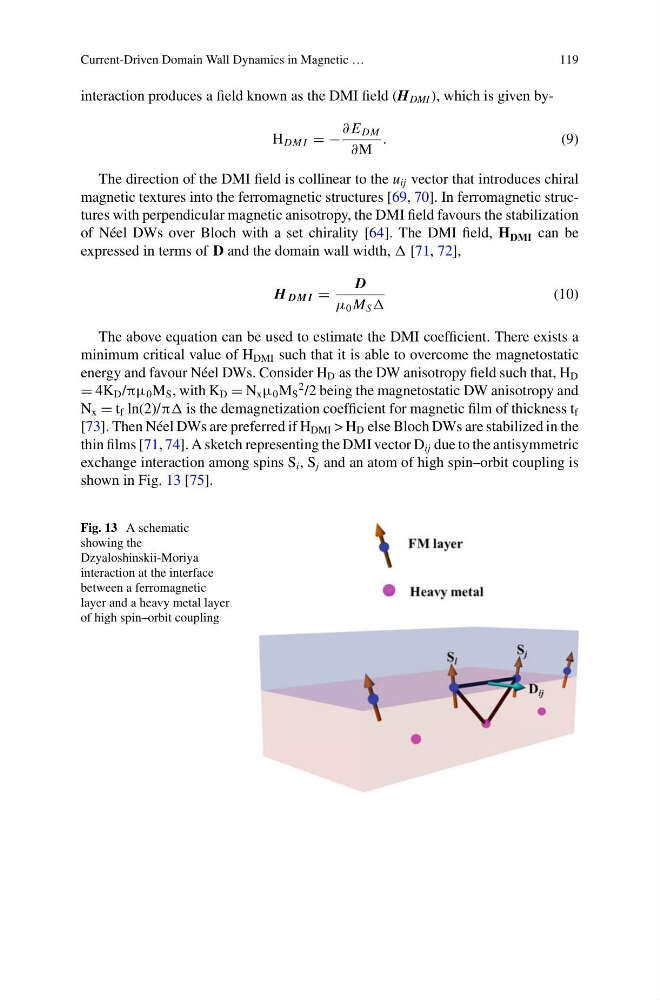
thin films [71, 74]. A sketch representing the DMI vector D ij due to the antisymmetric
exchange interaction among spins S i , S j and an atom of high spin–orbit coupling is
shown in Fig. 13 [75].
Fig. 13 A schematic
showing the
Dzyaloshinskii-Moriya
interaction at the interface
between a ferromagnetic
layer and a heavy metal layer
of high spin–orbit coupling
119
interaction produces a field known as the DMI field (H DMI ), which is given byH DM I = −
∂ E DM
∂M
.
(9)
The direction of the DMI field is collinear to the u ij vector that introduces chiral
magnetic textures into the ferromagnetic structures [69, 70]. In ferromagnetic structures with perpendicular magnetic anisotropy, the DMI field favours the stabilization
of Néel DWs over Bloch with a set chirality [64]. The DMI field, H DMI can be
expressed in terms of D and the domain wall width, [71, 72],
H DM I =
D
μ 0 M S
(10)
The above equation can be used to estimate the DMI coefficient. There exists a
minimum critical value of H DMI such that it is able to overcome the magnetostatic
energy and favour Néel DWs. Consider H D as the DW anisotropy field such that, H D
= 4K D /πμ 0 M S , with K D = N x μ 0 M S
2 /2 being the magnetostatic DW anisotropy and
N x = t f ln(2)/π is the demagnetization coefficient for magnetic film of thickness t f
[73]. Then Néel DWs are preferred if H DMI > H D else Bloch DWs are stabilized in the
thin films [71, 74]. A sketch representing the DMI vector D ij due to the antisymmetric
exchange interaction among spins S i , S j and an atom of high spin–orbit coupling is
shown in Fig. 13 [75].
Fig. 13 A schematic
showing the
Dzyaloshinskii-Moriya
interaction at the interface
between a ferromagnetic
layer and a heavy metal layer
of high spin–orbit coupling