

116
S. Krishnia and W. S. Lew
3.2.1 Rashba Effect
Unlike the STT-induced magnetization switching, the SOT does not require polarization of spins, and thus it opens new prospects in magnetization manipulation to design
energy efficient spintronics devices. In systems with broken inversion symmetry
having a ferromagnet and heavy metal interface e.g. Pt/Co/AlO x or Ta/CoFeB/MgO,
there exists a source of SOT, namely, Rashba effect [55, 56]. These structures exhibit
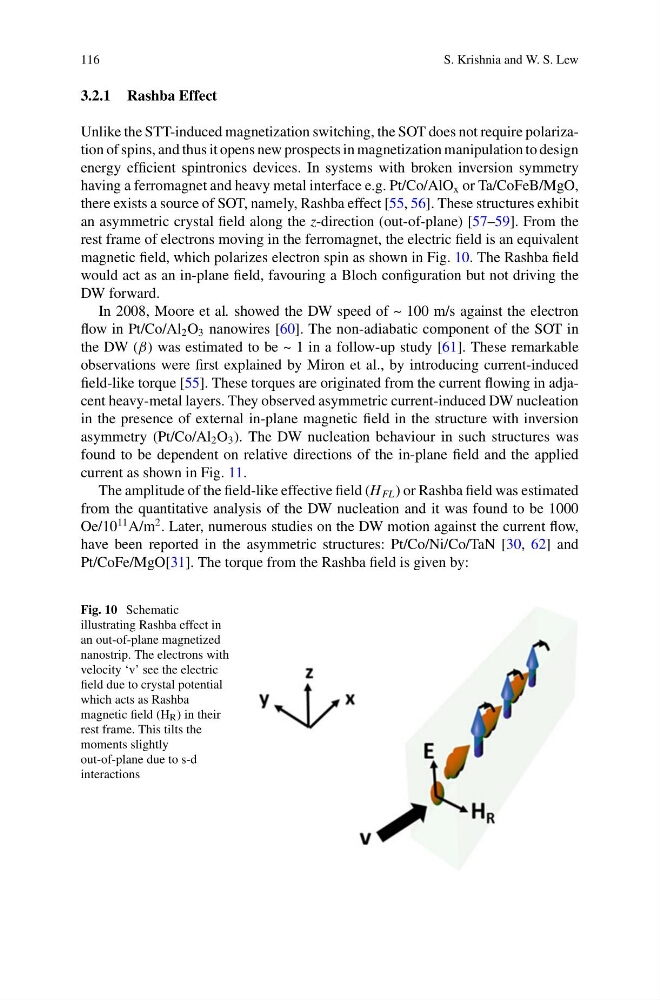
an asymmetric crystal field along the z-direction (out-of-plane) [57–59]. From the
rest frame of electrons moving in the ferromagnet, the electric field is an equivalent
magnetic field, which polarizes electron spin as shown in Fig. 10. The Rashba field
would act as an in-plane field, favouring a Bloch configuration but not driving the
DW forward.
In 2008, Moore et al. showed the DW speed of ~ 100 m/s against the electron
flow in Pt/Co/Al 2 O 3 nanowires [60]. The non-adiabatic component of the SOT in
the DW (β) was estimated to be ~ 1 in a follow-up study [61]. These remarkable
observations were first explained by Miron et al., by introducing current-induced
field-like torque [55]. These torques are originated from the current flowing in adjacent heavy-metal layers. They observed asymmetric current-induced DW nucleation
in the presence of external in-plane magnetic field in the structure with inversion
asymmetry (Pt/Co/Al 2 O 3 ). The DW nucleation behaviour in such structures was
found to be dependent on relative directions of the in-plane field and the applied
current as shown in Fig. 11.
The amplitude of the field-like effective field (H FL ) or Rashba field was estimated
from the quantitative analysis of the DW nucleation and it was found to be 1000
Oe/10
11 A/m
2 . Later, numerous studies on the DW motion against the current flow,
have been reported in the asymmetric structures: Pt/Co/Ni/Co/TaN [30, 62] and
Pt/CoFe/MgO[31]. The torque from the Rashba field is given by:
Fig. 10 Schematic
illustrating Rashba effect in
an out-of-plane magnetized
nanostrip. The electrons with
velocity ‘v’ see the electric
field due to crystal potential
which acts as Rashba
magnetic field (H R ) in their
rest frame. This tilts the
moments slightly
out-of-plane due to s-d
interactions
S. Krishnia and W. S. Lew
3.2.1 Rashba Effect
Unlike the STT-induced magnetization switching, the SOT does not require polarization of spins, and thus it opens new prospects in magnetization manipulation to design
energy efficient spintronics devices. In systems with broken inversion symmetry
having a ferromagnet and heavy metal interface e.g. Pt/Co/AlO x or Ta/CoFeB/MgO,
there exists a source of SOT, namely, Rashba effect [55, 56]. These structures exhibit
an asymmetric crystal field along the z-direction (out-of-plane) [57–59]. From the
rest frame of electrons moving in the ferromagnet, the electric field is an equivalent
magnetic field, which polarizes electron spin as shown in Fig. 10. The Rashba field
would act as an in-plane field, favouring a Bloch configuration but not driving the
DW forward.
In 2008, Moore et al. showed the DW speed of ~ 100 m/s against the electron
flow in Pt/Co/Al 2 O 3 nanowires [60]. The non-adiabatic component of the SOT in
the DW (β) was estimated to be ~ 1 in a follow-up study [61]. These remarkable
observations were first explained by Miron et al., by introducing current-induced
field-like torque [55]. These torques are originated from the current flowing in adjacent heavy-metal layers. They observed asymmetric current-induced DW nucleation
in the presence of external in-plane magnetic field in the structure with inversion
asymmetry (Pt/Co/Al 2 O 3 ). The DW nucleation behaviour in such structures was
found to be dependent on relative directions of the in-plane field and the applied
current as shown in Fig. 11.
The amplitude of the field-like effective field (H FL ) or Rashba field was estimated
from the quantitative analysis of the DW nucleation and it was found to be 1000
Oe/10
11 A/m
2 . Later, numerous studies on the DW motion against the current flow,
have been reported in the asymmetric structures: Pt/Co/Ni/Co/TaN [30, 62] and
Pt/CoFe/MgO[31]. The torque from the Rashba field is given by:
Fig. 10 Schematic
illustrating Rashba effect in
an out-of-plane magnetized
nanostrip. The electrons with
velocity ‘v’ see the electric
field due to crystal potential
which acts as Rashba
magnetic field (H R ) in their
rest frame. This tilts the
moments slightly
out-of-plane due to s-d
interactions