

Current-Driven Domain Wall Dynamics in Magnetic …
115
For the precessional regime of the DW motion, the DW velocity approaches v → u
[27, 48].
The physical origin of non-adiabatic STT may be due to spin mistracking, i.e. when
conduction electrons may get scattered from narrow DWs instead of tracking the
moments and directly transfer linear momentum [44]. The ratio of non-adiabaticity
parameter, β, to the Gilbert damping parameter, α, is crucial in ascertaining the DW
dynamics. Some studies propose β/α ~ 1 [51, 52], while more recent studies propose
β/α ~ 10 [53, 54].
It should be notated that the DWs are driven along the electron flow direction by
STT when majority carriers are electrons with positive spin-polarization. This is in a
sharp contrast with spin–orbit torque (SOT) induced DW dynamics. The SOT moves
the DWs along either current flow or electron flow direction [31]. The direction of
SOT driven DW motion depends on the signs of spin–orbit interactions, inversion
symmetries etc., which are discussed in the following section.
3.2 Spin–Orbit Torque Driven Domain Wall Dynamics
Aside from the STT, the DWs can also be drive via spin–orbit torques that originate from spin–orbit interactions. These torques are often called spin–orbit torques
(SOTs). An electron possesses orbital as well as spin angular momentum. These may
be coupled to give rise to total angular momentum j, such that m = γj where γ is
the gyromagnetic ratio. The basic principle is that in the rest frame of an electron,
the nucleus revolves around it with speed v, generating a current loop I = Zev/2πr,
where Z is the atomic number. This produces a magnetic field μ 0 I/2r at the center
which is responsible for the spin–orbit coupling, B so = μ 0 Zev
4πr
2
. The energy
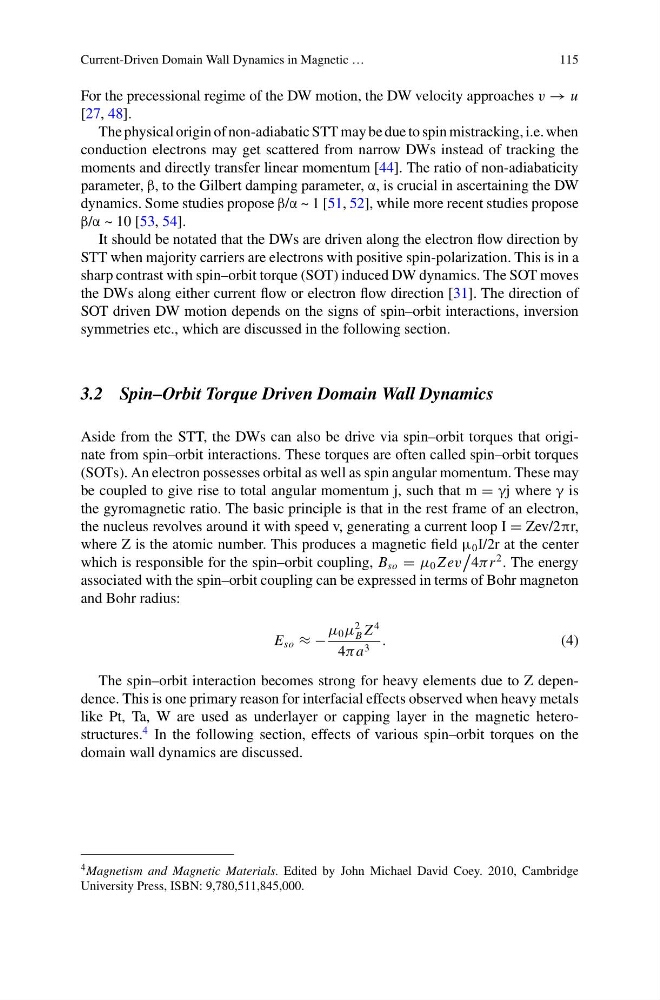
associated with the spin–orbit coupling can be expressed in terms of Bohr magneton
and Bohr radius:
E so ≈ −
μ 0 μ
2
B Z
4
4πa 3 .
(4)
The spin–orbit interaction becomes strong for heavy elements due to Z dependence. This is one primary reason for interfacial effects observed when heavy metals
like Pt, Ta, W are used as underlayer or capping layer in the magnetic heterostructures.
4 In the following section, effects of various spin–orbit torques on the
domain wall dynamics are discussed.
4 Magnetism and Magnetic Materials. Edited by John Michael David Coey. 2010, Cambridge
University Press, ISBN: 9,780,511,845,000.
115
For the precessional regime of the DW motion, the DW velocity approaches v → u
[27, 48].
The physical origin of non-adiabatic STT may be due to spin mistracking, i.e. when
conduction electrons may get scattered from narrow DWs instead of tracking the
moments and directly transfer linear momentum [44]. The ratio of non-adiabaticity
parameter, β, to the Gilbert damping parameter, α, is crucial in ascertaining the DW
dynamics. Some studies propose β/α ~ 1 [51, 52], while more recent studies propose
β/α ~ 10 [53, 54].
It should be notated that the DWs are driven along the electron flow direction by
STT when majority carriers are electrons with positive spin-polarization. This is in a
sharp contrast with spin–orbit torque (SOT) induced DW dynamics. The SOT moves
the DWs along either current flow or electron flow direction [31]. The direction of
SOT driven DW motion depends on the signs of spin–orbit interactions, inversion
symmetries etc., which are discussed in the following section.
3.2 Spin–Orbit Torque Driven Domain Wall Dynamics
Aside from the STT, the DWs can also be drive via spin–orbit torques that originate from spin–orbit interactions. These torques are often called spin–orbit torques
(SOTs). An electron possesses orbital as well as spin angular momentum. These may
be coupled to give rise to total angular momentum j, such that m = γj where γ is
the gyromagnetic ratio. The basic principle is that in the rest frame of an electron,
the nucleus revolves around it with speed v, generating a current loop I = Zev/2πr,
where Z is the atomic number. This produces a magnetic field μ 0 I/2r at the center
which is responsible for the spin–orbit coupling, B so = μ 0 Zev
4πr
2
. The energy
associated with the spin–orbit coupling can be expressed in terms of Bohr magneton
and Bohr radius:
E so ≈ −
μ 0 μ
2
B Z
4
4πa 3 .
(4)
The spin–orbit interaction becomes strong for heavy elements due to Z dependence. This is one primary reason for interfacial effects observed when heavy metals
like Pt, Ta, W are used as underlayer or capping layer in the magnetic heterostructures.
4 In the following section, effects of various spin–orbit torques on the
domain wall dynamics are discussed.
4 Magnetism and Magnetic Materials. Edited by John Michael David Coey. 2010, Cambridge
University Press, ISBN: 9,780,511,845,000.