

114
S. Krishnia and W. S. Lew
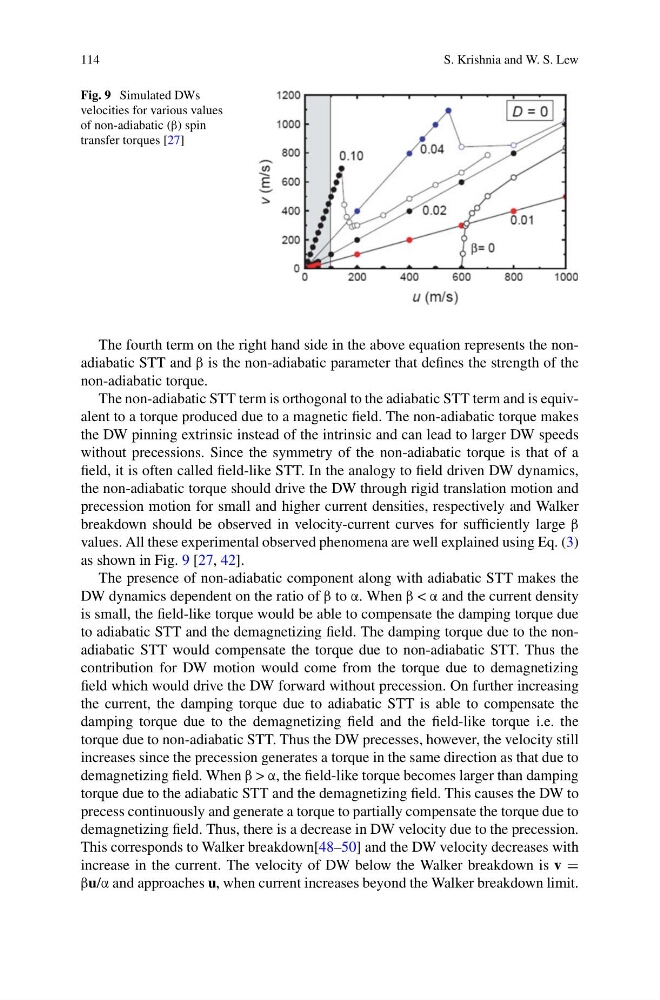
Fig. 9 Simulated DWs
velocities for various values
of non-adiabatic (β) spin
transfer torques [27]
The fourth term on the right hand side in the above equation represents the nonadiabatic STT and β is the non-adiabatic parameter that defines the strength of the
non-adiabatic torque.
The non-adiabatic STT term is orthogonal to the adiabatic STT term and is equivalent to a torque produced due to a magnetic field. The non-adiabatic torque makes
the DW pinning extrinsic instead of the intrinsic and can lead to larger DW speeds
without precessions. Since the symmetry of the non-adiabatic torque is that of a
field, it is often called field-like STT. In the analogy to field driven DW dynamics,
the non-adiabatic torque should drive the DW through rigid translation motion and
precession motion for small and higher current densities, respectively and Walker
breakdown should be observed in velocity-current curves for sufficiently large β
values. All these experimental observed phenomena are well explained using Eq. (3)
as shown in Fig. 9 [27, 42].
The presence of non-adiabatic component along with adiabatic STT makes the
DW dynamics dependent on the ratio of β to α. When β < α and the current density
is small, the field-like torque would be able to compensate the damping torque due
to adiabatic STT and the demagnetizing field. The damping torque due to the nonadiabatic STT would compensate the torque due to non-adiabatic STT. Thus the
contribution for DW motion would come from the torque due to demagnetizing
field which would drive the DW forward without precession. On further increasing
the current, the damping torque due to adiabatic STT is able to compensate the
damping torque due to the demagnetizing field and the field-like torque i.e. the
torque due to non-adiabatic STT. Thus the DW precesses, however, the velocity still
increases since the precession generates a torque in the same direction as that due to
demagnetizing field. When β > α, the field-like torque becomes larger than damping
torque due to the adiabatic STT and the demagnetizing field. This causes the DW to
precess continuously and generate a torque to partially compensate the torque due to
demagnetizing field. Thus, there is a decrease in DW velocity due to the precession.
This corresponds to Walker breakdown[48–50] and the DW velocity decreases with
increase in the current. The velocity of DW below the Walker breakdown is v =
βu/α and approaches u, when current increases beyond the Walker breakdown limit.
S. Krishnia and W. S. Lew
Fig. 9 Simulated DWs
velocities for various values
of non-adiabatic (β) spin
transfer torques [27]
The fourth term on the right hand side in the above equation represents the nonadiabatic STT and β is the non-adiabatic parameter that defines the strength of the
non-adiabatic torque.
The non-adiabatic STT term is orthogonal to the adiabatic STT term and is equivalent to a torque produced due to a magnetic field. The non-adiabatic torque makes
the DW pinning extrinsic instead of the intrinsic and can lead to larger DW speeds
without precessions. Since the symmetry of the non-adiabatic torque is that of a
field, it is often called field-like STT. In the analogy to field driven DW dynamics,
the non-adiabatic torque should drive the DW through rigid translation motion and
precession motion for small and higher current densities, respectively and Walker
breakdown should be observed in velocity-current curves for sufficiently large β
values. All these experimental observed phenomena are well explained using Eq. (3)
as shown in Fig. 9 [27, 42].
The presence of non-adiabatic component along with adiabatic STT makes the
DW dynamics dependent on the ratio of β to α. When β < α and the current density
is small, the field-like torque would be able to compensate the damping torque due
to adiabatic STT and the demagnetizing field. The damping torque due to the nonadiabatic STT would compensate the torque due to non-adiabatic STT. Thus the
contribution for DW motion would come from the torque due to demagnetizing
field which would drive the DW forward without precession. On further increasing
the current, the damping torque due to adiabatic STT is able to compensate the
damping torque due to the demagnetizing field and the field-like torque i.e. the
torque due to non-adiabatic STT. Thus the DW precesses, however, the velocity still
increases since the precession generates a torque in the same direction as that due to
demagnetizing field. When β > α, the field-like torque becomes larger than damping
torque due to the adiabatic STT and the demagnetizing field. This causes the DW to
precess continuously and generate a torque to partially compensate the torque due to
demagnetizing field. Thus, there is a decrease in DW velocity due to the precession.
This corresponds to Walker breakdown[48–50] and the DW velocity decreases with
increase in the current. The velocity of DW below the Walker breakdown is v =
βu/α and approaches u, when current increases beyond the Walker breakdown limit.