

Current-Driven Domain Wall Dynamics in Magnetic …
113
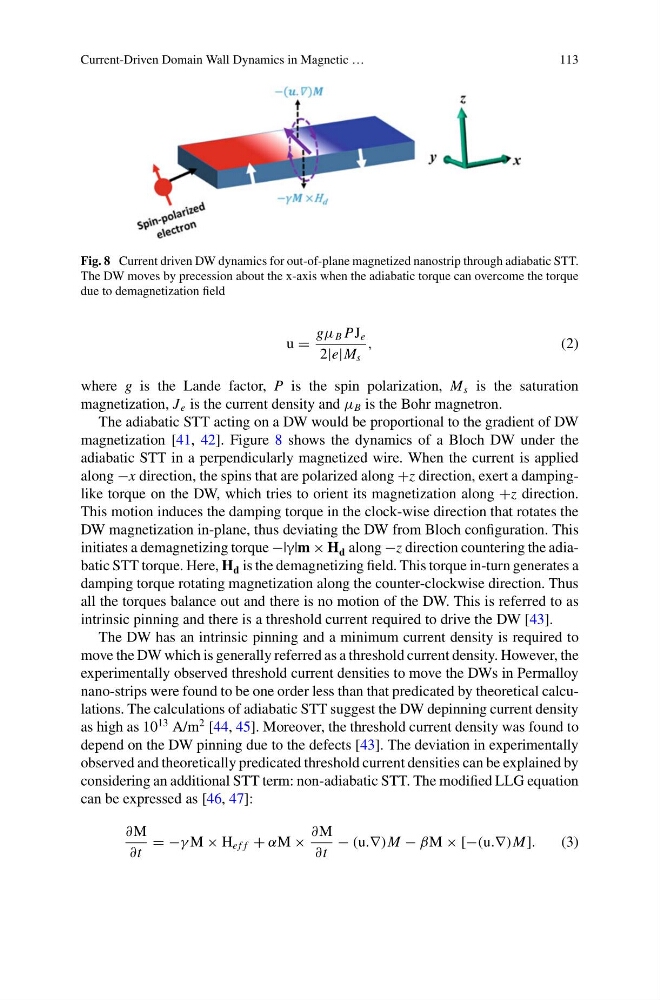
Fig. 8 Current driven DW dynamics for out-of-plane magnetized nanostrip through adiabatic STT.
The DW moves by precession about the x-axis when the adiabatic torque can overcome the torque
due to demagnetization field
u =
gμ B PJ e
2|e|M s
,
(2)
where g is the Lande factor, P is the spin polarization, M s is the saturation
magnetization, J e is the current density and μ B is the Bohr magnetron.
The adiabatic STT acting on a DW would be proportional to the gradient of DW
magnetization [41, 42]. Figure 8 shows the dynamics of a Bloch DW under the
adiabatic STT in a perpendicularly magnetized wire. When the current is applied
along −x direction, the spins that are polarized along +z direction, exert a dampinglike torque on the DW, which tries to orient its magnetization along +z direction.
This motion induces the damping torque in the clock-wise direction that rotates the
DW magnetization in-plane, thus deviating the DW from Bloch configuration. This
initiates a demagnetizing torque −|γ|m × H d along −z direction countering the adiabatic STT torque. Here, H d is the demagnetizing field. This torque in-turn generates a
damping torque rotating magnetization along the counter-clockwise direction. Thus
all the torques balance out and there is no motion of the DW. This is referred to as
intrinsic pinning and there is a threshold current required to drive the DW [43].
The DW has an intrinsic pinning and a minimum current density is required to
move the DW which is generally referred as a threshold current density. However, the
experimentally observed threshold current densities to move the DWs in Permalloy
nano-strips were found to be one order less than that predicated by theoretical calculations. The calculations of adiabatic STT suggest the DW depinning current density
as high as 10
13 A/m
2 [44, 45]. Moreover, the threshold current density was found to
depend on the DW pinning due to the defects [43]. The deviation in experimentally
observed and theoretically predicated threshold current densities can be explained by
considering an additional STT term: non-adiabatic STT. The modified LLG equation
can be expressed as [46, 47]:
∂M
∂t
= −γ M × H e f f + αM ×
∂M
∂t
− (u.∇)M − βM × [−(u.∇)M].
(3)
113
Fig. 8 Current driven DW dynamics for out-of-plane magnetized nanostrip through adiabatic STT.
The DW moves by precession about the x-axis when the adiabatic torque can overcome the torque
due to demagnetization field
u =
gμ B PJ e
2|e|M s
,
(2)
where g is the Lande factor, P is the spin polarization, M s is the saturation
magnetization, J e is the current density and μ B is the Bohr magnetron.
The adiabatic STT acting on a DW would be proportional to the gradient of DW
magnetization [41, 42]. Figure 8 shows the dynamics of a Bloch DW under the
adiabatic STT in a perpendicularly magnetized wire. When the current is applied
along −x direction, the spins that are polarized along +z direction, exert a dampinglike torque on the DW, which tries to orient its magnetization along +z direction.
This motion induces the damping torque in the clock-wise direction that rotates the
DW magnetization in-plane, thus deviating the DW from Bloch configuration. This
initiates a demagnetizing torque −|γ|m × H d along −z direction countering the adiabatic STT torque. Here, H d is the demagnetizing field. This torque in-turn generates a
damping torque rotating magnetization along the counter-clockwise direction. Thus
all the torques balance out and there is no motion of the DW. This is referred to as
intrinsic pinning and there is a threshold current required to drive the DW [43].
The DW has an intrinsic pinning and a minimum current density is required to
move the DW which is generally referred as a threshold current density. However, the
experimentally observed threshold current densities to move the DWs in Permalloy
nano-strips were found to be one order less than that predicated by theoretical calculations. The calculations of adiabatic STT suggest the DW depinning current density
as high as 10
13 A/m
2 [44, 45]. Moreover, the threshold current density was found to
depend on the DW pinning due to the defects [43]. The deviation in experimentally
observed and theoretically predicated threshold current densities can be explained by
considering an additional STT term: non-adiabatic STT. The modified LLG equation
can be expressed as [46, 47]:
∂M
∂t
= −γ M × H e f f + αM ×
∂M
∂t
− (u.∇)M − βM × [−(u.∇)M].
(3)