

112
S. Krishnia and W. S. Lew
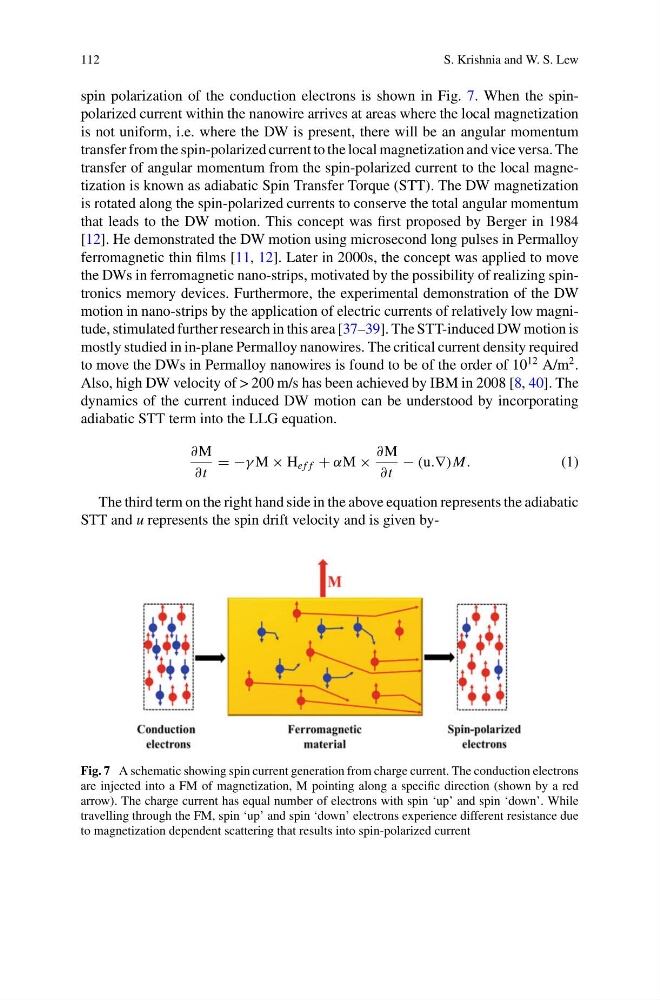
spin polarization of the conduction electrons is shown in Fig. 7. When the spinpolarized current within the nanowire arrives at areas where the local magnetization
is not uniform, i.e. where the DW is present, there will be an angular momentum
transfer from the spin-polarized current to the local magnetization and vice versa. The
transfer of angular momentum from the spin-polarized current to the local magnetization is known as adiabatic Spin Transfer Torque (STT). The DW magnetization
is rotated along the spin-polarized currents to conserve the total angular momentum
that leads to the DW motion. This concept was first proposed by Berger in 1984
[12]. He demonstrated the DW motion using microsecond long pulses in Permalloy
ferromagnetic thin films [11, 12]. Later in 2000s, the concept was applied to move
the DWs in ferromagnetic nano-strips, motivated by the possibility of realizing spintronics memory devices. Furthermore, the experimental demonstration of the DW
motion in nano-strips by the application of electric currents of relatively low magnitude, stimulated further research in this area [37–39]. The STT-induced DW motion is
mostly studied in in-plane Permalloy nanowires. The critical current density required
to move the DWs in Permalloy nanowires is found to be of the order of 10
12 A/m
2 .
Also, high DW velocity of > 200 m/s has been achieved by IBM in 2008 [8, 40]. The
dynamics of the current induced DW motion can be understood by incorporating
adiabatic STT term into the LLG equation.
∂M
∂t
= −γ M × H e f f + αM ×
∂M
∂t
− (u.∇)M.
(1)
The third term on the right hand side in the above equation represents the adiabatic
STT and u represents the spin drift velocity and is given byFig. 7 A schematic showing spin current generation from charge current. The conduction electrons
are injected into a FM of magnetization, M pointing along a specific direction (shown by a red
arrow). The charge current has equal number of electrons with spin ‘up’ and spin ‘down’. While
travelling through the FM, spin ‘up’ and spin ‘down’ electrons experience different resistance due
to magnetization dependent scattering that results into spin-polarized current
S. Krishnia and W. S. Lew
spin polarization of the conduction electrons is shown in Fig. 7. When the spinpolarized current within the nanowire arrives at areas where the local magnetization
is not uniform, i.e. where the DW is present, there will be an angular momentum
transfer from the spin-polarized current to the local magnetization and vice versa. The
transfer of angular momentum from the spin-polarized current to the local magnetization is known as adiabatic Spin Transfer Torque (STT). The DW magnetization
is rotated along the spin-polarized currents to conserve the total angular momentum
that leads to the DW motion. This concept was first proposed by Berger in 1984
[12]. He demonstrated the DW motion using microsecond long pulses in Permalloy
ferromagnetic thin films [11, 12]. Later in 2000s, the concept was applied to move
the DWs in ferromagnetic nano-strips, motivated by the possibility of realizing spintronics memory devices. Furthermore, the experimental demonstration of the DW
motion in nano-strips by the application of electric currents of relatively low magnitude, stimulated further research in this area [37–39]. The STT-induced DW motion is
mostly studied in in-plane Permalloy nanowires. The critical current density required
to move the DWs in Permalloy nanowires is found to be of the order of 10
12 A/m
2 .
Also, high DW velocity of > 200 m/s has been achieved by IBM in 2008 [8, 40]. The
dynamics of the current induced DW motion can be understood by incorporating
adiabatic STT term into the LLG equation.
∂M
∂t
= −γ M × H e f f + αM ×
∂M
∂t
− (u.∇)M.
(1)
The third term on the right hand side in the above equation represents the adiabatic
STT and u represents the spin drift velocity and is given byFig. 7 A schematic showing spin current generation from charge current. The conduction electrons
are injected into a FM of magnetization, M pointing along a specific direction (shown by a red
arrow). The charge current has equal number of electrons with spin ‘up’ and spin ‘down’. While
travelling through the FM, spin ‘up’ and spin ‘down’ electrons experience different resistance due
to magnetization dependent scattering that results into spin-polarized current