

Current-Driven Domain Wall Dynamics in Magnetic …
117
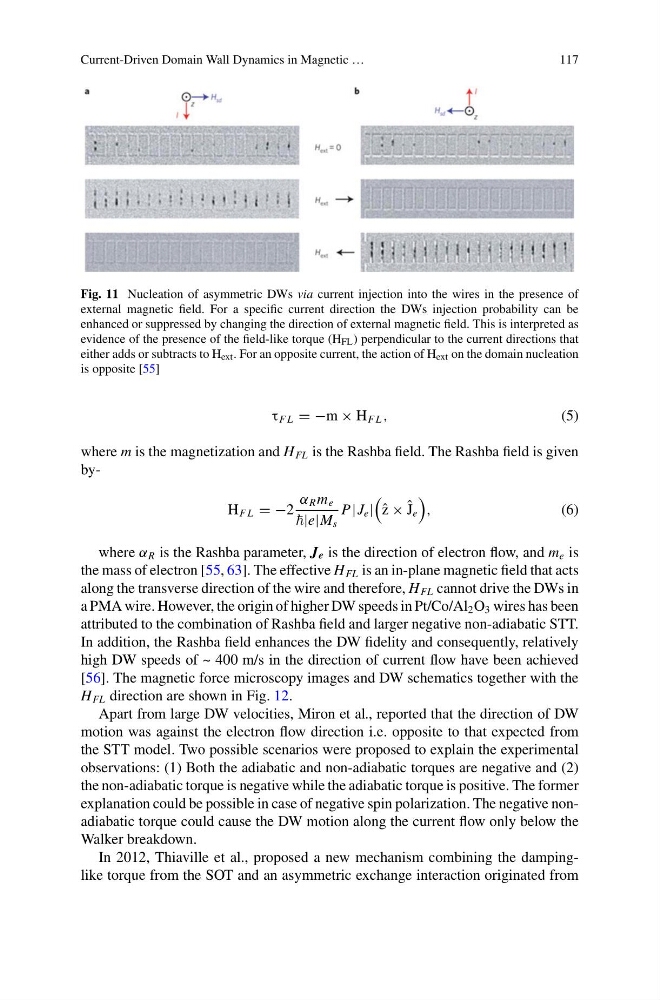
Fig. 11 Nucleation of asymmetric DWs via current injection into the wires in the presence of
external magnetic field. For a specific current direction the DWs injection probability can be
enhanced or suppressed by changing the direction of external magnetic field. This is interpreted as
evidence of the presence of the field-like torque (H FL ) perpendicular to the current directions that
either adds or subtracts to H ext . For an opposite current, the action of H ext on the domain nucleation
is opposite [55]
τ F L = −m × H F L ,
(5)
where m is the magnetization and H FL is the Rashba field. The Rashba field is given
byH F L = −2
α R m e
|e|M s
P|J e |
ˆ
z × ˆ
J e
,
(6)
where α R is the Rashba parameter, J e is the direction of electron flow, and m e is
the mass of electron [55, 63]. The effective H FL is an in-plane magnetic field that acts
along the transverse direction of the wire and therefore, H FL cannot drive the DWs in
a PMA wire. However, the origin of higher DW speeds in Pt/Co/Al 2 O 3 wires has been
attributed to the combination of Rashba field and larger negative non-adiabatic STT.
In addition, the Rashba field enhances the DW fidelity and consequently, relatively
high DW speeds of ~ 400 m/s in the direction of current flow have been achieved
[56]. The magnetic force microscopy images and DW schematics together with the
H FL direction are shown in Fig. 12.
Apart from large DW velocities, Miron et al., reported that the direction of DW
motion was against the electron flow direction i.e. opposite to that expected from
the STT model. Two possible scenarios were proposed to explain the experimental
observations: (1) Both the adiabatic and non-adiabatic torques are negative and (2)
the non-adiabatic torque is negative while the adiabatic torque is positive. The former
explanation could be possible in case of negative spin polarization. The negative nonadiabatic torque could cause the DW motion along the current flow only below the
Walker breakdown.
In 2012, Thiaville et al., proposed a new mechanism combining the dampinglike torque from the SOT and an asymmetric exchange interaction originated from
117
Fig. 11 Nucleation of asymmetric DWs via current injection into the wires in the presence of
external magnetic field. For a specific current direction the DWs injection probability can be
enhanced or suppressed by changing the direction of external magnetic field. This is interpreted as
evidence of the presence of the field-like torque (H FL ) perpendicular to the current directions that
either adds or subtracts to H ext . For an opposite current, the action of H ext on the domain nucleation
is opposite [55]
τ F L = −m × H F L ,
(5)
where m is the magnetization and H FL is the Rashba field. The Rashba field is given
byH F L = −2
α R m e
|e|M s
P|J e |
ˆ
z × ˆ
J e
,
(6)
where α R is the Rashba parameter, J e is the direction of electron flow, and m e is
the mass of electron [55, 63]. The effective H FL is an in-plane magnetic field that acts
along the transverse direction of the wire and therefore, H FL cannot drive the DWs in
a PMA wire. However, the origin of higher DW speeds in Pt/Co/Al 2 O 3 wires has been
attributed to the combination of Rashba field and larger negative non-adiabatic STT.
In addition, the Rashba field enhances the DW fidelity and consequently, relatively
high DW speeds of ~ 400 m/s in the direction of current flow have been achieved
[56]. The magnetic force microscopy images and DW schematics together with the
H FL direction are shown in Fig. 12.
Apart from large DW velocities, Miron et al., reported that the direction of DW
motion was against the electron flow direction i.e. opposite to that expected from
the STT model. Two possible scenarios were proposed to explain the experimental
observations: (1) Both the adiabatic and non-adiabatic torques are negative and (2)
the non-adiabatic torque is negative while the adiabatic torque is positive. The former
explanation could be possible in case of negative spin polarization. The negative nonadiabatic torque could cause the DW motion along the current flow only below the
Walker breakdown.
In 2012, Thiaville et al., proposed a new mechanism combining the dampinglike torque from the SOT and an asymmetric exchange interaction originated from