

Chapter 3
Elasticity
There is still plenty of good music to be written in C major.
Arnold Schoenberg, 1874–1951
Elasticity is certainly the most intensely studied and best understood paradigm model for
elementary material behavior. Thereby, due to
his systematic studies of elastic springs in his
book De potentia restitutiva from 1678, Robert
Hooke [1635–1702] may indeed be called the
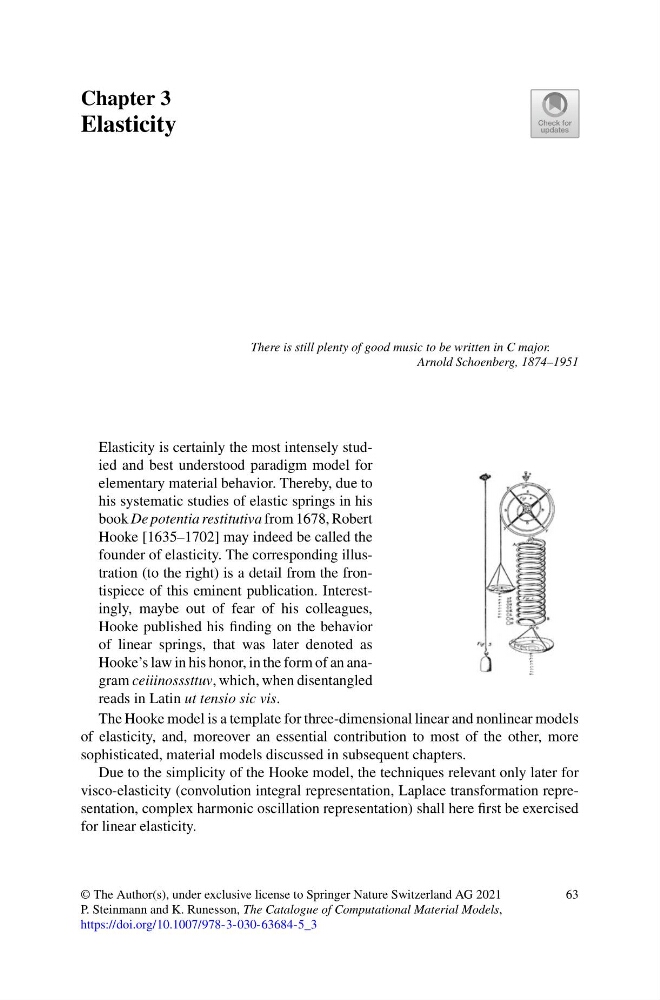
founder of elasticity. The corresponding illustration (to the right) is a detail from the frontispiece of this eminent publication. Interestingly, maybe out of fear of his colleagues,
Hooke published his finding on the behavior
of linear springs, that was later denoted as
Hooke’s law in his honor, in the form of an anagram ceiiinosssttuv, which, when disentangled
reads in Latin ut tensio sic vis.
The Hooke model is a template for three-dimensional linear and nonlinear models
of elasticity, and, moreover an essential contribution to most of the other, more
sophisticated, material models discussed in subsequent chapters.
Due to the simplicity of the Hooke model, the techniques relevant only later for
visco-elasticity (convolution integral representation, Laplace transformation representation, complex harmonic oscillation representation) shall here first be exercised
for linear elasticity.
© The Author(s), under exclusive license to Springer Nature Switzerland AG 2021
P. Steinmann and K. Runesson, The Catalogue of Computational Material Models,
https://doi.org/10.1007/978-3-030-63684-5_3
63
Elasticity
There is still plenty of good music to be written in C major.
Arnold Schoenberg, 1874–1951
Elasticity is certainly the most intensely studied and best understood paradigm model for
elementary material behavior. Thereby, due to
his systematic studies of elastic springs in his
book De potentia restitutiva from 1678, Robert
Hooke [1635–1702] may indeed be called the
founder of elasticity. The corresponding illustration (to the right) is a detail from the frontispiece of this eminent publication. Interestingly, maybe out of fear of his colleagues,
Hooke published his finding on the behavior
of linear springs, that was later denoted as
Hooke’s law in his honor, in the form of an anagram ceiiinosssttuv, which, when disentangled
reads in Latin ut tensio sic vis.
The Hooke model is a template for three-dimensional linear and nonlinear models
of elasticity, and, moreover an essential contribution to most of the other, more
sophisticated, material models discussed in subsequent chapters.
Due to the simplicity of the Hooke model, the techniques relevant only later for
visco-elasticity (convolution integral representation, Laplace transformation representation, complex harmonic oscillation representation) shall here first be exercised
for linear elasticity.
© The Author(s), under exclusive license to Springer Nature Switzerland AG 2021
P. Steinmann and K. Runesson, The Catalogue of Computational Material Models,
https://doi.org/10.1007/978-3-030-63684-5_3
63