

64
3 Elasticity
3.1 Hooke Model
The Hooke model of an elastic solid (in short the Hooke model) consists of an elastic
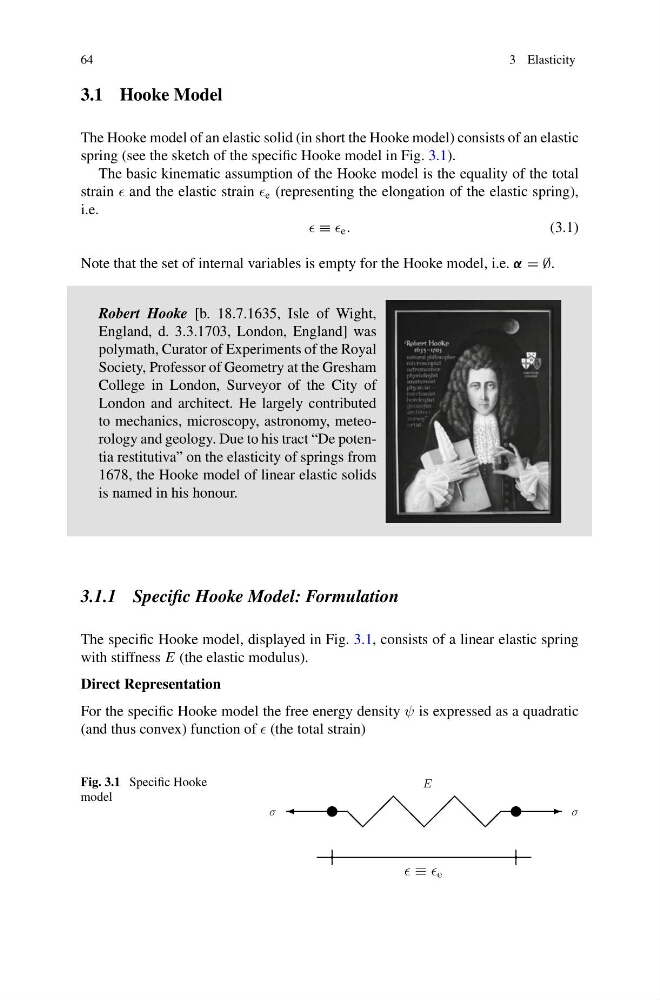
spring (see the sketch of the specific Hooke model in Fig. 3.1).
The basic kinematic assumption of the Hooke model is the equality of the total
strain and the elastic strain e (representing the elongation of the elastic spring),
i.e.
≡ e .
(3.1)
Note that the set of internal variables is empty for the Hooke model, i.e. α = ∅.
Robert Hooke [b. 18.7.1635, Isle of Wight,
England, d. 3.3.1703, London, England] was
polymath, Curator of Experiments of the Royal
Society, Professor of Geometry at the Gresham
College in London, Surveyor of the City of
London and architect. He largely contributed
to mechanics, microscopy, astronomy, meteorology and geology. Due to his tract “De potentia restitutiva” on the elasticity of springs from
1678, the Hooke model of linear elastic solids
is named in his honour.
3.1.1 Specific Hooke Model: Formulation
The specific Hooke model, displayed in Fig. 3.1, consists of a linear elastic spring
with stiffness E (the elastic modulus).
Direct Representation
For the specific Hooke model the free energy density ψ is expressed as a quadratic
(and thus convex) function of (the total strain)
Fig. 3.1 Specific Hooke
model
σ
σ
e
E
3 Elasticity
3.1 Hooke Model
The Hooke model of an elastic solid (in short the Hooke model) consists of an elastic
spring (see the sketch of the specific Hooke model in Fig. 3.1).
The basic kinematic assumption of the Hooke model is the equality of the total
strain and the elastic strain e (representing the elongation of the elastic spring),
i.e.
≡ e .
(3.1)
Note that the set of internal variables is empty for the Hooke model, i.e. α = ∅.
Robert Hooke [b. 18.7.1635, Isle of Wight,
England, d. 3.3.1703, London, England] was
polymath, Curator of Experiments of the Royal
Society, Professor of Geometry at the Gresham
College in London, Surveyor of the City of
London and architect. He largely contributed
to mechanics, microscopy, astronomy, meteorology and geology. Due to his tract “De potentia restitutiva” on the elasticity of springs from
1678, the Hooke model of linear elastic solids
is named in his honour.
3.1.1 Specific Hooke Model: Formulation
The specific Hooke model, displayed in Fig. 3.1, consists of a linear elastic spring
with stiffness E (the elastic modulus).
Direct Representation
For the specific Hooke model the free energy density ψ is expressed as a quadratic
(and thus convex) function of (the total strain)
Fig. 3.1 Specific Hooke
model
σ
σ
e
E