

2.3 Mathematical Tools
61
g(x) = 0.
(2.144)
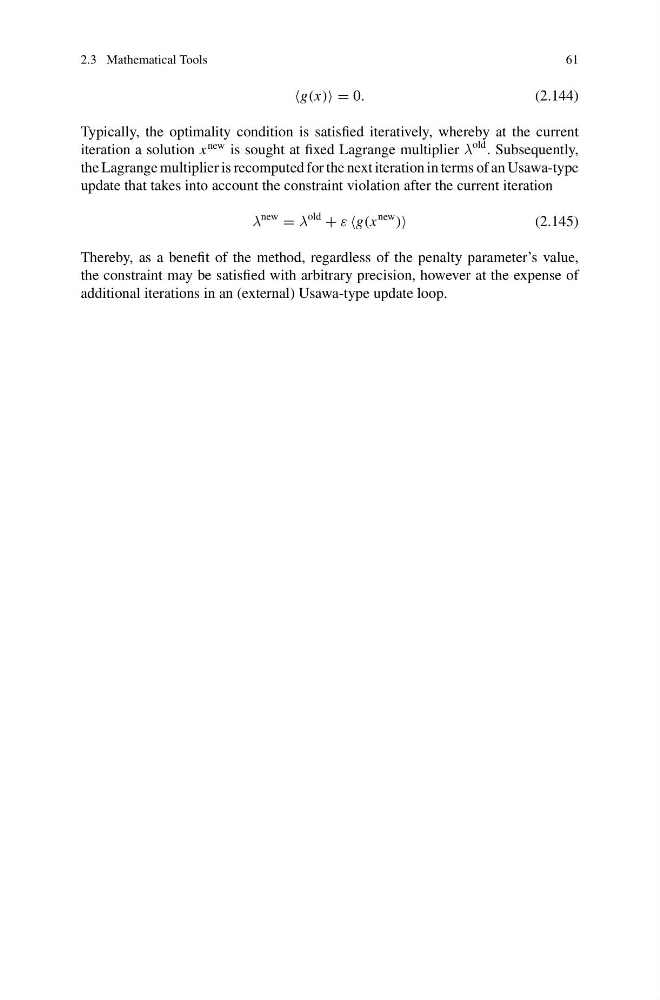
Typically, the optimality condition is satisfied iteratively, whereby at the current
iteration a solution x
new is sought at fixed Lagrange multiplier λ
old . Subsequently,
the Lagrange multiplier is recomputed for the next iteration in terms of an Usawa-type
update that takes into account the constraint violation after the current iteration
λ
new
= λ
old
+ ε g(x
new
)
(2.145)
Thereby, as a benefit of the method, regardless of the penalty parameter’s value,
the constraint may be satisfied with arbitrary precision, however at the expense of
additional iterations in an (external) Usawa-type update loop.
61
g(x) = 0.
(2.144)
Typically, the optimality condition is satisfied iteratively, whereby at the current
iteration a solution x
new is sought at fixed Lagrange multiplier λ
old . Subsequently,
the Lagrange multiplier is recomputed for the next iteration in terms of an Usawa-type
update that takes into account the constraint violation after the current iteration
λ
new
= λ
old
+ ε g(x
new
)
(2.145)
Thereby, as a benefit of the method, regardless of the penalty parameter’s value,
the constraint may be satisfied with arbitrary precision, however at the expense of
additional iterations in an (external) Usawa-type update loop.