

2.3 Mathematical Tools
55
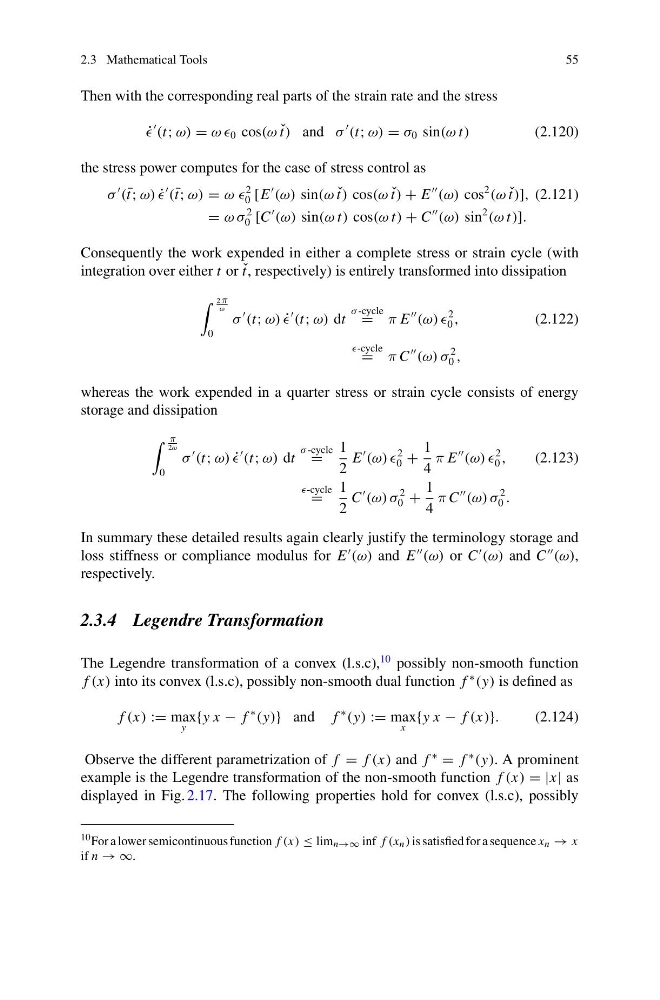
Then with the corresponding real parts of the strain rate and the stress
˙
(t; ω) = ω ω 0 cos(ω ˇ
t) and σ
(t; ω) = σ 0 sin(ω t)
(2.120)
the stress power computes for the case of stress control as
σ
(¯ t; ω) ˙
(¯ t; ω) = ω ω
2
0 [E
(ω) sin(ω ˇ
t) cos(ω ˇ
t) + E
(ω) cos
2
(ω ˇ
t)], (2.121)
= ω σ
2
0 [C
(ω) sin(ω t) cos(ω t) + C
(ω) sin
2
(ω t)].
Consequently the work expended in either a complete stress or strain cycle (with
integration over either t or ˇ
t, respectively) is entirely transformed into dissipation
2 π
ω
0
σ
(t; ω) ˙
(t; ω) dt
σ -cycle
= π E
(ω) )
2
0 ,
(2.122)
-cycle
= π C
(ω) σ
2
0 ,
whereas the work expended in a quarter stress or strain cycle consists of energy
storage and dissipation
π
2ω
0
σ
(t; ω) ˙
(t; ω) dt
σ -cycle
=
1
2
E
(ω) )
2
0 +
1
4
π E
(ω) )
2
0 ,
(2.123)
-cycle
=
1
2
C
(ω) σ
2
0 +
1
4
π C
(ω) σ
2
0 .
In summary these detailed results again clearly justify the terminology storage and
loss stiffness or compliance modulus for E
(ω) and E
(ω) or C
(ω) and C
(ω),
respectively.
2.3.4 Legendre Transformation
The Legendre transformation of a convex (l.s.c),
10 possibly non-smooth function
f (x) into its convex (l.s.c), possibly non-smooth dual function f
∗
(y) is defined as
f (x) := max
y
{y x − f
∗
(y)} and f
∗
(y) := max
x
{y x − f (x)}.
(2.124)
Observe the different parametrization of f = f (x) and f
∗
= f
∗
(y). A prominent
example is the Legendre transformation of the non-smooth function f (x) = |x| as
displayed in Fig. 2.17. The following properties hold for convex (l.s.c), possibly
10 For a lower semicontinuous function f (x) ≤ lim n→∞ inf f (x n ) is satisfied for a sequence x n → x
if n → ∞.
55
Then with the corresponding real parts of the strain rate and the stress
˙
(t; ω) = ω ω 0 cos(ω ˇ
t) and σ
(t; ω) = σ 0 sin(ω t)
(2.120)
the stress power computes for the case of stress control as
σ
(¯ t; ω) ˙
(¯ t; ω) = ω ω
2
0 [E
(ω) sin(ω ˇ
t) cos(ω ˇ
t) + E
(ω) cos
2
(ω ˇ
t)], (2.121)
= ω σ
2
0 [C
(ω) sin(ω t) cos(ω t) + C
(ω) sin
2
(ω t)].
Consequently the work expended in either a complete stress or strain cycle (with
integration over either t or ˇ
t, respectively) is entirely transformed into dissipation
2 π
ω
0
σ
(t; ω) ˙
(t; ω) dt
σ -cycle
= π E
(ω) )
2
0 ,
(2.122)
-cycle
= π C
(ω) σ
2
0 ,
whereas the work expended in a quarter stress or strain cycle consists of energy
storage and dissipation
π
2ω
0
σ
(t; ω) ˙
(t; ω) dt
σ -cycle
=
1
2
E
(ω) )
2
0 +
1
4
π E
(ω) )
2
0 ,
(2.123)
-cycle
=
1
2
C
(ω) σ
2
0 +
1
4
π C
(ω) σ
2
0 .
In summary these detailed results again clearly justify the terminology storage and
loss stiffness or compliance modulus for E
(ω) and E
(ω) or C
(ω) and C
(ω),
respectively.
2.3.4 Legendre Transformation
The Legendre transformation of a convex (l.s.c),
10 possibly non-smooth function
f (x) into its convex (l.s.c), possibly non-smooth dual function f
∗
(y) is defined as
f (x) := max
y
{y x − f
∗
(y)} and f
∗
(y) := max
x
{y x − f (x)}.
(2.124)
Observe the different parametrization of f = f (x) and f
∗
= f
∗
(y). A prominent
example is the Legendre transformation of the non-smooth function f (x) = |x| as
displayed in Fig. 2.17. The following properties hold for convex (l.s.c), possibly
10 For a lower semicontinuous function f (x) ≤ lim n→∞ inf f (x n ) is satisfied for a sequence x n → x
if n → ∞.