

56
2 Preliminaries
x
y
x (y)
y (x)
f
∗ (y)
f (x)
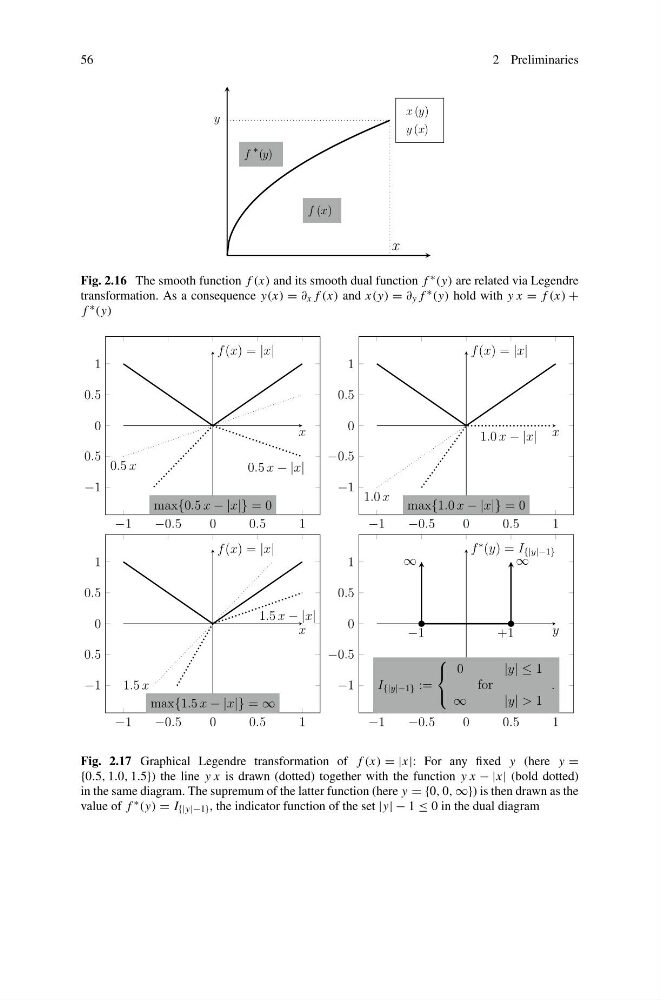
Fig. 2.16 The smooth function f (x) and its smooth dual function f ∗ (y) are related via Legendre
transformation. As a consequence y(x) = ∂ x f (x) and x(y) = ∂ y f ∗ (y) hold with y x = f (x) +
f ∗ (y)
−1
−0.5
0
0.5
1
−1
0.5
0
0.5
1
x
f (x) = |x|
0.5 x
0.5 x − |x|
max{0.5 x − |x|} = 0
−1
−0.5
0
0.5
1
−1
−0.5
0
0.5
1
x
f (x) = |x|
1.0 x
1.0 x − |x|
max{1.0 x − |x|} = 0
−1
−0.5
0
0.5
1
−1
0.5
0
0.5
1
x
f (x) = |x|
1.5 x
1.5 x − |x|
max{1.5 x − |x|} = ∞
−1
−0.5
0
0.5
1
−1
−0.5
0
0.5
1
y
−1
+ 1
f
∗ (y) = I {|y|−1}
∞
∞
I {|y|−1} :=
⎧
⎨
⎩
0
|y| ≤ 1
for
∞
| y| > 1
.
Fig. 2.17 Graphical Legendre transformation of f (x) = |x|: For any fixed y (here y =
{0.5, 1.0, 1.5}) the line y x is drawn (dotted) together with the function y x − |x| (bold dotted)
in the same diagram. The supremum of the latter function (here y = {0, 0, ∞}) is then drawn as the
value of f ∗ (y) = I {|y|−1} , the indicator function of the set |y| − 1 ≤ 0 in the dual diagram
2 Preliminaries
x
y
x (y)
y (x)
f
∗ (y)
f (x)
Fig. 2.16 The smooth function f (x) and its smooth dual function f ∗ (y) are related via Legendre
transformation. As a consequence y(x) = ∂ x f (x) and x(y) = ∂ y f ∗ (y) hold with y x = f (x) +
f ∗ (y)
−1
−0.5
0
0.5
1
−1
0.5
0
0.5
1
x
f (x) = |x|
0.5 x
0.5 x − |x|
max{0.5 x − |x|} = 0
−1
−0.5
0
0.5
1
−1
−0.5
0
0.5
1
x
f (x) = |x|
1.0 x
1.0 x − |x|
max{1.0 x − |x|} = 0
−1
−0.5
0
0.5
1
−1
0.5
0
0.5
1
x
f (x) = |x|
1.5 x
1.5 x − |x|
max{1.5 x − |x|} = ∞
−1
−0.5
0
0.5
1
−1
−0.5
0
0.5
1
y
−1
+ 1
f
∗ (y) = I {|y|−1}
∞
∞
I {|y|−1} :=
⎧
⎨
⎩
0
|y| ≤ 1
for
∞
| y| > 1
.
Fig. 2.17 Graphical Legendre transformation of f (x) = |x|: For any fixed y (here y =
{0.5, 1.0, 1.5}) the line y x is drawn (dotted) together with the function y x − |x| (bold dotted)
in the same diagram. The supremum of the latter function (here y = {0, 0, ∞}) is then drawn as the
value of f ∗ (y) = I {|y|−1} , the indicator function of the set |y| − 1 ≤ 0 in the dual diagram