

54
2 Preliminaries
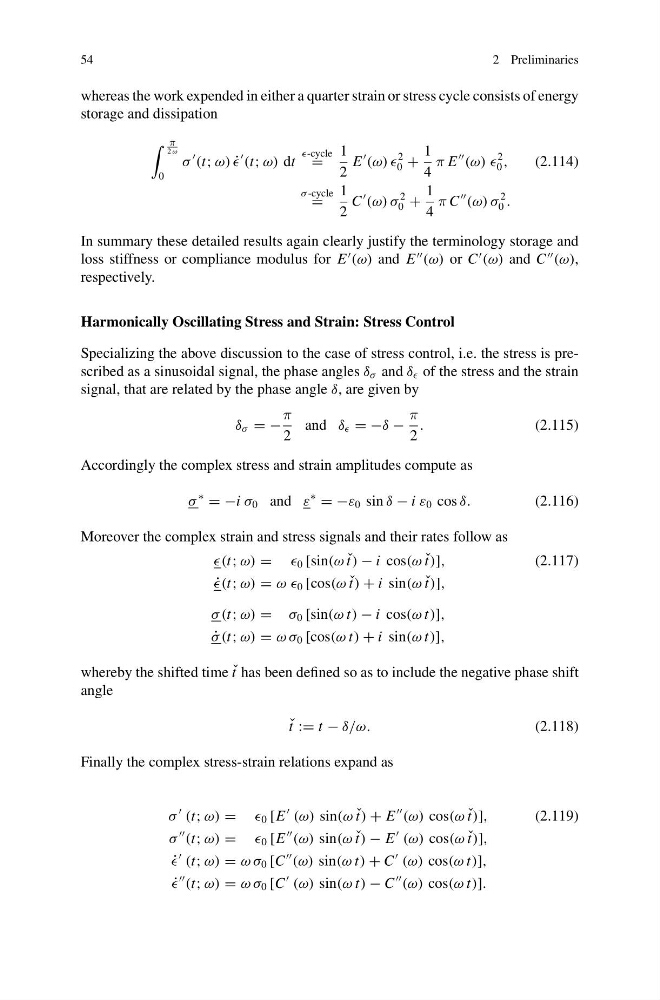
whereas the work expended in either a quarter strain or stress cycle consists of energy
storage and dissipation
π
2 ω
0
σ
(t; ω) ˙
(t; ω) dt
-cycle
=
1
2
E
(ω) )
2
0 +
1
4
π E
(ω) )
2
0 ,
(2.114)
σ -cycle
=
1
2
C
(ω) σ
2
0 +
1
4
π C
(ω) σ
2
0 .
In summary these detailed results again clearly justify the terminology storage and
loss stiffness or compliance modulus for E
(ω) and E
(ω) or C
(ω) and C
(ω),
respectively.
Harmonically Oscillating Stress and Strain: Stress Control
Specializing the above discussion to the case of stress control, i.e. the stress is prescribed as a sinusoidal signal, the phase angles δ σ and δ of the stress and the strain
signal, that are related by the phase angle δ, are given by
δ σ = −
π
2
and δ = −δ −
π
2
.
(2.115)
Accordingly the complex stress and strain amplitudes compute as
σ
∗
= −i σ 0 and ε
∗
= −ε 0 sin δ − i ε 0 cos δ.
(2.116)
Moreover the complex strain and stress signals and their rates follow as
(t; ω) = 0 [sin(ω ˇ
t) − i cos(ω ˇ
t)],
(2.117)
˙
(t; ω) = ω ω 0 [cos(ω ˇ
t) + i sin(ω ˇ
t)],
σ (t; ω) = σ 0 [sin(ω t) − i cos(ω t)],
˙
σ (t; ω) = ω σ 0 [cos(ω t) + i sin(ω t)],
whereby the shifted time ˇ
t has been defined so as to include the negative phase shift
angle
ˇ
t := t − δ/ω.
(2.118)
Finally the complex stress-strain relations expand as
σ
(t; ω) = 0 [E
(ω) sin(ω ˇ
t) + E
(ω) cos(ω ˇ
t)],
(2.119)
σ
(t; ω) = 0 [E
(ω) sin(ω ˇ
t) − E
(ω) cos(ω ˇ
t)],
˙
(t; ω) = ω σ 0 [C
(ω) sin(ω t) + C
(ω) cos(ω t)],
˙
(t; ω) = ω σ 0 [C
(ω) sin(ω t) − C
(ω) cos(ω t)].
2 Preliminaries
whereas the work expended in either a quarter strain or stress cycle consists of energy
storage and dissipation
π
2 ω
0
σ
(t; ω) ˙
(t; ω) dt
-cycle
=
1
2
E
(ω) )
2
0 +
1
4
π E
(ω) )
2
0 ,
(2.114)
σ -cycle
=
1
2
C
(ω) σ
2
0 +
1
4
π C
(ω) σ
2
0 .
In summary these detailed results again clearly justify the terminology storage and
loss stiffness or compliance modulus for E
(ω) and E
(ω) or C
(ω) and C
(ω),
respectively.
Harmonically Oscillating Stress and Strain: Stress Control
Specializing the above discussion to the case of stress control, i.e. the stress is prescribed as a sinusoidal signal, the phase angles δ σ and δ of the stress and the strain
signal, that are related by the phase angle δ, are given by
δ σ = −
π
2
and δ = −δ −
π
2
.
(2.115)
Accordingly the complex stress and strain amplitudes compute as
σ
∗
= −i σ 0 and ε
∗
= −ε 0 sin δ − i ε 0 cos δ.
(2.116)
Moreover the complex strain and stress signals and their rates follow as
(t; ω) = 0 [sin(ω ˇ
t) − i cos(ω ˇ
t)],
(2.117)
˙
(t; ω) = ω ω 0 [cos(ω ˇ
t) + i sin(ω ˇ
t)],
σ (t; ω) = σ 0 [sin(ω t) − i cos(ω t)],
˙
σ (t; ω) = ω σ 0 [cos(ω t) + i sin(ω t)],
whereby the shifted time ˇ
t has been defined so as to include the negative phase shift
angle
ˇ
t := t − δ/ω.
(2.118)
Finally the complex stress-strain relations expand as
σ
(t; ω) = 0 [E
(ω) sin(ω ˇ
t) + E
(ω) cos(ω ˇ
t)],
(2.119)
σ
(t; ω) = 0 [E
(ω) sin(ω ˇ
t) − E
(ω) cos(ω ˇ
t)],
˙
(t; ω) = ω σ 0 [C
(ω) sin(ω t) + C
(ω) cos(ω t)],
˙
(t; ω) = ω σ 0 [C
(ω) sin(ω t) − C
(ω) cos(ω t)].