

2.3 Mathematical Tools
53
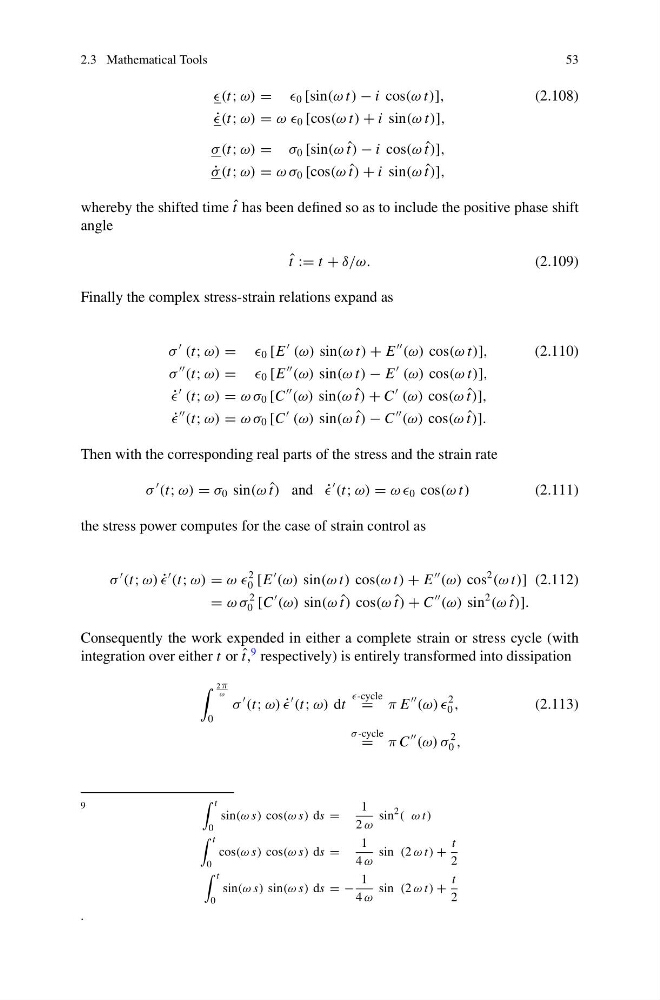
(t; ω) = 0 [sin(ω t) − i cos(ω t)],
(2.108)
˙
(t; ω) = ω ω 0 [cos(ω t) + i sin(ω t)],
σ (t; ω) = σ 0 [sin(ω ˆ
t) − i cos(ω ˆ
t)],
˙
σ (t; ω) = ω σ 0 [cos(ω ˆ
t) + i sin(ω ˆ
t)],
whereby the shifted time ˆ
t has been defined so as to include the positive phase shift
angle
ˆ
t := t + δ/ω.
(2.109)
Finally the complex stress-strain relations expand as
σ
(t; ω) = 0 [E
(ω) sin(ω t) + E
(ω) cos(ω t)],
(2.110)
σ
(t; ω) = 0 [E
(ω) sin(ω t) − E
(ω) cos(ω t)],
˙
(t; ω) = ω σ 0 [C
(ω) sin(ω ˆ
t) + C
(ω) cos(ω ˆ
t)],
˙
(t; ω) = ω σ 0 [C
(ω) sin(ω ˆ
t) − C
(ω) cos(ω ˆ
t)].
Then with the corresponding real parts of the stress and the strain rate
σ
(t; ω) = σ 0 sin(ω ˆ
t) and ˙
(t; ω) = ω ω 0 cos(ω t)
(2.111)
the stress power computes for the case of strain control as
σ
(t; ω) ˙
(t; ω) = ω ω
2
0 [E
(ω) sin(ω t) cos(ω t) + E
(ω) cos
2
(ω t)] (2.112)
= ω σ
2
0 [C
(ω) sin(ω ˆ
t) cos(ω ˆ
t) + C
(ω) sin
2
(ω ˆ
t)].
Consequently the work expended in either a complete strain or stress cycle (with
integration over either t or ˆ
t,
9 respectively) is entirely transformed into dissipation
2 π
ω
0
σ
(t; ω) ˙
(t; ω) dt
-cycle
= π E
(ω) )
2
0 ,
(2.113)
σ -cycle
= π C
(ω) σ
2
0 ,
9
t
0
sin(ω s) cos(ω s) ds =
1
2 ω
sin
2 ( ω t)
t
0
cos(ω s) cos(ω s) ds =
1
4 ω
sin (2 ω t) +
t
2
t
0
sin(ω s) sin(ω s) ds = −
1
4 ω
sin (2 ω t) +
t
2
.
53
(t; ω) = 0 [sin(ω t) − i cos(ω t)],
(2.108)
˙
(t; ω) = ω ω 0 [cos(ω t) + i sin(ω t)],
σ (t; ω) = σ 0 [sin(ω ˆ
t) − i cos(ω ˆ
t)],
˙
σ (t; ω) = ω σ 0 [cos(ω ˆ
t) + i sin(ω ˆ
t)],
whereby the shifted time ˆ
t has been defined so as to include the positive phase shift
angle
ˆ
t := t + δ/ω.
(2.109)
Finally the complex stress-strain relations expand as
σ
(t; ω) = 0 [E
(ω) sin(ω t) + E
(ω) cos(ω t)],
(2.110)
σ
(t; ω) = 0 [E
(ω) sin(ω t) − E
(ω) cos(ω t)],
˙
(t; ω) = ω σ 0 [C
(ω) sin(ω ˆ
t) + C
(ω) cos(ω ˆ
t)],
˙
(t; ω) = ω σ 0 [C
(ω) sin(ω ˆ
t) − C
(ω) cos(ω ˆ
t)].
Then with the corresponding real parts of the stress and the strain rate
σ
(t; ω) = σ 0 sin(ω ˆ
t) and ˙
(t; ω) = ω ω 0 cos(ω t)
(2.111)
the stress power computes for the case of strain control as
σ
(t; ω) ˙
(t; ω) = ω ω
2
0 [E
(ω) sin(ω t) cos(ω t) + E
(ω) cos
2
(ω t)] (2.112)
= ω σ
2
0 [C
(ω) sin(ω ˆ
t) cos(ω ˆ
t) + C
(ω) sin
2
(ω ˆ
t)].
Consequently the work expended in either a complete strain or stress cycle (with
integration over either t or ˆ
t,
9 respectively) is entirely transformed into dissipation
2 π
ω
0
σ
(t; ω) ˙
(t; ω) dt
-cycle
= π E
(ω) )
2
0 ,
(2.113)
σ -cycle
= π C
(ω) σ
2
0 ,
9
t
0
sin(ω s) cos(ω s) ds =
1
2 ω
sin
2 ( ω t)
t
0
cos(ω s) cos(ω s) ds =
1
4 ω
sin (2 ω t) +
t
2
t
0
sin(ω s) sin(ω s) ds = −
1
4 ω
sin (2 ω t) +
t
2
.