

52
2 Preliminaries
W (t; ω) =
1
2
E
(ω) |
(t; ω)|
2
+ E
(ω)/ω
t
0
| ˙
(s; ω)|
2 ds, (2.105)
=
1
2
C
(ω) |σ
(t; ω)|
2
+ C
(ω) ω
t
0
|σ
(s; ω)|
2 ds.
It is thus obvious that the real parts of the complex stiffness modulus E
(ω) and the
complex compliance modulus C
(ω) relate to energy storage, whereas the imaginary
parts of the complex stiffness modulus E
(ω) and the complex compliance modulus
C
(ω) connect to energy loss (dissipation). Thus E
(ω) and E
(ω) are commonly
denoted as storage and loss stiffness modulus, and C
(ω) and C
(ω) are commonly
denoted as storage and loss compliance modulus, respectively.
Harmonically Oscillating Stress and Strain: Strain Control
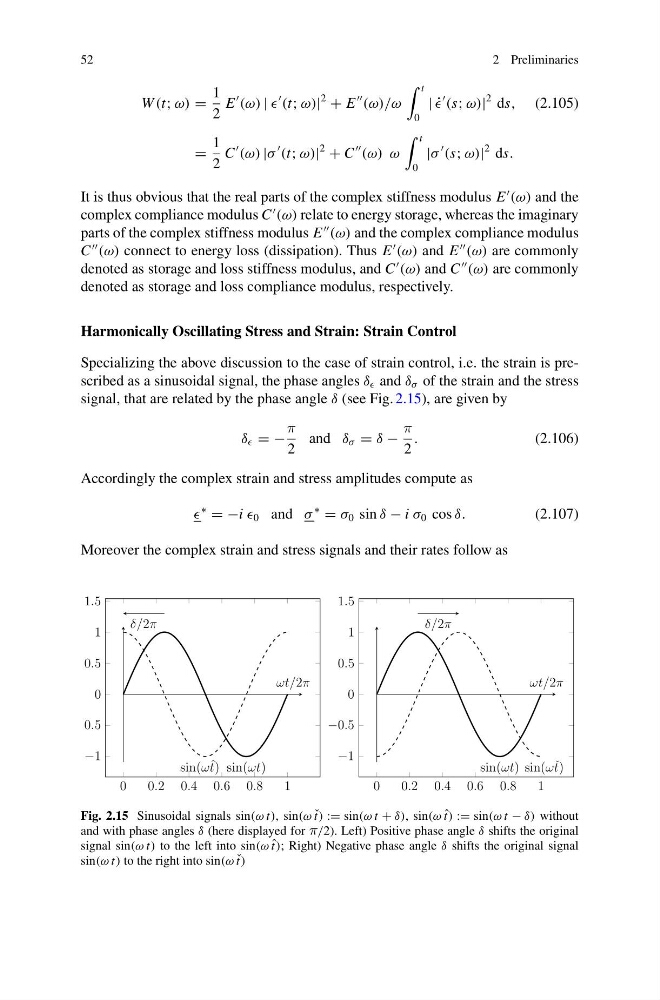
Specializing the above discussion to the case of strain control, i.e. the strain is prescribed as a sinusoidal signal, the phase angles δ and δ σ of the strain and the stress
signal, that are related by the phase angle δ (see Fig. 2.15), are given by
δ = −
π
2
and δ σ = δ −
π
2
.
(2.106)
Accordingly the complex strain and stress amplitudes compute as
∗
= −i 0 and σ
∗
= σ 0 sin δ − i σ 0 cos δ.
(2.107)
Moreover the complex strain and stress signals and their rates follow as
0
0.2 0.4 0.6 0.8
1
−1
0.5
0
0.5
1
1.5
ωt/2π
δ/2π
sin(ωt)
sin(ω ˆ
t)
0
0.2 0.4 0.6 0.8
1
−1
−0.5
0
0.5
1
1.5
ωt/2π
δ/2π
sin(ωt) sin(ω ˇ
t)
Fig. 2.15 Sinusoidal signals sin(ω t), sin(ω ˇ
t) := sin(ω t + δ), sin(ω ˆ
t) := sin(ω t − δ) without
and with phase angles δ (here displayed for π/2). Left) Positive phase angle δ shifts the original
signal sin(ω t) to the left into sin(ω ˆ
t); Right) Negative phase angle δ shifts the original signal
sin(ω t) to the right into sin(ω ˇ
t)
2 Preliminaries
W (t; ω) =
1
2
E
(ω) |
(t; ω)|
2
+ E
(ω)/ω
t
0
| ˙
(s; ω)|
2 ds, (2.105)
=
1
2
C
(ω) |σ
(t; ω)|
2
+ C
(ω) ω
t
0
|σ
(s; ω)|
2 ds.
It is thus obvious that the real parts of the complex stiffness modulus E
(ω) and the
complex compliance modulus C
(ω) relate to energy storage, whereas the imaginary
parts of the complex stiffness modulus E
(ω) and the complex compliance modulus
C
(ω) connect to energy loss (dissipation). Thus E
(ω) and E
(ω) are commonly
denoted as storage and loss stiffness modulus, and C
(ω) and C
(ω) are commonly
denoted as storage and loss compliance modulus, respectively.
Harmonically Oscillating Stress and Strain: Strain Control
Specializing the above discussion to the case of strain control, i.e. the strain is prescribed as a sinusoidal signal, the phase angles δ and δ σ of the strain and the stress
signal, that are related by the phase angle δ (see Fig. 2.15), are given by
δ = −
π
2
and δ σ = δ −
π
2
.
(2.106)
Accordingly the complex strain and stress amplitudes compute as
∗
= −i 0 and σ
∗
= σ 0 sin δ − i σ 0 cos δ.
(2.107)
Moreover the complex strain and stress signals and their rates follow as
0
0.2 0.4 0.6 0.8
1
−1
0.5
0
0.5
1
1.5
ωt/2π
δ/2π
sin(ωt)
sin(ω ˆ
t)
0
0.2 0.4 0.6 0.8
1
−1
−0.5
0
0.5
1
1.5
ωt/2π
δ/2π
sin(ωt) sin(ω ˇ
t)
Fig. 2.15 Sinusoidal signals sin(ω t), sin(ω ˇ
t) := sin(ω t + δ), sin(ω ˆ
t) := sin(ω t − δ) without
and with phase angles δ (here displayed for π/2). Left) Positive phase angle δ shifts the original
signal sin(ω t) to the left into sin(ω ˆ
t); Right) Negative phase angle δ shifts the original signal
sin(ω t) to the right into sin(ω ˇ
t)