

6.1 Bingham Model
291
• For ˙
< 0 (with σ < −σ y ) the overstress in the viscous damper results in σ v = σ +
σ y ≡ −|σ| + σ y and thus the stress σ p in the frictional slider coincides identically
with the (negative) yield stress σ p ≡ −σ y .
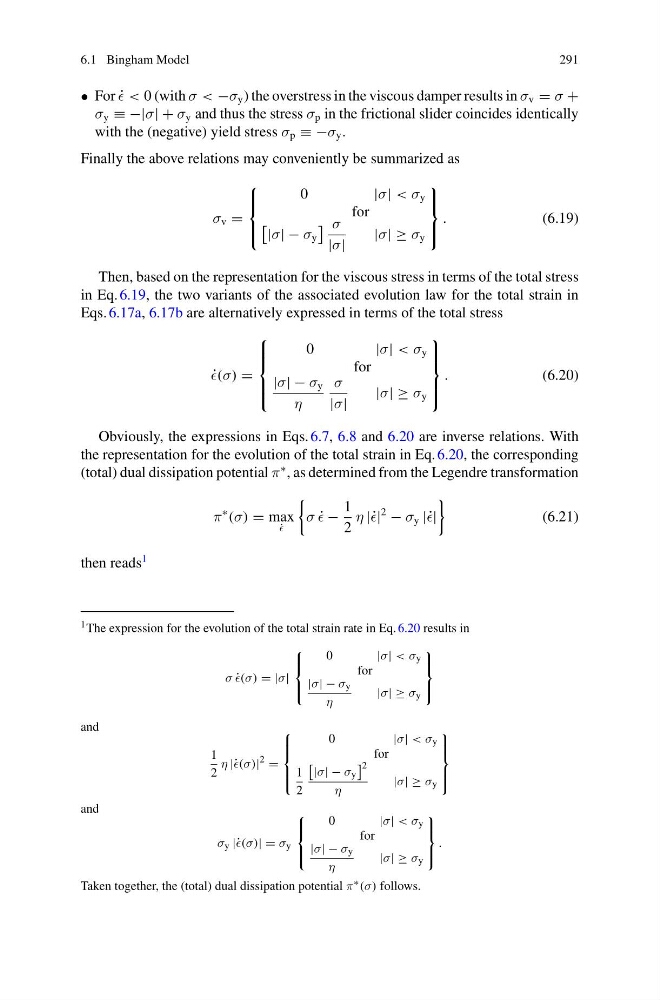
Finally the above relations may conveniently be summarized as
σ v =
⎧
⎪ ⎨
⎪ ⎩
0
|σ| < σ y
for
|σ| − σ y
σ
|σ|
|σ| ≥ σ y
⎫
⎪ ⎬
⎪ ⎭
.
(6.19)
Then, based on the representation for the viscous stress in terms of the total stress
in Eq. 6.19, the two variants of the associated evolution law for the total strain in
Eqs. 6.17a, 6.17b are alternatively expressed in terms of the total stress
˙
(σ) =
⎧
⎪ ⎪ ⎨
⎪ ⎪ ⎩
0
|σ| < σ y
for
|σ| − σ y
η
σ
|σ|
|σ| ≥ σ y
⎫
⎪ ⎪ ⎬
⎪ ⎪ ⎭
.
(6.20)
Obviously, the expressions in Eqs. 6.7, 6.8 and 6.20 are inverse relations. With
the representation for the evolution of the total strain in Eq. 6.20, the corresponding
(total) dual dissipation potential π
∗ , as determined from the Legendre transformation
π
∗
(σ) = max
˙
σ ˙
−
1
2
η |˙ |
2
− σ y |˙ |
(6.21)
then reads
1
1 The expression for the evolution of the total strain rate in Eq. 6.20 results in
σ ˙
(σ) = |σ|
⎧
⎪ ⎨
⎪ ⎩
0
|σ| < σ y
for
|σ| − σ y
η
|σ| ≥ σ y
⎫
⎪ ⎬
⎪ ⎭
and
1
2
η |˙ (σ)|
2 =
⎧
⎪ ⎪ ⎨
⎪ ⎪ ⎩
0
|σ| < σ y
for
1
2
|σ| − σ y
2
η
|σ| ≥ σ y
⎫
⎪ ⎪ ⎬
⎪ ⎪ ⎭
and
σ y |˙ (σ)| = σ y
⎧
⎪ ⎨
⎪ ⎩
0
|σ| < σ y
for
|σ| − σ y
η
|σ| ≥ σ y
⎫
⎪ ⎬
⎪ ⎭
.
Taken together, the (total) dual dissipation potential π ∗ (σ) follows.
291
• For ˙
< 0 (with σ < −σ y ) the overstress in the viscous damper results in σ v = σ +
σ y ≡ −|σ| + σ y and thus the stress σ p in the frictional slider coincides identically
with the (negative) yield stress σ p ≡ −σ y .
Finally the above relations may conveniently be summarized as
σ v =
⎧
⎪ ⎨
⎪ ⎩
0
|σ| < σ y
for
|σ| − σ y
σ
|σ|
|σ| ≥ σ y
⎫
⎪ ⎬
⎪ ⎭
.
(6.19)
Then, based on the representation for the viscous stress in terms of the total stress
in Eq. 6.19, the two variants of the associated evolution law for the total strain in
Eqs. 6.17a, 6.17b are alternatively expressed in terms of the total stress
˙
(σ) =
⎧
⎪ ⎪ ⎨
⎪ ⎪ ⎩
0
|σ| < σ y
for
|σ| − σ y
η
σ
|σ|
|σ| ≥ σ y
⎫
⎪ ⎪ ⎬
⎪ ⎪ ⎭
.
(6.20)
Obviously, the expressions in Eqs. 6.7, 6.8 and 6.20 are inverse relations. With
the representation for the evolution of the total strain in Eq. 6.20, the corresponding
(total) dual dissipation potential π
∗ , as determined from the Legendre transformation
π
∗
(σ) = max
˙
σ ˙
−
1
2
η |˙ |
2
− σ y |˙ |
(6.21)
then reads
1
1 The expression for the evolution of the total strain rate in Eq. 6.20 results in
σ ˙
(σ) = |σ|
⎧
⎪ ⎨
⎪ ⎩
0
|σ| < σ y
for
|σ| − σ y
η
|σ| ≥ σ y
⎫
⎪ ⎬
⎪ ⎭
and
1
2
η |˙ (σ)|
2 =
⎧
⎪ ⎪ ⎨
⎪ ⎪ ⎩
0
|σ| < σ y
for
1
2
|σ| − σ y
2
η
|σ| ≥ σ y
⎫
⎪ ⎪ ⎬
⎪ ⎪ ⎭
and
σ y |˙ (σ)| = σ y
⎧
⎪ ⎨
⎪ ⎩
0
|σ| < σ y
for
|σ| − σ y
η
|σ| ≥ σ y
⎫
⎪ ⎬
⎪ ⎭
.
Taken together, the (total) dual dissipation potential π ∗ (σ) follows.