

292
6 Visco-Plasticity
−2
−1
0
1
2
2
1
0
1
2
˙
π( ˙)
1
2
η ˙
2 + σ y | ˙|
−2
−1
0
1
2
−2
−1
0
1
2
˙
σ( ˙)
η ˙ + sgn( ˙)σ y
−2
−1
0
1
2
2
1
0
1
2
σ
−σ y
+σ y
π
∗ (σ)
1
2
1
η
σ| − σ y
2
−2
−1
0
1
2
−2
−1
0
1
2
σ
−σ y
+σ y
˙(σ)
1
η
σ| − σ y sgn(σ)
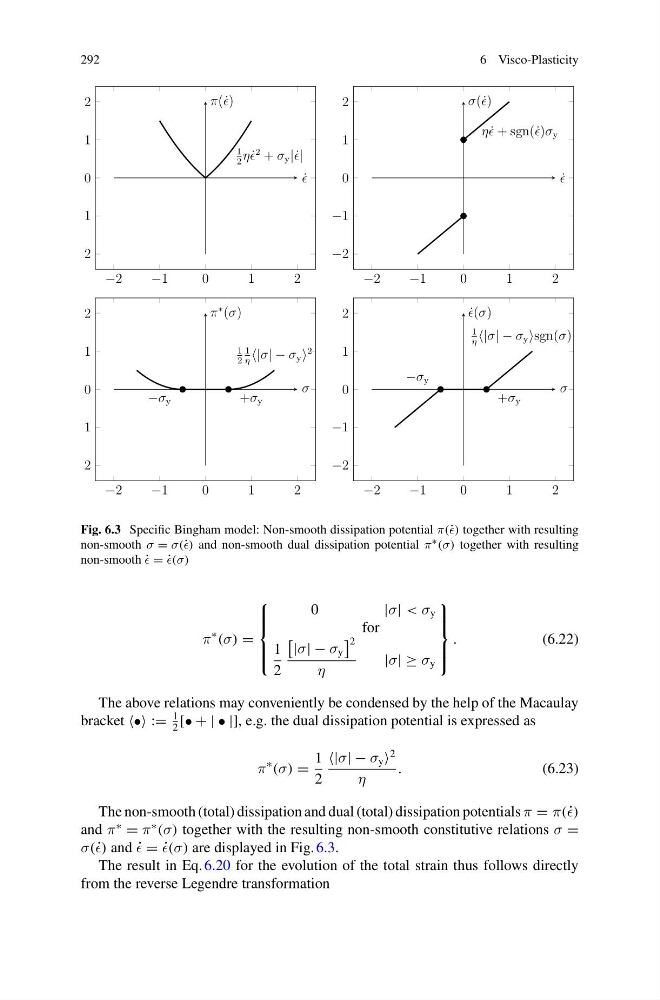
Fig. 6.3 Specific Bingham model: Non-smooth dissipation potential π(˙ together with resulting
non-smooth σ = σ(˙ and non-smooth dual dissipation potential π ∗ (σ) together with resulting
non-smooth ˙
= ˙
π
∗
(σ) =
⎧
⎪ ⎪ ⎨
⎪ ⎪ ⎩
0
|σ| < σ y
for
1
2
|σ| − σ y
2
η
|σ| ≥ σ y
⎫
⎪ ⎪ ⎬
⎪ ⎪ ⎭
.
(6.22)
The above relations may conveniently be condensed by the help of the Macaulay
bracket :=
1
2
[• + | • |], e.g. the dual dissipation potential is expressed as
π
∗
(σ) =
1
2
− σ y
2
η
.
(6.23)
The non-smooth (total) dissipation and dual (total) dissipation potentials π = π(˙
and π
∗
= π
∗
(σ) together with the resulting non-smooth constitutive relations σ =
σ(˙ and ˙
= ˙
are displayed in Fig. 6.3.
The result in Eq. 6.20 for the evolution of the total strain thus follows directly
from the reverse Legendre transformation
6 Visco-Plasticity
−2
−1
0
1
2
2
1
0
1
2
˙
π( ˙)
1
2
η ˙
2 + σ y | ˙|
−2
−1
0
1
2
−2
−1
0
1
2
˙
σ( ˙)
η ˙ + sgn( ˙)σ y
−2
−1
0
1
2
2
1
0
1
2
σ
−σ y
+σ y
π
∗ (σ)
1
2
1
η
σ| − σ y
2
−2
−1
0
1
2
−2
−1
0
1
2
σ
−σ y
+σ y
˙(σ)
1
η
σ| − σ y sgn(σ)
Fig. 6.3 Specific Bingham model: Non-smooth dissipation potential π(˙ together with resulting
non-smooth σ = σ(˙ and non-smooth dual dissipation potential π ∗ (σ) together with resulting
non-smooth ˙
= ˙
π
∗
(σ) =
⎧
⎪ ⎪ ⎨
⎪ ⎪ ⎩
0
|σ| < σ y
for
1
2
|σ| − σ y
2
η
|σ| ≥ σ y
⎫
⎪ ⎪ ⎬
⎪ ⎪ ⎭
.
(6.22)
The above relations may conveniently be condensed by the help of the Macaulay
bracket :=
1
2
[• + | • |], e.g. the dual dissipation potential is expressed as
π
∗
(σ) =
1
2
− σ y
2
η
.
(6.23)
The non-smooth (total) dissipation and dual (total) dissipation potentials π = π(˙
and π
∗
= π
∗
(σ) together with the resulting non-smooth constitutive relations σ =
σ(˙ and ˙
= ˙
are displayed in Fig. 6.3.
The result in Eq. 6.20 for the evolution of the total strain thus follows directly
from the reverse Legendre transformation