

290
6 Visco-Plasticity
Total Stress
Alternatively, the Bingham model may be formulated further by considering the total
stress. To this end the viscous and the plastic stress need to be related to the total
stress.
Remarkably, since at yield the plastic stress satisfies |σ p | = σ y , the viscous overstress σ v = σ − σ p allows representation in terms of the yield condition that is,
however, evaluated in terms of the total stress σ
σ v =
⎧
⎪ ⎪ ⎨
⎪ ⎪ ⎩
+|σ| − σ y
0
−|σ| + σ y
if
σ > +σ y
else
σ < −σ y
⎫
⎪ ⎪ ⎬
⎪ ⎪ ⎭
.
(6.18)
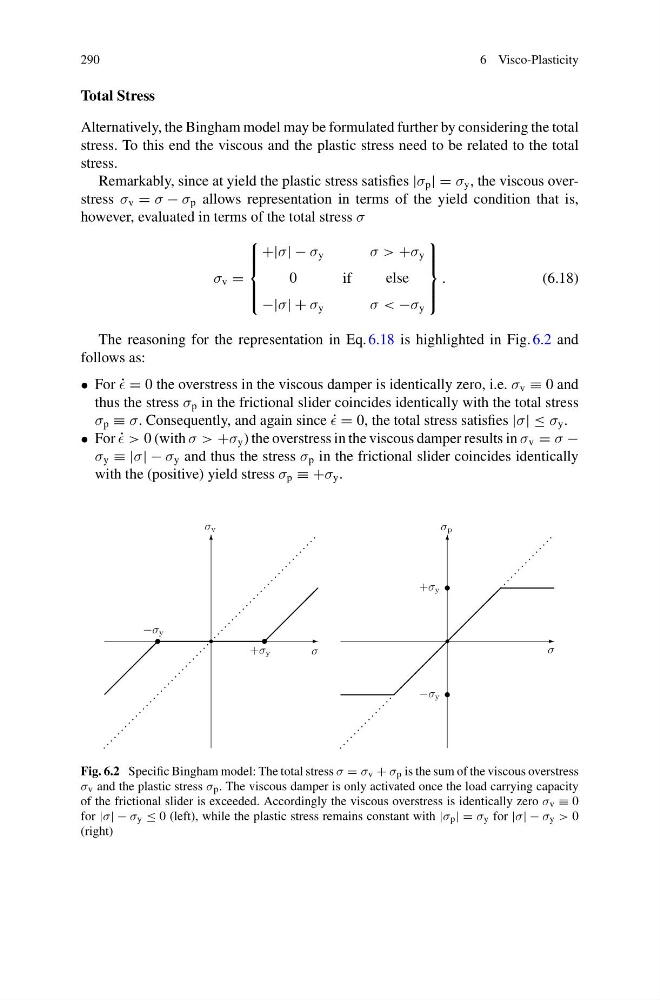
The reasoning for the representation in Eq. 6.18 is highlighted in Fig. 6.2 and
follows as:
• For ˙
= 0 the overstress in the viscous damper is identically zero, i.e. σ v ≡ 0 and
thus the stress σ p in the frictional slider coincides identically with the total stress
σ p ≡ σ. Consequently, and again since ˙
= 0, the total stress satisfies |σ| ≤ σ y .
• For ˙
> 0 (with σ > +σ y ) the overstress in the viscous damper results in σ v = σ −
σ y ≡ |σ| − σ y and thus the stress σ p in the frictional slider coincides identically
with the (positive) yield stress σ p ≡ +σ y .
σ
σ v
−σ y
+σ y
σ
σ p
+σ y
−σ y
Fig. 6.2 Specific Bingham model: The total stress σ = σ v + σ p is the sum of the viscous overstress
σ v and the plastic stress σ p . The viscous damper is only activated once the load carrying capacity
of the frictional slider is exceeded. Accordingly the viscous overstress is identically zero σ v ≡ 0
for |σ| − σ y ≤ 0 (left), while the plastic stress remains constant with |σ p | = σ y for |σ| − σ y > 0
(right)
6 Visco-Plasticity
Total Stress
Alternatively, the Bingham model may be formulated further by considering the total
stress. To this end the viscous and the plastic stress need to be related to the total
stress.
Remarkably, since at yield the plastic stress satisfies |σ p | = σ y , the viscous overstress σ v = σ − σ p allows representation in terms of the yield condition that is,
however, evaluated in terms of the total stress σ
σ v =
⎧
⎪ ⎪ ⎨
⎪ ⎪ ⎩
+|σ| − σ y
0
−|σ| + σ y
if
σ > +σ y
else
σ < −σ y
⎫
⎪ ⎪ ⎬
⎪ ⎪ ⎭
.
(6.18)
The reasoning for the representation in Eq. 6.18 is highlighted in Fig. 6.2 and
follows as:
• For ˙
= 0 the overstress in the viscous damper is identically zero, i.e. σ v ≡ 0 and
thus the stress σ p in the frictional slider coincides identically with the total stress
σ p ≡ σ. Consequently, and again since ˙
= 0, the total stress satisfies |σ| ≤ σ y .
• For ˙
> 0 (with σ > +σ y ) the overstress in the viscous damper results in σ v = σ −
σ y ≡ |σ| − σ y and thus the stress σ p in the frictional slider coincides identically
with the (positive) yield stress σ p ≡ +σ y .
σ
σ v
−σ y
+σ y
σ
σ p
+σ y
−σ y
Fig. 6.2 Specific Bingham model: The total stress σ = σ v + σ p is the sum of the viscous overstress
σ v and the plastic stress σ p . The viscous damper is only activated once the load carrying capacity
of the frictional slider is exceeded. Accordingly the viscous overstress is identically zero σ v ≡ 0
for |σ| − σ y ≤ 0 (left), while the plastic stress remains constant with |σ p | = σ y for |σ| − σ y > 0
(right)