

1.2 Compositions of Rheological Models
9
σ
σ
σ
σ
σ
σ
1
2
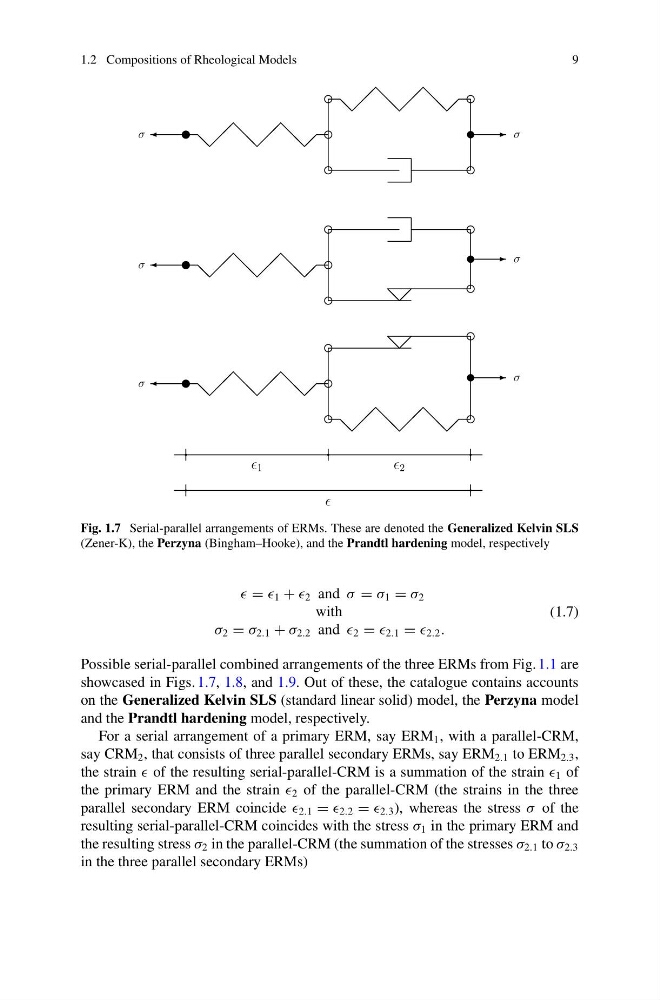
Fig. 1.7 Serial-parallel arrangements of ERMs. These are denoted the Generalized Kelvin SLS
(Zener-K), the Perzyna (Bingham–Hooke), and the Prandtl hardening model, respectively
= 1 + 2 and σ = σ 1 = σ 2
with
σ 2 = σ 2.1 + σ 2.2 and 2 = 2.1 = 2.2 .
(1.7)
Possible serial-parallel combined arrangements of the three ERMs from Fig. 1.1 are
showcased in Figs. 1.7, 1.8, and 1.9. Out of these, the catalogue contains accounts
on the Generalized Kelvin SLS (standard linear solid) model, the Perzyna model
and the Prandtl hardening model, respectively.
For a serial arrangement of a primary ERM, say ERM 1 , with a parallel-CRM,
say CRM 2 , that consists of three parallel secondary ERMs, say ERM 2.1 to ERM 2.3 ,
the strain of the resulting serial-parallel-CRM is a summation of the strain 1 of
the primary ERM and the strain 2 of the parallel-CRM (the strains in the three
parallel secondary ERM coincide 2.1 = 2.2 = 2.3 ), whereas the stress σ of the
resulting serial-parallel-CRM coincides with the stress σ 1 in the primary ERM and
the resulting stress σ 2 in the parallel-CRM (the summation of the stresses σ 2.1 to σ 2.3
in the three parallel secondary ERMs)
9
σ
σ
σ
σ
σ
σ
1
2
Fig. 1.7 Serial-parallel arrangements of ERMs. These are denoted the Generalized Kelvin SLS
(Zener-K), the Perzyna (Bingham–Hooke), and the Prandtl hardening model, respectively
= 1 + 2 and σ = σ 1 = σ 2
with
σ 2 = σ 2.1 + σ 2.2 and 2 = 2.1 = 2.2 .
(1.7)
Possible serial-parallel combined arrangements of the three ERMs from Fig. 1.1 are
showcased in Figs. 1.7, 1.8, and 1.9. Out of these, the catalogue contains accounts
on the Generalized Kelvin SLS (standard linear solid) model, the Perzyna model
and the Prandtl hardening model, respectively.
For a serial arrangement of a primary ERM, say ERM 1 , with a parallel-CRM,
say CRM 2 , that consists of three parallel secondary ERMs, say ERM 2.1 to ERM 2.3 ,
the strain of the resulting serial-parallel-CRM is a summation of the strain 1 of
the primary ERM and the strain 2 of the parallel-CRM (the strains in the three
parallel secondary ERM coincide 2.1 = 2.2 = 2.3 ), whereas the stress σ of the
resulting serial-parallel-CRM coincides with the stress σ 1 in the primary ERM and
the resulting stress σ 2 in the parallel-CRM (the summation of the stresses σ 2.1 to σ 2.3
in the three parallel secondary ERMs)