

200
5 Plasticity
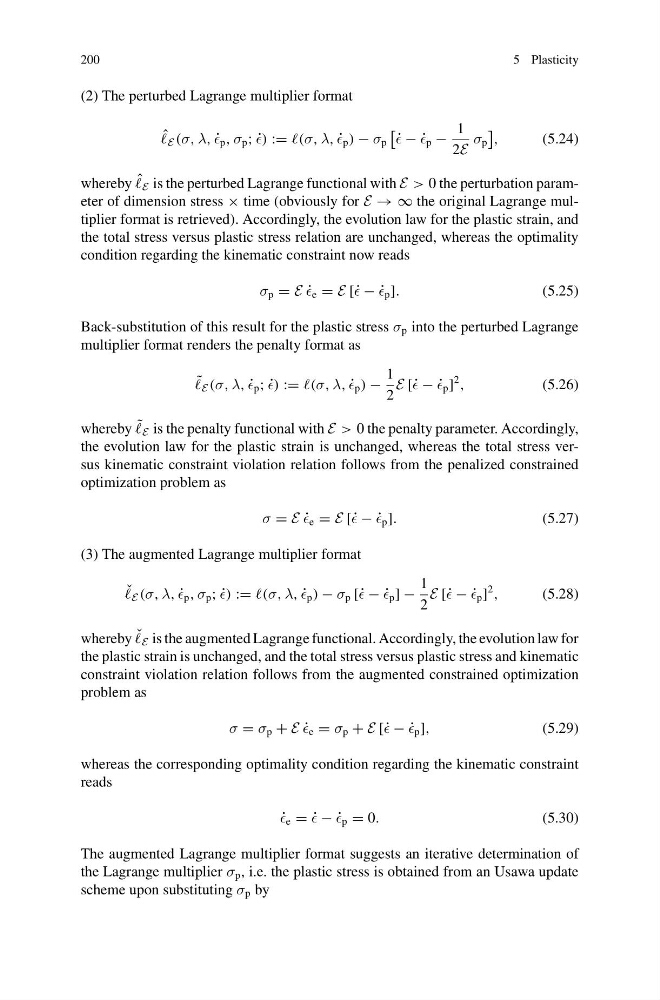
(2) The perturbed Lagrange multiplier format
ˆ
E (σ, λ, ˙
p , σ p ; ˙
) := (σ, λ, ˙
p ) − σ p
˙
− ˙
p −
1
2E
σ p
,
(5.24)
whereby ˆ
E is the perturbed Lagrange functional with E > 0 the perturbation parameter of dimension stress × time (obviously for E → ∞ the original Lagrange multiplier format is retrieved). Accordingly, the evolution law for the plastic strain, and
the total stress versus plastic stress relation are unchanged, whereas the optimality
condition regarding the kinematic constraint now reads
σ p = E ˙
e = E [˙ − ˙
p ].
(5.25)
Back-substitution of this result for the plastic stress σ p into the perturbed Lagrange
multiplier format renders the penalty format as
˜
E (σ, λ, ˙
p ; ˙
) := (σ, λ, ˙
p ) −
1
2
E [˙ − ˙
p ]
2
,
(5.26)
whereby ˜
E is the penalty functional with E > 0 the penalty parameter. Accordingly,
the evolution law for the plastic strain is unchanged, whereas the total stress versus kinematic constraint violation relation follows from the penalized constrained
optimization problem as
σ = E ˙
e = E [˙ − ˙
p ].
(5.27)
(3) The augmented Lagrange multiplier format
ˇ
E (σ, λ, ˙
p , σ p ; ˙
) := (σ, λ, ˙
p ) − σ p [˙ − ˙
p ] −
1
2
E [˙ − ˙
p ]
2
,
(5.28)
whereby ˇ
E is the augmented Lagrange functional. Accordingly, the evolution law for
the plastic strain is unchanged, and the total stress versus plastic stress and kinematic
constraint violation relation follows from the augmented constrained optimization
problem as
σ = σ p + E ˙
e = σ p + E [˙ − ˙
p ],
(5.29)
whereas the corresponding optimality condition regarding the kinematic constraint
reads
˙
e = ˙
− ˙
p = 0.
(5.30)
The augmented Lagrange multiplier format suggests an iterative determination of
the Lagrange multiplier σ p , i.e. the plastic stress is obtained from an Usawa update
scheme upon substituting σ p by
5 Plasticity
(2) The perturbed Lagrange multiplier format
ˆ
E (σ, λ, ˙
p , σ p ; ˙
) := (σ, λ, ˙
p ) − σ p
˙
− ˙
p −
1
2E
σ p
,
(5.24)
whereby ˆ
E is the perturbed Lagrange functional with E > 0 the perturbation parameter of dimension stress × time (obviously for E → ∞ the original Lagrange multiplier format is retrieved). Accordingly, the evolution law for the plastic strain, and
the total stress versus plastic stress relation are unchanged, whereas the optimality
condition regarding the kinematic constraint now reads
σ p = E ˙
e = E [˙ − ˙
p ].
(5.25)
Back-substitution of this result for the plastic stress σ p into the perturbed Lagrange
multiplier format renders the penalty format as
˜
E (σ, λ, ˙
p ; ˙
) := (σ, λ, ˙
p ) −
1
2
E [˙ − ˙
p ]
2
,
(5.26)
whereby ˜
E is the penalty functional with E > 0 the penalty parameter. Accordingly,
the evolution law for the plastic strain is unchanged, whereas the total stress versus kinematic constraint violation relation follows from the penalized constrained
optimization problem as
σ = E ˙
e = E [˙ − ˙
p ].
(5.27)
(3) The augmented Lagrange multiplier format
ˇ
E (σ, λ, ˙
p , σ p ; ˙
) := (σ, λ, ˙
p ) − σ p [˙ − ˙
p ] −
1
2
E [˙ − ˙
p ]
2
,
(5.28)
whereby ˇ
E is the augmented Lagrange functional. Accordingly, the evolution law for
the plastic strain is unchanged, and the total stress versus plastic stress and kinematic
constraint violation relation follows from the augmented constrained optimization
problem as
σ = σ p + E ˙
e = σ p + E [˙ − ˙
p ],
(5.29)
whereas the corresponding optimality condition regarding the kinematic constraint
reads
˙
e = ˙
− ˙
p = 0.
(5.30)
The augmented Lagrange multiplier format suggests an iterative determination of
the Lagrange multiplier σ p , i.e. the plastic stress is obtained from an Usawa update
scheme upon substituting σ p by