

198
5 Plasticity
−1
−0.5
0
0.5
1
−1
0.5
0
0.5
1
˙
π( ˙)
σ y | ˙|
−1
−0.5
0
0.5
1
−1
−0.5
0
0.5
1
˙
σ( ˙)
−σ y
+σ y
−1
−0.5
0
0.5
1
−1
0.5
0
0.5
1
σ
−σ y
+σ y
π
∗ (σ)
∞
∞
−1
−0.5
0
0.5
1
−1
−0.5
0
0.5
1
σ
−σ y
+σ y
˙(σ)
| ˙|
| ˙|
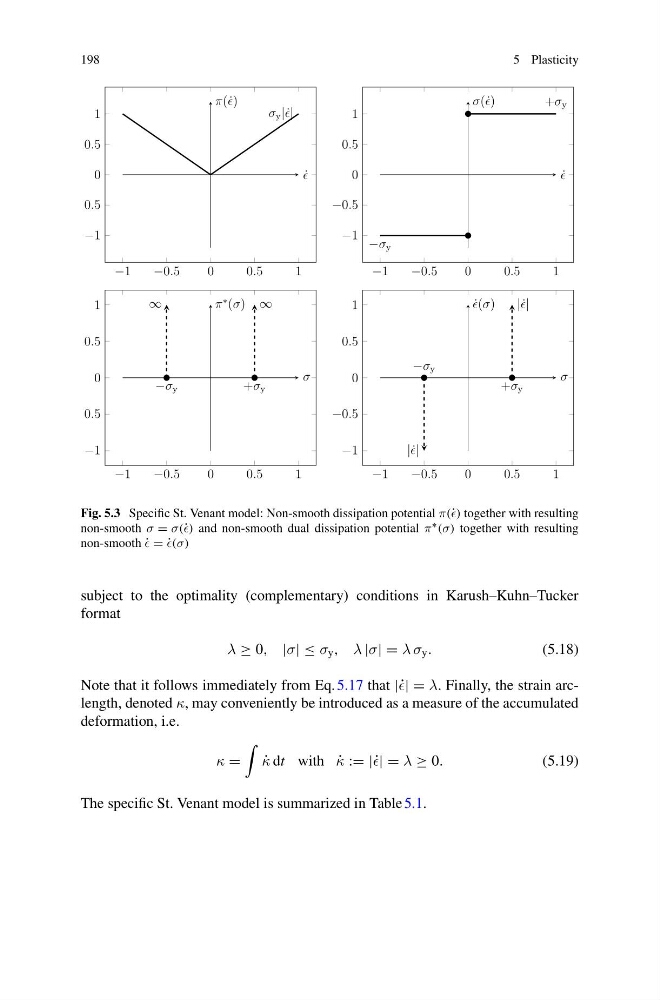
Fig. 5.3 Specific St. Venant model: Non-smooth dissipation potential π(˙ together with resulting
non-smooth σ = σ(˙ and non-smooth dual dissipation potential π ∗ (σ) together with resulting
non-smooth ˙
= ˙
subject to the optimality (complementary) conditions in Karush–Kuhn–Tucker
format
λ ≥ 0, |σ| ≤ σ y , λ |σ| = λ σ y .
(5.18)
Note that it follows immediately from Eq. 5.17 that |˙ | = λ. Finally, the strain arclength, denoted κ, may conveniently be introduced as a measure of the accumulated
deformation, i.e.
κ =
˙
κ dt with ˙
κ := |˙ | = λ ≥ 0.
(5.19)
The specific St. Venant model is summarized in Table 5.1.
5 Plasticity
−1
−0.5
0
0.5
1
−1
0.5
0
0.5
1
˙
π( ˙)
σ y | ˙|
−1
−0.5
0
0.5
1
−1
−0.5
0
0.5
1
˙
σ( ˙)
−σ y
+σ y
−1
−0.5
0
0.5
1
−1
0.5
0
0.5
1
σ
−σ y
+σ y
π
∗ (σ)
∞
∞
−1
−0.5
0
0.5
1
−1
−0.5
0
0.5
1
σ
−σ y
+σ y
˙(σ)
| ˙|
| ˙|
Fig. 5.3 Specific St. Venant model: Non-smooth dissipation potential π(˙ together with resulting
non-smooth σ = σ(˙ and non-smooth dual dissipation potential π ∗ (σ) together with resulting
non-smooth ˙
= ˙
subject to the optimality (complementary) conditions in Karush–Kuhn–Tucker
format
λ ≥ 0, |σ| ≤ σ y , λ |σ| = λ σ y .
(5.18)
Note that it follows immediately from Eq. 5.17 that |˙ | = λ. Finally, the strain arclength, denoted κ, may conveniently be introduced as a measure of the accumulated
deformation, i.e.
κ =
˙
κ dt with ˙
κ := |˙ | = λ ≥ 0.
(5.19)
The specific St. Venant model is summarized in Table 5.1.