

5.1 St. Venant Model
197
π
∗
(σ) = I A (σ) :=
⎧
⎨
⎩
0
|σ| ≤ σ y
for
∞
|σ| > σ y
⎫
⎬
⎭
,
(5.12)
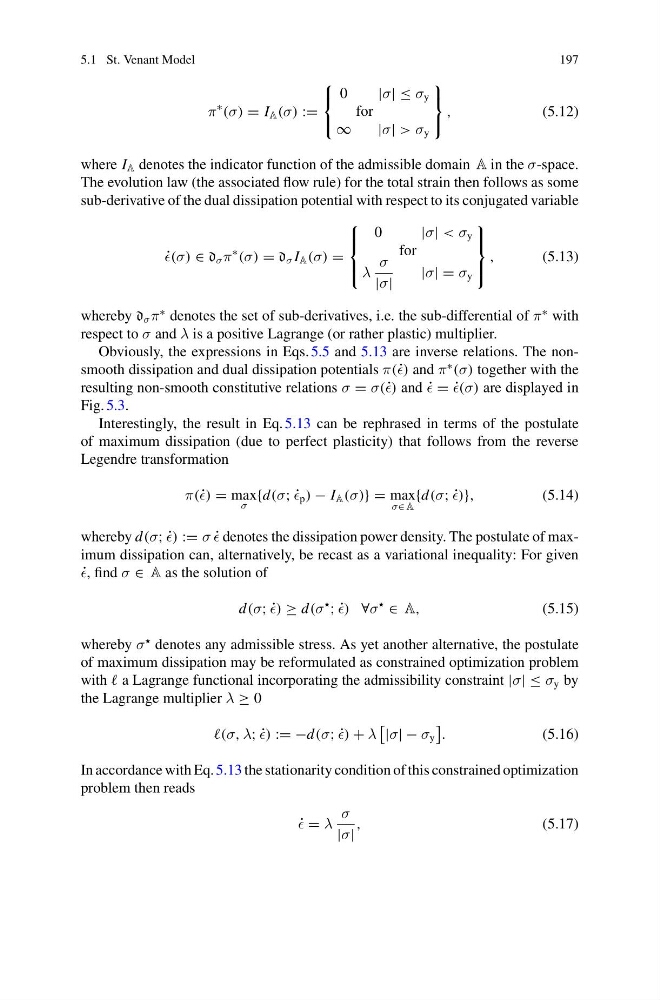
where I A denotes the indicator function of the admissible domain A in the σ-space.
The evolution law (the associated flow rule) for the total strain then follows as some
sub-derivative of the dual dissipation potential with respect to its conjugated variable
˙
(σ) ∈ d σ π
∗
(σ) = d σ I A (σ) =
⎧
⎪ ⎨
⎪ ⎩
0
|σ| < σ y
for
λ
σ
|σ|
|σ| = σ y
⎫
⎪ ⎬
⎪ ⎭
,
(5.13)
whereby d σ π
∗ denotes the set of sub-derivatives, i.e. the sub-differential of π
∗ with
respect to σ and λ is a positive Lagrange (or rather plastic) multiplier.
Obviously, the expressions in Eqs. 5.5 and 5.13 are inverse relations. The nonsmooth dissipation and dual dissipation potentials π(˙ ) and π
∗
(σ) together with the
resulting non-smooth constitutive relations σ = σ(˙ ) and ˙
= ˙
(σ) are displayed in
Fig. 5.3.
Interestingly, the result in Eq. 5.13 can be rephrased in terms of the postulate
of maximum dissipation (due to perfect plasticity) that follows from the reverse
Legendre transformation
π(˙ ) = max
σ
{d(σ; ˙
p ) − I A (σ)} = max
σ∈ A
{d(σ; ˙
)},
(5.14)
whereby d(σ; ˙
) := σ ˙
denotes the dissipation power density. The postulate of maximum dissipation can, alternatively, be recast as a variational inequality: For given
˙
, find σ ∈ A as the solution of
d(σ; ˙
) ≥ d(σ
; ˙
) ∀σ
∈ A,
(5.15)
whereby σ
denotes any admissible stress. As yet another alternative, the postulate
of maximum dissipation may be reformulated as constrained optimization problem
with a Lagrange functional incorporating the admissibility constraint |σ| ≤ σ y by
the Lagrange multiplier λ ≥ 0
(σ, λ; ˙
) := −d(σ; ˙
) + λ
|σ| − σ y
.
(5.16)
In accordance with Eq. 5.13 the stationarity condition of this constrained optimization
problem then reads
˙
= λ
σ
|σ|
,
(5.17)
197
π
∗
(σ) = I A (σ) :=
⎧
⎨
⎩
0
|σ| ≤ σ y
for
∞
|σ| > σ y
⎫
⎬
⎭
,
(5.12)
where I A denotes the indicator function of the admissible domain A in the σ-space.
The evolution law (the associated flow rule) for the total strain then follows as some
sub-derivative of the dual dissipation potential with respect to its conjugated variable
˙
(σ) ∈ d σ π
∗
(σ) = d σ I A (σ) =
⎧
⎪ ⎨
⎪ ⎩
0
|σ| < σ y
for
λ
σ
|σ|
|σ| = σ y
⎫
⎪ ⎬
⎪ ⎭
,
(5.13)
whereby d σ π
∗ denotes the set of sub-derivatives, i.e. the sub-differential of π
∗ with
respect to σ and λ is a positive Lagrange (or rather plastic) multiplier.
Obviously, the expressions in Eqs. 5.5 and 5.13 are inverse relations. The nonsmooth dissipation and dual dissipation potentials π(˙ ) and π
∗
(σ) together with the
resulting non-smooth constitutive relations σ = σ(˙ ) and ˙
= ˙
(σ) are displayed in
Fig. 5.3.
Interestingly, the result in Eq. 5.13 can be rephrased in terms of the postulate
of maximum dissipation (due to perfect plasticity) that follows from the reverse
Legendre transformation
π(˙ ) = max
σ
{d(σ; ˙
p ) − I A (σ)} = max
σ∈ A
{d(σ; ˙
)},
(5.14)
whereby d(σ; ˙
) := σ ˙
denotes the dissipation power density. The postulate of maximum dissipation can, alternatively, be recast as a variational inequality: For given
˙
, find σ ∈ A as the solution of
d(σ; ˙
) ≥ d(σ
; ˙
) ∀σ
∈ A,
(5.15)
whereby σ
denotes any admissible stress. As yet another alternative, the postulate
of maximum dissipation may be reformulated as constrained optimization problem
with a Lagrange functional incorporating the admissibility constraint |σ| ≤ σ y by
the Lagrange multiplier λ ≥ 0
(σ, λ; ˙
) := −d(σ; ˙
) + λ
|σ| − σ y
.
(5.16)
In accordance with Eq. 5.13 the stationarity condition of this constrained optimization
problem then reads
˙
= λ
σ
|σ|
,
(5.17)