

196
5 Plasticity
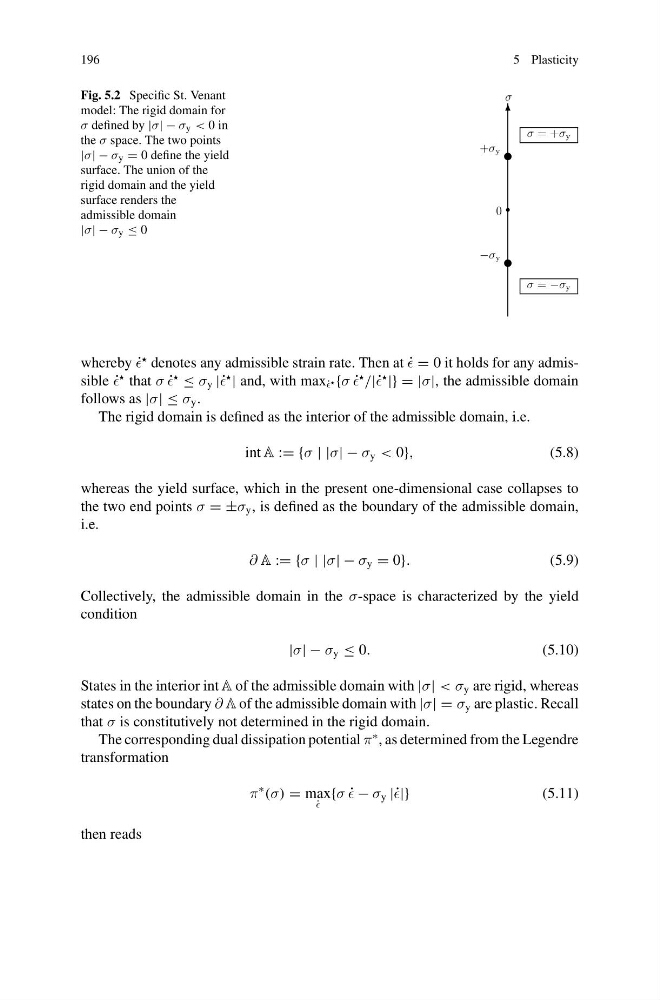
Fig. 5.2 Specific St. Venant
model: The rigid domain for
σ defined by |σ| − σ y < 0 in
the σ space. The two points
|σ| − σ y = 0 define the yield
surface. The union of the
rigid domain and the yield
surface renders the
admissible domain
|σ| − σ y ≤ 0
σ
0
+σ y
σ = +σ y
−σ y
σ = −σ y
whereby ˙
denotes any admissible strain rate. Then at ˙
= 0 it holds for any admissible ˙
that σ ˙
≤ σ y |˙
| and, with max ˙
{σ ˙
/|˙
|} = |σ|, the admissible domain
follows as |σ| ≤ σ y .
The rigid domain is defined as the interior of the admissible domain, i.e.
int A := {σ | |σ| − σ y < 0},
(5.8)
whereas the yield surface, which in the present one-dimensional case collapses to
the two end points σ = ±σ y , is defined as the boundary of the admissible domain,
i.e.
∂ A := {σ | |σ| − σ y = 0}.
(5.9)
Collectively, the admissible domain in the σ-space is characterized by the yield
condition
|σ| − σ y ≤ 0.
(5.10)
States in the interior int A of the admissible domain with |σ| < σ y are rigid, whereas
states on the boundary ∂ A of the admissible domain with |σ| = σ y are plastic. Recall
that σ is constitutively not determined in the rigid domain.
The corresponding dual dissipation potential π
∗ , as determined from the Legendre
transformation
π
∗
(σ) = max
˙
{σ ˙
− σ y |˙ |}
(5.11)
then reads
5 Plasticity
Fig. 5.2 Specific St. Venant
model: The rigid domain for
σ defined by |σ| − σ y < 0 in
the σ space. The two points
|σ| − σ y = 0 define the yield
surface. The union of the
rigid domain and the yield
surface renders the
admissible domain
|σ| − σ y ≤ 0
σ
0
+σ y
σ = +σ y
−σ y
σ = −σ y
whereby ˙
denotes any admissible strain rate. Then at ˙
= 0 it holds for any admissible ˙
that σ ˙
≤ σ y |˙
| and, with max ˙
{σ ˙
/|˙
|} = |σ|, the admissible domain
follows as |σ| ≤ σ y .
The rigid domain is defined as the interior of the admissible domain, i.e.
int A := {σ | |σ| − σ y < 0},
(5.8)
whereas the yield surface, which in the present one-dimensional case collapses to
the two end points σ = ±σ y , is defined as the boundary of the admissible domain,
i.e.
∂ A := {σ | |σ| − σ y = 0}.
(5.9)
Collectively, the admissible domain in the σ-space is characterized by the yield
condition
|σ| − σ y ≤ 0.
(5.10)
States in the interior int A of the admissible domain with |σ| < σ y are rigid, whereas
states on the boundary ∂ A of the admissible domain with |σ| = σ y are plastic. Recall
that σ is constitutively not determined in the rigid domain.
The corresponding dual dissipation potential π
∗ , as determined from the Legendre
transformation
π
∗
(σ) = max
˙
{σ ˙
− σ y |˙ |}
(5.11)
then reads