

1.2 Compositions of Rheological Models
5
constituting ERMs in sans serif font
1 (the named and un-named CRMs in sans
serif font that are mainly of relevance to model fluid materials will be considered
separately elsewhere).
Generically, the ERMs from Fig. 1.1 provide input/output relations between the
stress σ and the strain (or the strain rate ˙
ERM
σ
↔
(σ
↔
˙
)
(1.1)
1.2.1 Serial Arrangement of ERMs
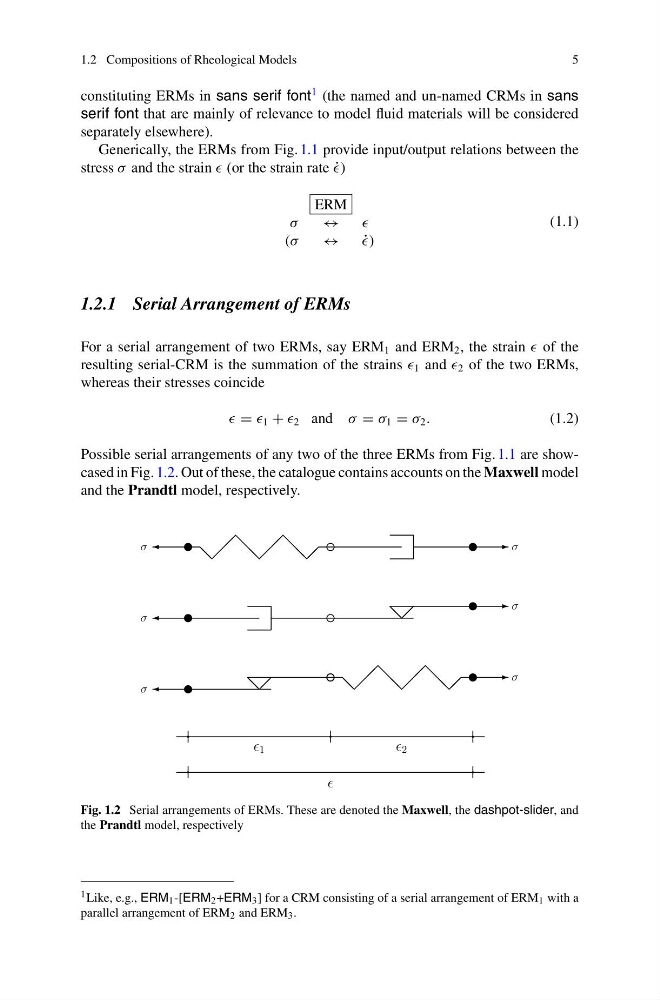
For a serial arrangement of two ERMs, say ERM 1 and ERM 2 , the strain of the
resulting serial-CRM is the summation of the strains 1 and 2 of the two ERMs,
whereas their stresses coincide
= 1 + 2 and σ = σ 1 = σ 2 .
(1.2)
Possible serial arrangements of any two of the three ERMs from Fig. 1.1 are showcased in Fig. 1.2. Out of these, the catalogue contains accounts on the Maxwell model
and the Prandtl model, respectively.
σ
σ
σ
σ
σ
σ
1
2
Fig. 1.2 Serial arrangements of ERMs. These are denoted the Maxwell, the dashpot-slider, and
the Prandtl model, respectively
1 Like, e.g., ERM 1 -[ERM 2 +ERM 3 ] for a CRM consisting of a serial arrangement of ERM 1 with a
parallel arrangement of ERM 2 and ERM 3 .
5
constituting ERMs in sans serif font
1 (the named and un-named CRMs in sans
serif font that are mainly of relevance to model fluid materials will be considered
separately elsewhere).
Generically, the ERMs from Fig. 1.1 provide input/output relations between the
stress σ and the strain (or the strain rate ˙
ERM
σ
↔
(σ
↔
˙
)
(1.1)
1.2.1 Serial Arrangement of ERMs
For a serial arrangement of two ERMs, say ERM 1 and ERM 2 , the strain of the
resulting serial-CRM is the summation of the strains 1 and 2 of the two ERMs,
whereas their stresses coincide
= 1 + 2 and σ = σ 1 = σ 2 .
(1.2)
Possible serial arrangements of any two of the three ERMs from Fig. 1.1 are showcased in Fig. 1.2. Out of these, the catalogue contains accounts on the Maxwell model
and the Prandtl model, respectively.
σ
σ
σ
σ
σ
σ
1
2
Fig. 1.2 Serial arrangements of ERMs. These are denoted the Maxwell, the dashpot-slider, and
the Prandtl model, respectively
1 Like, e.g., ERM 1 -[ERM 2 +ERM 3 ] for a CRM consisting of a serial arrangement of ERM 1 with a
parallel arrangement of ERM 2 and ERM 3 .