

4
1 Introduction
Table 1.3 Generic structure for the presentation of basic material models
Specific model: formulation
Specific model: algorithmic update
Specific model: response analysis
Generic model: formulation
for the identical histories (Zig-Zag, Sine, Ramp) of prescribed strain and stress so
as to clearly showcase and to contrast to each other the characteristics of the various
modelling options.
1.2 Compositions of Rheological Models
Phenomenologically, the mechanical behavior of generic materials (either solid or
fluid) can be captured in a one-dimensional setting by arbitrarily sophisticated combined rheological models (CRM). These can be composed by serial and parallel
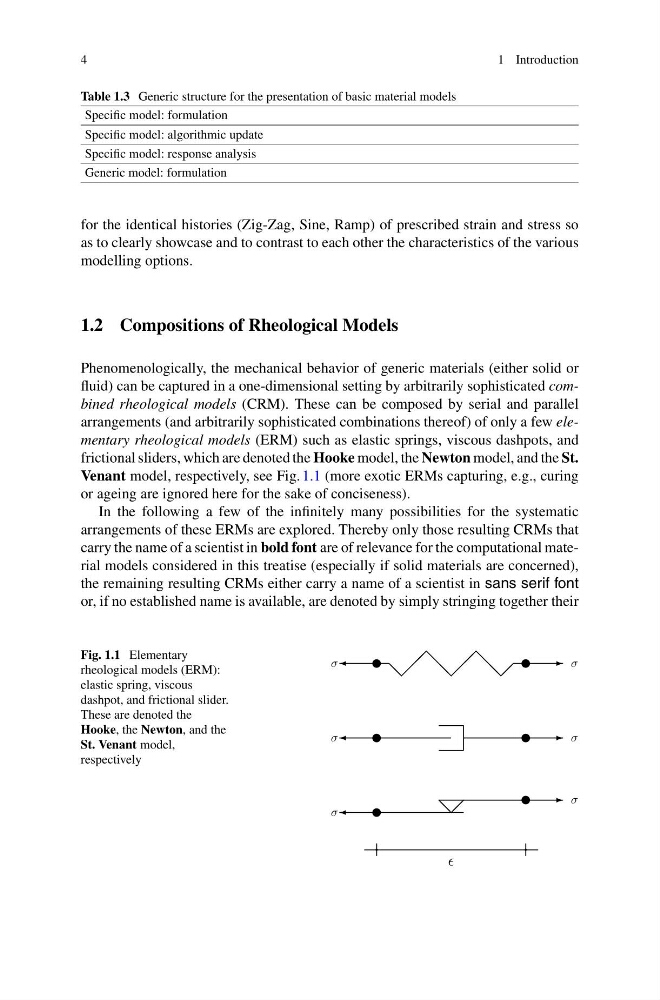
arrangements (and arbitrarily sophisticated combinations thereof) of only a few elementary rheological models (ERM) such as elastic springs, viscous dashpots, and
frictional sliders, which are denoted the Hooke model, the Newton model, and the St.
Venant model, respectively, see Fig. 1.1 (more exotic ERMs capturing, e.g., curing
or ageing are ignored here for the sake of conciseness).
In the following a few of the infinitely many possibilities for the systematic
arrangements of these ERMs are explored. Thereby only those resulting CRMs that
carry the name of a scientist in bold font are of relevance for the computational material models considered in this treatise (especially if solid materials are concerned),
the remaining resulting CRMs either carry a name of a scientist in sans serif font
or, if no established name is available, are denoted by simply stringing together their
Fig. 1.1 Elementary
rheological models (ERM):
elastic spring, viscous
dashpot, and frictional slider.
These are denoted the
Hooke, the Newton, and the
St. Venant model,
respectively
σ
σ
σ
σ
σ
σ
1 Introduction
Table 1.3 Generic structure for the presentation of basic material models
Specific model: formulation
Specific model: algorithmic update
Specific model: response analysis
Generic model: formulation
for the identical histories (Zig-Zag, Sine, Ramp) of prescribed strain and stress so
as to clearly showcase and to contrast to each other the characteristics of the various
modelling options.
1.2 Compositions of Rheological Models
Phenomenologically, the mechanical behavior of generic materials (either solid or
fluid) can be captured in a one-dimensional setting by arbitrarily sophisticated combined rheological models (CRM). These can be composed by serial and parallel
arrangements (and arbitrarily sophisticated combinations thereof) of only a few elementary rheological models (ERM) such as elastic springs, viscous dashpots, and
frictional sliders, which are denoted the Hooke model, the Newton model, and the St.
Venant model, respectively, see Fig. 1.1 (more exotic ERMs capturing, e.g., curing
or ageing are ignored here for the sake of conciseness).
In the following a few of the infinitely many possibilities for the systematic
arrangements of these ERMs are explored. Thereby only those resulting CRMs that
carry the name of a scientist in bold font are of relevance for the computational material models considered in this treatise (especially if solid materials are concerned),
the remaining resulting CRMs either carry a name of a scientist in sans serif font
or, if no established name is available, are denoted by simply stringing together their
Fig. 1.1 Elementary
rheological models (ERM):
elastic spring, viscous
dashpot, and frictional slider.
These are denoted the
Hooke, the Newton, and the
St. Venant model,
respectively
σ
σ
σ
σ
σ
σ