

1.1 Motivation
3
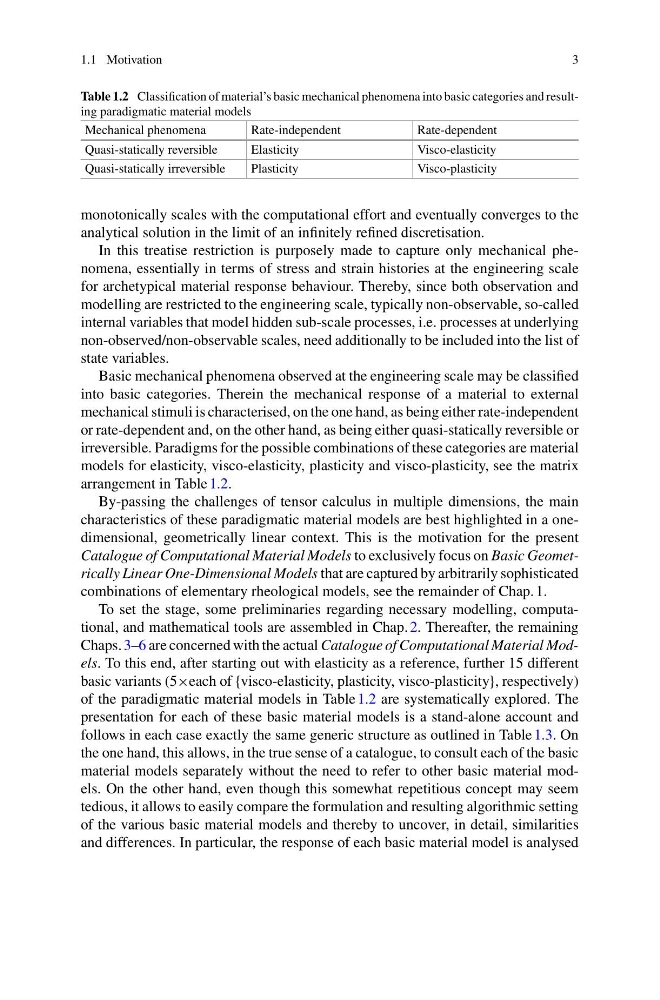
Table 1.2 Classification of material’s basic mechanical phenomena into basic categories and resulting paradigmatic material models
Mechanical phenomena
Rate-independent
Rate-dependent
Quasi-statically reversible
Elasticity
Visco-elasticity
Quasi-statically irreversible
Plasticity
Visco-plasticity
monotonically scales with the computational effort and eventually converges to the
analytical solution in the limit of an infinitely refined discretisation.
In this treatise restriction is purposely made to capture only mechanical phenomena, essentially in terms of stress and strain histories at the engineering scale
for archetypical material response behaviour. Thereby, since both observation and
modelling are restricted to the engineering scale, typically non-observable, so-called
internal variables that model hidden sub-scale processes, i.e. processes at underlying
non-observed/non-observable scales, need additionally to be included into the list of
state variables.
Basic mechanical phenomena observed at the engineering scale may be classified
into basic categories. Therein the mechanical response of a material to external
mechanical stimuli is characterised, on the one hand, as being either rate-independent
or rate-dependent and, on the other hand, as being either quasi-statically reversible or
irreversible. Paradigms for the possible combinations of these categories are material
models for elasticity, visco-elasticity, plasticity and visco-plasticity, see the matrix
arrangement in Table 1.2.
By-passing the challenges of tensor calculus in multiple dimensions, the main
characteristics of these paradigmatic material models are best highlighted in a onedimensional, geometrically linear context. This is the motivation for the present
Catalogue of Computational Material Models to exclusively focus on Basic Geometrically Linear One-Dimensional Models that are captured by arbitrarily sophisticated
combinations of elementary rheological models, see the remainder of Chap. 1.
To set the stage, some preliminaries regarding necessary modelling, computational, and mathematical tools are assembled in Chap. 2. Thereafter, the remaining
Chaps. 3–6 are concerned with the actual Catalogue of Computational Material Models. To this end, after starting out with elasticity as a reference, further 15 different
basic variants (5×each of {visco-elasticity, plasticity, visco-plasticity}, respectively)
of the paradigmatic material models in Table 1.2 are systematically explored. The
presentation for each of these basic material models is a stand-alone account and
follows in each case exactly the same generic structure as outlined in Table 1.3. On
the one hand, this allows, in the true sense of a catalogue, to consult each of the basic
material models separately without the need to refer to other basic material models. On the other hand, even though this somewhat repetitious concept may seem
tedious, it allows to easily compare the formulation and resulting algorithmic setting
of the various basic material models and thereby to uncover, in detail, similarities
and differences. In particular, the response of each basic material model is analysed
3
Table 1.2 Classification of material’s basic mechanical phenomena into basic categories and resulting paradigmatic material models
Mechanical phenomena
Rate-independent
Rate-dependent
Quasi-statically reversible
Elasticity
Visco-elasticity
Quasi-statically irreversible
Plasticity
Visco-plasticity
monotonically scales with the computational effort and eventually converges to the
analytical solution in the limit of an infinitely refined discretisation.
In this treatise restriction is purposely made to capture only mechanical phenomena, essentially in terms of stress and strain histories at the engineering scale
for archetypical material response behaviour. Thereby, since both observation and
modelling are restricted to the engineering scale, typically non-observable, so-called
internal variables that model hidden sub-scale processes, i.e. processes at underlying
non-observed/non-observable scales, need additionally to be included into the list of
state variables.
Basic mechanical phenomena observed at the engineering scale may be classified
into basic categories. Therein the mechanical response of a material to external
mechanical stimuli is characterised, on the one hand, as being either rate-independent
or rate-dependent and, on the other hand, as being either quasi-statically reversible or
irreversible. Paradigms for the possible combinations of these categories are material
models for elasticity, visco-elasticity, plasticity and visco-plasticity, see the matrix
arrangement in Table 1.2.
By-passing the challenges of tensor calculus in multiple dimensions, the main
characteristics of these paradigmatic material models are best highlighted in a onedimensional, geometrically linear context. This is the motivation for the present
Catalogue of Computational Material Models to exclusively focus on Basic Geometrically Linear One-Dimensional Models that are captured by arbitrarily sophisticated
combinations of elementary rheological models, see the remainder of Chap. 1.
To set the stage, some preliminaries regarding necessary modelling, computational, and mathematical tools are assembled in Chap. 2. Thereafter, the remaining
Chaps. 3–6 are concerned with the actual Catalogue of Computational Material Models. To this end, after starting out with elasticity as a reference, further 15 different
basic variants (5×each of {visco-elasticity, plasticity, visco-plasticity}, respectively)
of the paradigmatic material models in Table 1.2 are systematically explored. The
presentation for each of these basic material models is a stand-alone account and
follows in each case exactly the same generic structure as outlined in Table 1.3. On
the one hand, this allows, in the true sense of a catalogue, to consult each of the basic
material models separately without the need to refer to other basic material models. On the other hand, even though this somewhat repetitious concept may seem
tedious, it allows to easily compare the formulation and resulting algorithmic setting
of the various basic material models and thereby to uncover, in detail, similarities
and differences. In particular, the response of each basic material model is analysed