

2
1 Introduction
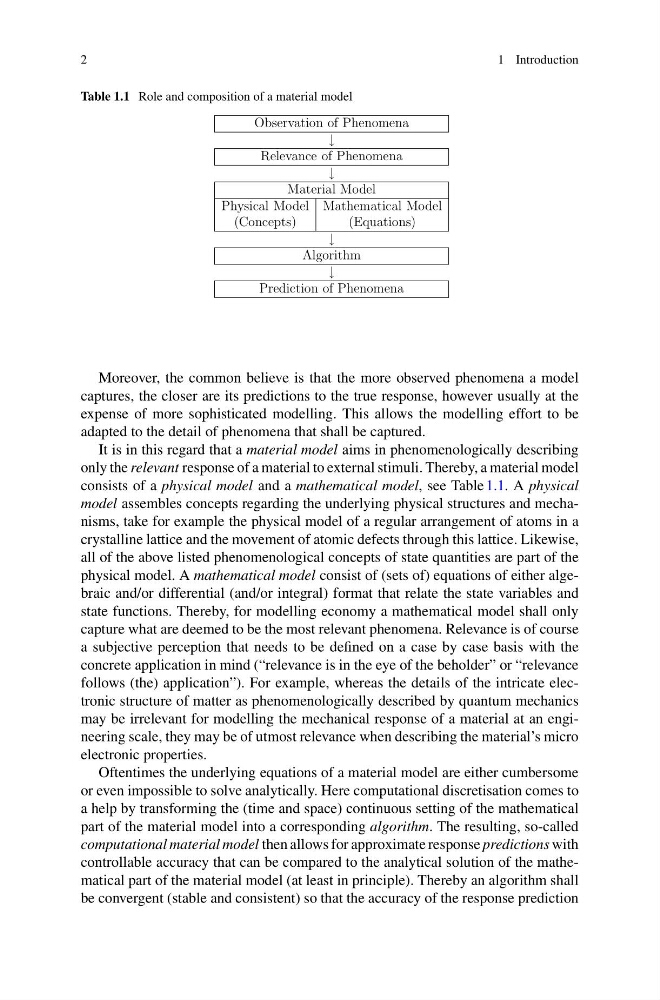
Table 1.1 Role and composition of a material model
Observation of Phenomena
↓
Relevance of Phenomena
↓
Material Model
Physical Model Mathematical Model
(Concepts)
(Equations)
↓
Algorithm
↓
Prediction of Phenomena
Moreover, the common believe is that the more observed phenomena a model
captures, the closer are its predictions to the true response, however usually at the
expense of more sophisticated modelling. This allows the modelling effort to be
adapted to the detail of phenomena that shall be captured.
It is in this regard that a material model aims in phenomenologically describing
only the relevant response of a material to external stimuli. Thereby, a material model
consists of a physical model and a mathematical model, see Table 1.1. A physical
model assembles concepts regarding the underlying physical structures and mechanisms, take for example the physical model of a regular arrangement of atoms in a
crystalline lattice and the movement of atomic defects through this lattice. Likewise,
all of the above listed phenomenological concepts of state quantities are part of the
physical model. A mathematical model consist of (sets of) equations of either algebraic and/or differential (and/or integral) format that relate the state variables and
state functions. Thereby, for modelling economy a mathematical model shall only
capture what are deemed to be the most relevant phenomena. Relevance is of course
a subjective perception that needs to be defined on a case by case basis with the
concrete application in mind (“relevance is in the eye of the beholder” or “relevance
follows (the) application”). For example, whereas the details of the intricate electronic structure of matter as phenomenologically described by quantum mechanics
may be irrelevant for modelling the mechanical response of a material at an engineering scale, they may be of utmost relevance when describing the material’s micro
electronic properties.
Oftentimes the underlying equations of a material model are either cumbersome
or even impossible to solve analytically. Here computational discretisation comes to
a help by transforming the (time and space) continuous setting of the mathematical
part of the material model into a corresponding algorithm. The resulting, so-called
computational material model then allows for approximate response predictions with
controllable accuracy that can be compared to the analytical solution of the mathematical part of the material model (at least in principle). Thereby an algorithm shall
be convergent (stable and consistent) so that the accuracy of the response prediction
1 Introduction
Table 1.1 Role and composition of a material model
Observation of Phenomena
↓
Relevance of Phenomena
↓
Material Model
Physical Model Mathematical Model
(Concepts)
(Equations)
↓
Algorithm
↓
Prediction of Phenomena
Moreover, the common believe is that the more observed phenomena a model
captures, the closer are its predictions to the true response, however usually at the
expense of more sophisticated modelling. This allows the modelling effort to be
adapted to the detail of phenomena that shall be captured.
It is in this regard that a material model aims in phenomenologically describing
only the relevant response of a material to external stimuli. Thereby, a material model
consists of a physical model and a mathematical model, see Table 1.1. A physical
model assembles concepts regarding the underlying physical structures and mechanisms, take for example the physical model of a regular arrangement of atoms in a
crystalline lattice and the movement of atomic defects through this lattice. Likewise,
all of the above listed phenomenological concepts of state quantities are part of the
physical model. A mathematical model consist of (sets of) equations of either algebraic and/or differential (and/or integral) format that relate the state variables and
state functions. Thereby, for modelling economy a mathematical model shall only
capture what are deemed to be the most relevant phenomena. Relevance is of course
a subjective perception that needs to be defined on a case by case basis with the
concrete application in mind (“relevance is in the eye of the beholder” or “relevance
follows (the) application”). For example, whereas the details of the intricate electronic structure of matter as phenomenologically described by quantum mechanics
may be irrelevant for modelling the mechanical response of a material at an engineering scale, they may be of utmost relevance when describing the material’s micro
electronic properties.
Oftentimes the underlying equations of a material model are either cumbersome
or even impossible to solve analytically. Here computational discretisation comes to
a help by transforming the (time and space) continuous setting of the mathematical
part of the material model into a corresponding algorithm. The resulting, so-called
computational material model then allows for approximate response predictions with
controllable accuracy that can be compared to the analytical solution of the mathematical part of the material model (at least in principle). Thereby an algorithm shall
be convergent (stable and consistent) so that the accuracy of the response prediction