

4.2 Kelvin Model
105
10
−3 10
−2 10
−1 10
0 10
1 10
2 10
3
10
0
10
1
10
2
10
3
10
4
10
5
ω
E a
E
τ = 10
2
, 10
1
, 10
0
, 10
−1
, 10
−2
√
1 + ω 2 τ 2
10
−3 10
−2 10
−1 10
0 10
1 10
2 10
3
10
−6
10
−3
10
0
10
3
10
6
ω
E
E
τ = 10
2
, 10
1
, 10
0
, 10
−1
, 10
−2
ωτ
10
−3 10
−2 10
−1 10
0 10
1 10
2 10
3
10
−5
10
−4
10
−3
10
−2
10
−1
10
0
ω
C a
C
τ = 10
2
, 10
1
, 10
0
, 10
−1
, 10
−2
1
√
1 + ω 2 τ 2
10
−3 10
−2 10
−1 10
0 10
1 10
2 10
3
10
−6
10
−3
10
0
10
3
10
6
ω
C
C
τ = 10
2
, 10
1
, 10
0
, 10
−1
, 10
−2
ωτ
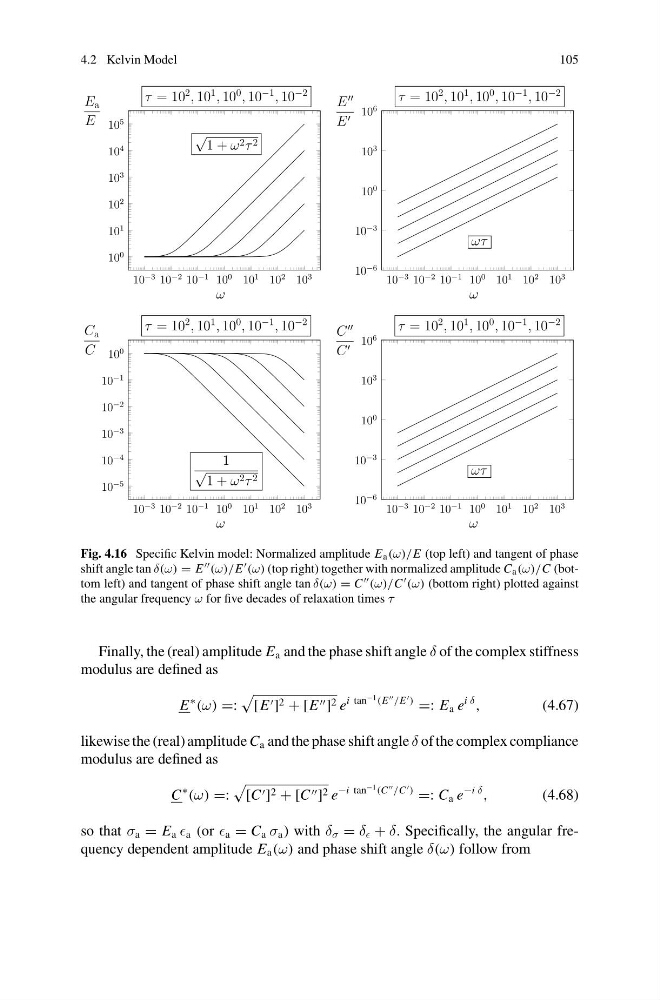
Fig. 4.16 Specific Kelvin model: Normalized amplitude E a (ω)/E (top left) and tangent of phase
shift angle tan δ(ω) = E (ω)/E (ω) (top right) together with normalized amplitude C a (ω)/C (bottom left) and tangent of phase shift angle tan δ(ω) = C (ω)/C (ω) (bottom right) plotted against
the angular frequency ω for five decades of relaxation times τ
Finally, the (real) amplitude E a and the phase shift angle δ of the complex stiffness
modulus are defined as
E
∗
(ω) =:
[E ] 2 + [E ] 2 e
i tan
−1 (E
/E
)
=: E a e
i δ
,
(4.67)
likewise the (real) amplitude C a and the phase shift angle δ of the complex compliance
modulus are defined as
C
∗
(ω) =:
[C ] 2 + [C ] 2 e
−i tan
−1 (C
/C
)
=: C a e
−i δ
,
(4.68)
so that σ a = E a a (or a = C a σ a ) with δ σ = δ + δ. Specifically, the angular frequency dependent amplitude E a (ω) and phase shift angle δ(ω) follow from
105
10
−3 10
−2 10
−1 10
0 10
1 10
2 10
3
10
0
10
1
10
2
10
3
10
4
10
5
ω
E a
E
τ = 10
2
, 10
1
, 10
0
, 10
−1
, 10
−2
√
1 + ω 2 τ 2
10
−3 10
−2 10
−1 10
0 10
1 10
2 10
3
10
−6
10
−3
10
0
10
3
10
6
ω
E
E
τ = 10
2
, 10
1
, 10
0
, 10
−1
, 10
−2
ωτ
10
−3 10
−2 10
−1 10
0 10
1 10
2 10
3
10
−5
10
−4
10
−3
10
−2
10
−1
10
0
ω
C a
C
τ = 10
2
, 10
1
, 10
0
, 10
−1
, 10
−2
1
√
1 + ω 2 τ 2
10
−3 10
−2 10
−1 10
0 10
1 10
2 10
3
10
−6
10
−3
10
0
10
3
10
6
ω
C
C
τ = 10
2
, 10
1
, 10
0
, 10
−1
, 10
−2
ωτ
Fig. 4.16 Specific Kelvin model: Normalized amplitude E a (ω)/E (top left) and tangent of phase
shift angle tan δ(ω) = E (ω)/E (ω) (top right) together with normalized amplitude C a (ω)/C (bottom left) and tangent of phase shift angle tan δ(ω) = C (ω)/C (ω) (bottom right) plotted against
the angular frequency ω for five decades of relaxation times τ
Finally, the (real) amplitude E a and the phase shift angle δ of the complex stiffness
modulus are defined as
E
∗
(ω) =:
[E ] 2 + [E ] 2 e
i tan
−1 (E
/E
)
=: E a e
i δ
,
(4.67)
likewise the (real) amplitude C a and the phase shift angle δ of the complex compliance
modulus are defined as
C
∗
(ω) =:
[C ] 2 + [C ] 2 e
−i tan
−1 (C
/C
)
=: C a e
−i δ
,
(4.68)
so that σ a = E a a (or a = C a σ a ) with δ σ = δ + δ. Specifically, the angular frequency dependent amplitude E a (ω) and phase shift angle δ(ω) follow from