

5.3 Dipole in a Ratchet Electrical Potential
71
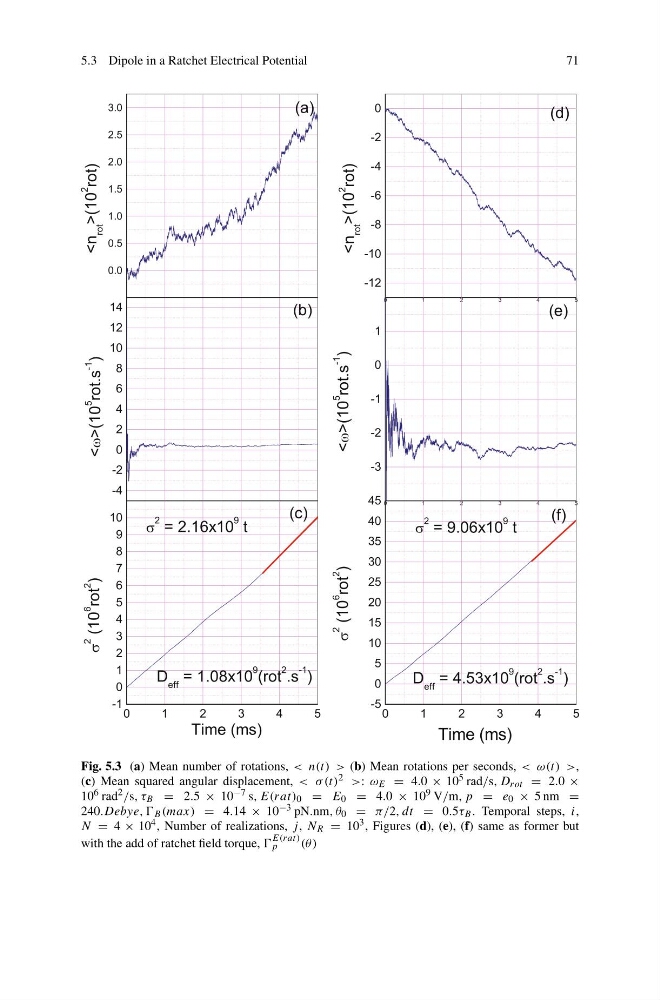
Fig. 5.3 (a) Mean number of rotations, < n(t) > (b) Mean rotations per seconds, < ω(t) >,
(c) Mean squared angular displacement, < σ (t) 2 >: ω E = 4.0 × 10 5 rad/s, D rot = 2.0 ×
10 6 rad
2 /s, τ B = 2.5 × 10 −7 s, E(rat) 0 = E 0 = 4.0 × 10 9 V/m, p = e 0 × 5 nm =
240.Debye, , B (max) = 4.14 × 10 −3 pN.nm, θ 0 = π/2, dt = 0.5τ B . Temporal steps, i,
N = 4 × 10 4 , Number of realizations, j , N R = 10 3 , Figures (d), (e), (f) same as former but
with the add of ratchet field torque,
E(rat)
p
(θ)
71
Fig. 5.3 (a) Mean number of rotations, < n(t) > (b) Mean rotations per seconds, < ω(t) >,
(c) Mean squared angular displacement, < σ (t) 2 >: ω E = 4.0 × 10 5 rad/s, D rot = 2.0 ×
10 6 rad
2 /s, τ B = 2.5 × 10 −7 s, E(rat) 0 = E 0 = 4.0 × 10 9 V/m, p = e 0 × 5 nm =
240.Debye, , B (max) = 4.14 × 10 −3 pN.nm, θ 0 = π/2, dt = 0.5τ B . Temporal steps, i,
N = 4 × 10 4 , Number of realizations, j , N R = 10 3 , Figures (d), (e), (f) same as former but
with the add of ratchet field torque,
E(rat)
p
(θ)