

J.1 Integral Algorithm for Colored Noise Simulation
193
b = random number,
(J.18)
h =
−
2D
τ
1 − E
2
ln(a)
1/2
cos(2πb),
(J.19)
+ t) = E + h
(J.20)
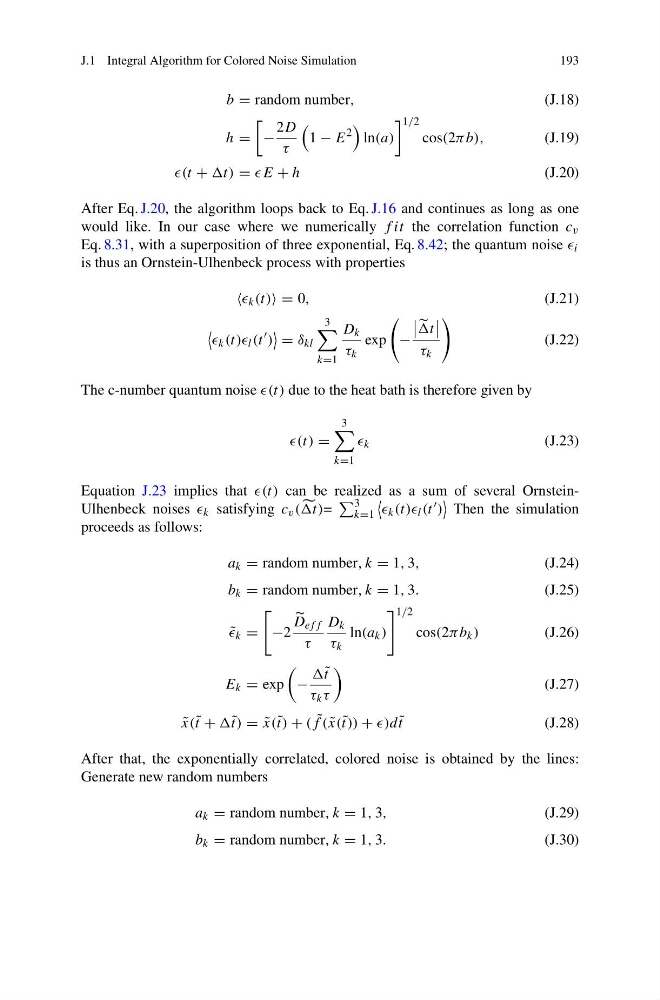
After Eq. J.20, the algorithm loops back to Eq. J.16 and continues as long as one
would like. In our case where we numerically f it the correlation function c v
Eq. 8.31, with a superposition of three exponential, Eq. 8.42; the quantum noise i
is thus an Ornstein-Ulhenbeck process with properties
k (t) = 0,
(J.21)
k (t)) l (t
)
= δ kl
3
k=1
D k
τ k
exp
−
t
τ k
(J.22)
The c-number quantum noise due to the heat bath is therefore given by
=
3
k=1
k
(J.23)
Equation J.23 implies that can be realized as a sum of several OrnsteinUlhenbeck noises k satisfying c v (
3
k=1
k (t)) l (t )
Then the simulation
proceeds as follows:
a k = random number, k = 1, 3,
(J.24)
b k = random number, k = 1, 3.
(J.25)
˜
k =
−2
D eff
τ
D k
τ k
ln(a k )
1/2
cos(2πb k )
(J.26)
E k = exp
−
˜ t
τ k τ
(J.27)
˜
x(˜ t + ˜ t) = ˜
x(˜ t) + ( ˜
f ( ˜
x(˜ t)) + )d ˜
t
(J.28)
After that, the exponentially correlated, colored noise is obtained by the lines:
Generate new random numbers
a k = random number, k = 1, 3,
(J.29)
b k = random number, k = 1, 3.
(J.30)
193
b = random number,
(J.18)
h =
−
2D
τ
1 − E
2
ln(a)
1/2
cos(2πb),
(J.19)
+ t) = E + h
(J.20)
After Eq. J.20, the algorithm loops back to Eq. J.16 and continues as long as one
would like. In our case where we numerically f it the correlation function c v
Eq. 8.31, with a superposition of three exponential, Eq. 8.42; the quantum noise i
is thus an Ornstein-Ulhenbeck process with properties
k (t) = 0,
(J.21)
k (t)) l (t
)
= δ kl
3
k=1
D k
τ k
exp
−
t
τ k
(J.22)
The c-number quantum noise due to the heat bath is therefore given by
=
3
k=1
k
(J.23)
Equation J.23 implies that can be realized as a sum of several OrnsteinUlhenbeck noises k satisfying c v (
3
k=1
k (t)) l (t )
Then the simulation
proceeds as follows:
a k = random number, k = 1, 3,
(J.24)
b k = random number, k = 1, 3.
(J.25)
˜
k =
−2
D eff
τ
D k
τ k
ln(a k )
1/2
cos(2πb k )
(J.26)
E k = exp
−
˜ t
τ k τ
(J.27)
˜
x(˜ t + ˜ t) = ˜
x(˜ t) + ( ˜
f ( ˜
x(˜ t)) + )d ˜
t
(J.28)
After that, the exponentially correlated, colored noise is obtained by the lines:
Generate new random numbers
a k = random number, k = 1, 3,
(J.29)
b k = random number, k = 1, 3.
(J.30)