

192
Appendix J
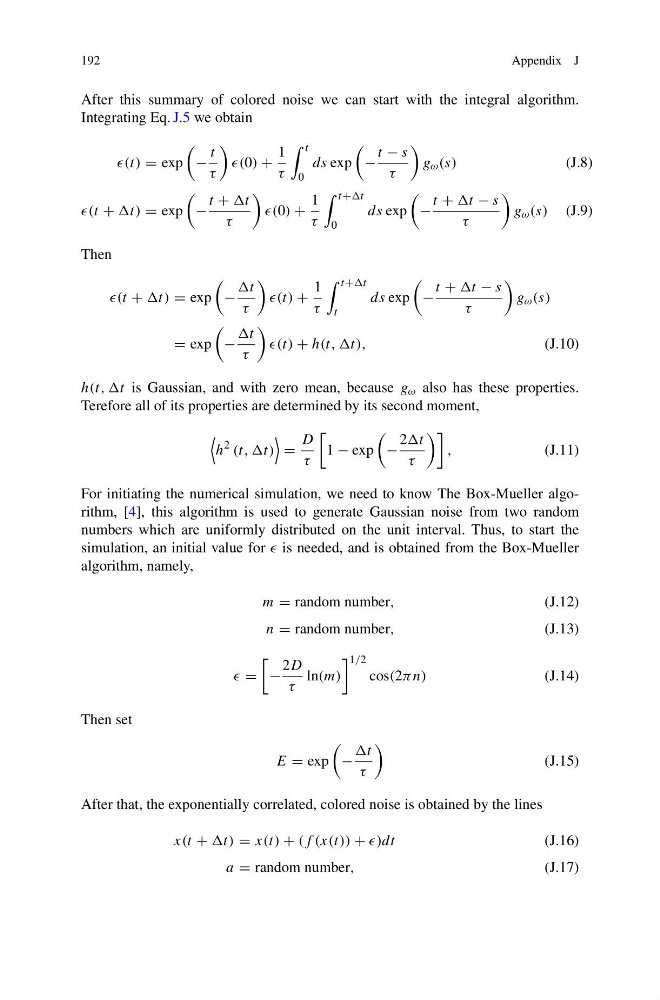
After this summary of colored noise we can start with the integral algorithm.
Integrating Eq. J.5 we obtain
= exp
−
t
τ
(0) +
1
τ
t
0
ds exp
−
t − s
τ
g ω (s)
(J.8)
(t + t) = exp
−
t + t
τ
(0) +
1
τ
t+t
0
ds exp
−
t + t − s
τ
g ω (s) (J.9)
Then
(t + t) = exp
−
t
τ
(t) +
1
τ
t+t
t
ds exp
−
t + t − s
τ
g ω (s)
= exp
−
t
τ
(t) + h(t, ,t),
(J.10)
h(t, ,t is Gaussian, and with zero mean, because g ω also has these properties.
Terefore all of its properties are determined by its second moment,
h
2 (t, ,t)
=
D
τ
1 − exp
−
2t
τ
,
(J.11)
For initiating the numerical simulation, we need to know The Box-Mueller algorithm, [4], this algorithm is used to generate Gaussian noise from two random
numbers which are uniformly distributed on the unit interval. Thus, to start the
simulation, an initial value for is needed, and is obtained from the Box-Mueller
algorithm, namely,
m = random number,
(J.12)
n = random number,
(J.13)
=
−
2D
τ
ln(m)
1/2
cos(2πn)
(J.14)
Then set
E = exp
−
t
τ
(J.15)
After that, the exponentially correlated, colored noise is obtained by the lines
x(t + = x(t) + (f (x(t)) +
(J.16)
a = random number,
(J.17)
Appendix J
After this summary of colored noise we can start with the integral algorithm.
Integrating Eq. J.5 we obtain
= exp
−
t
τ
(0) +
1
τ
t
0
ds exp
−
t − s
τ
g ω (s)
(J.8)
(t + t) = exp
−
t + t
τ
(0) +
1
τ
t+t
0
ds exp
−
t + t − s
τ
g ω (s) (J.9)
Then
(t + t) = exp
−
t
τ
(t) +
1
τ
t+t
t
ds exp
−
t + t − s
τ
g ω (s)
= exp
−
t
τ
(t) + h(t, ,t),
(J.10)
h(t, ,t is Gaussian, and with zero mean, because g ω also has these properties.
Terefore all of its properties are determined by its second moment,
h
2 (t, ,t)
=
D
τ
1 − exp
−
2t
τ
,
(J.11)
For initiating the numerical simulation, we need to know The Box-Mueller algorithm, [4], this algorithm is used to generate Gaussian noise from two random
numbers which are uniformly distributed on the unit interval. Thus, to start the
simulation, an initial value for is needed, and is obtained from the Box-Mueller
algorithm, namely,
m = random number,
(J.12)
n = random number,
(J.13)
=
−
2D
τ
ln(m)
1/2
cos(2πn)
(J.14)
Then set
E = exp
−
t
τ
(J.15)
After that, the exponentially correlated, colored noise is obtained by the lines
x(t + = x(t) + (f (x(t)) +
(J.16)
a = random number,
(J.17)