

8
1 Brownian Ratchets and Molecular Motors
1.4 Ratchet Coherency
Another quantity of central interest will be the effective diffusion coefficient
D eff ≡ lim
t→∞
x 2 (t)
− x (t)
2
2t
= lim
t→∞
σ 2
2t
(1.15)
The means are over the realizations of the stochastic process.
The competition between the drift v and diffusivity D eff in advection-diffusion
problems is often expressed by a dimensionless number, the Péclet number, P e,
[27],
P e =
|v| L
D eff
(1.16)
Here L is a typical length scale, in our case the length of a single ratchet element,
v is the average stationary velocity of the particle, in our case we used ||v cx |. The
larger the Péclet number, the more net drift predominates over diffusion.
1.5 First Passage Time
How long does it take a diffusing particle to travel from a starting point to a target?
This first-passage, or hitting time, (MPFT) [28] 1993, [29] 1967, is a fundamental
characteristic of diffusion and has a myriad of applications–to chemical kinetics
[29, 30], and neuronal dynamics [31–33] to name a few examples. If a diffusing
particle or protein is released at position x (0 ≤ x ≤ L) can diffuse either to
the right or to the left. After a time τ , it covers an average distance dx, so that
it is located at x = ±dx with equal probability 1/2. The MPFT to first reach an
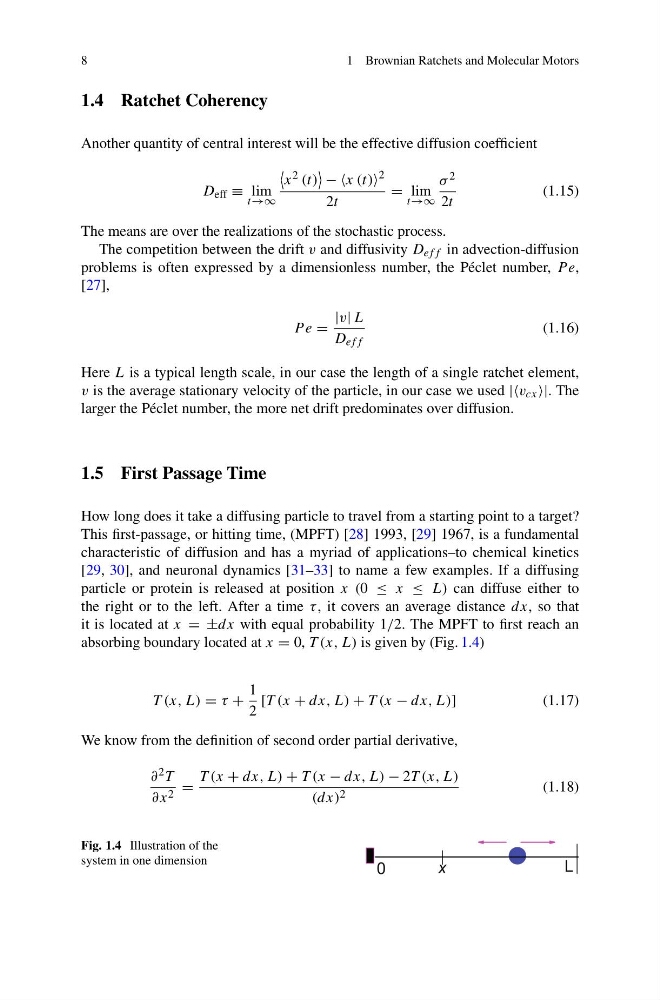
absorbing boundary located at x = 0, T (x, L) is given by (Fig. 1.4)
T (x, L) = τ +
1
2
[T (x + dx, L) + T (x − dx, L)]
(1.17)
We know from the definition of second order partial derivative,
∂ 2 T
∂x 2 =
T (x + dx, L) + T (x − dx, L) − 2T (x, L)
(dx) 2
(1.18)
Fig. 1.4 Illustration of the
system in one dimension
1 Brownian Ratchets and Molecular Motors
1.4 Ratchet Coherency
Another quantity of central interest will be the effective diffusion coefficient
D eff ≡ lim
t→∞
x 2 (t)
− x (t)
2
2t
= lim
t→∞
σ 2
2t
(1.15)
The means are over the realizations of the stochastic process.
The competition between the drift v and diffusivity D eff in advection-diffusion
problems is often expressed by a dimensionless number, the Péclet number, P e,
[27],
P e =
|v| L
D eff
(1.16)
Here L is a typical length scale, in our case the length of a single ratchet element,
v is the average stationary velocity of the particle, in our case we used ||v cx |. The
larger the Péclet number, the more net drift predominates over diffusion.
1.5 First Passage Time
How long does it take a diffusing particle to travel from a starting point to a target?
This first-passage, or hitting time, (MPFT) [28] 1993, [29] 1967, is a fundamental
characteristic of diffusion and has a myriad of applications–to chemical kinetics
[29, 30], and neuronal dynamics [31–33] to name a few examples. If a diffusing
particle or protein is released at position x (0 ≤ x ≤ L) can diffuse either to
the right or to the left. After a time τ , it covers an average distance dx, so that
it is located at x = ±dx with equal probability 1/2. The MPFT to first reach an
absorbing boundary located at x = 0, T (x, L) is given by (Fig. 1.4)
T (x, L) = τ +
1
2
[T (x + dx, L) + T (x − dx, L)]
(1.17)
We know from the definition of second order partial derivative,
∂ 2 T
∂x 2 =
T (x + dx, L) + T (x − dx, L) − 2T (x, L)
(dx) 2
(1.18)
Fig. 1.4 Illustration of the
system in one dimension