

1.3 Ratchet Efficiency
7
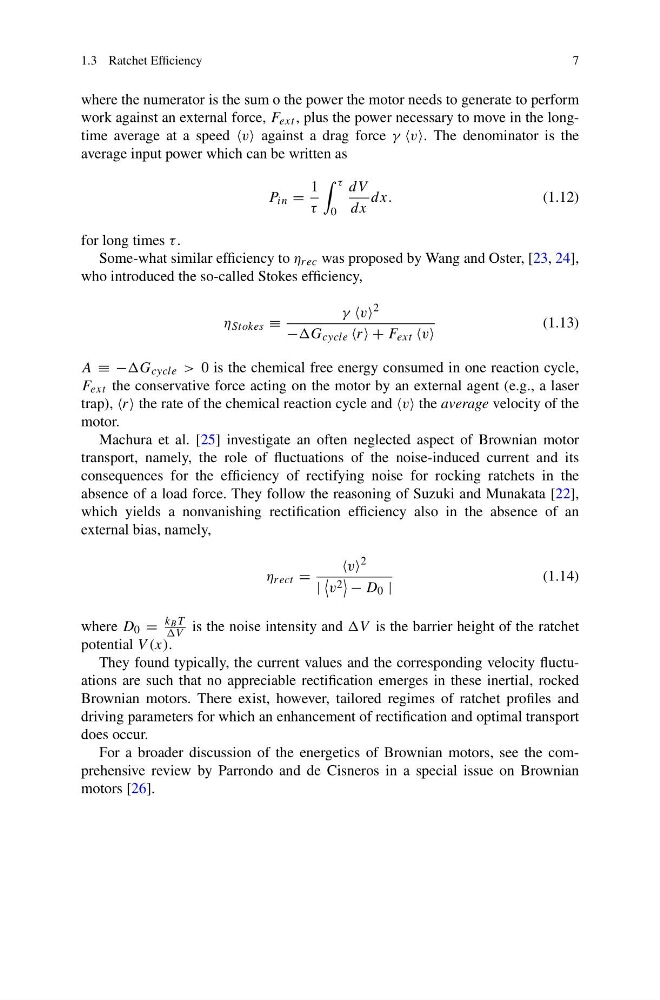
where the numerator is the sum o the power the motor needs to generate to perform
work against an external force, F ext , plus the power necessary to move in the longtime average at a speed v against a drag force γ v. The denominator is the
average input power which can be written as
P in =
1
τ
τ
0
dV
dx
dx.
(1.12)
for long times τ .
Some-what similar efficiency to η rec was proposed by Wang and Oster, [23, 24],
who introduced the so-called Stokes efficiency,
η Stokes ≡
γ v 2
−G cycle r + F ext v
(1.13)
A ≡ −G cycle > 0 is the chemical free energy consumed in one reaction cycle,
F ext the conservative force acting on the motor by an external agent (e.g., a laser
trap), r the rate of the chemical reaction cycle and v the average velocity of the
motor.
Machura et al. [25] investigate an often neglected aspect of Brownian motor
transport, namely, the role of fluctuations of the noise-induced current and its
consequences for the efficiency of rectifying noise for rocking ratchets in the
absence of a load force. They follow the reasoning of Suzuki and Munakata [22],
which yields a nonvanishing rectification efficiency also in the absence of an
external bias, namely,
η rect =
v 2
|
v 2
− D 0 |
(1.14)
where D 0 =
k B T
V is the noise intensity and V is the barrier height of the ratchet
potential V (x).
They found typically, the current values and the corresponding velocity fluctuations are such that no appreciable rectification emerges in these inertial, rocked
Brownian motors. There exist, however, tailored regimes of ratchet profiles and
driving parameters for which an enhancement of rectification and optimal transport
does occur.
For a broader discussion of the energetics of Brownian motors, see the comprehensive review by Parrondo and de Cisneros in a special issue on Brownian
motors [26].
7
where the numerator is the sum o the power the motor needs to generate to perform
work against an external force, F ext , plus the power necessary to move in the longtime average at a speed v against a drag force γ v. The denominator is the
average input power which can be written as
P in =
1
τ
τ
0
dV
dx
dx.
(1.12)
for long times τ .
Some-what similar efficiency to η rec was proposed by Wang and Oster, [23, 24],
who introduced the so-called Stokes efficiency,
η Stokes ≡
γ v 2
−G cycle r + F ext v
(1.13)
A ≡ −G cycle > 0 is the chemical free energy consumed in one reaction cycle,
F ext the conservative force acting on the motor by an external agent (e.g., a laser
trap), r the rate of the chemical reaction cycle and v the average velocity of the
motor.
Machura et al. [25] investigate an often neglected aspect of Brownian motor
transport, namely, the role of fluctuations of the noise-induced current and its
consequences for the efficiency of rectifying noise for rocking ratchets in the
absence of a load force. They follow the reasoning of Suzuki and Munakata [22],
which yields a nonvanishing rectification efficiency also in the absence of an
external bias, namely,
η rect =
v 2
|
v 2
− D 0 |
(1.14)
where D 0 =
k B T
V is the noise intensity and V is the barrier height of the ratchet
potential V (x).
They found typically, the current values and the corresponding velocity fluctuations are such that no appreciable rectification emerges in these inertial, rocked
Brownian motors. There exist, however, tailored regimes of ratchet profiles and
driving parameters for which an enhancement of rectification and optimal transport
does occur.
For a broader discussion of the energetics of Brownian motors, see the comprehensive review by Parrondo and de Cisneros in a special issue on Brownian
motors [26].