

6
1 Brownian Ratchets and Molecular Motors
of motors based on adiabatically changing potentials, named reversible ratchets,
exhibit a higher efficiency and the entropy production can be arbitrarily reduced.
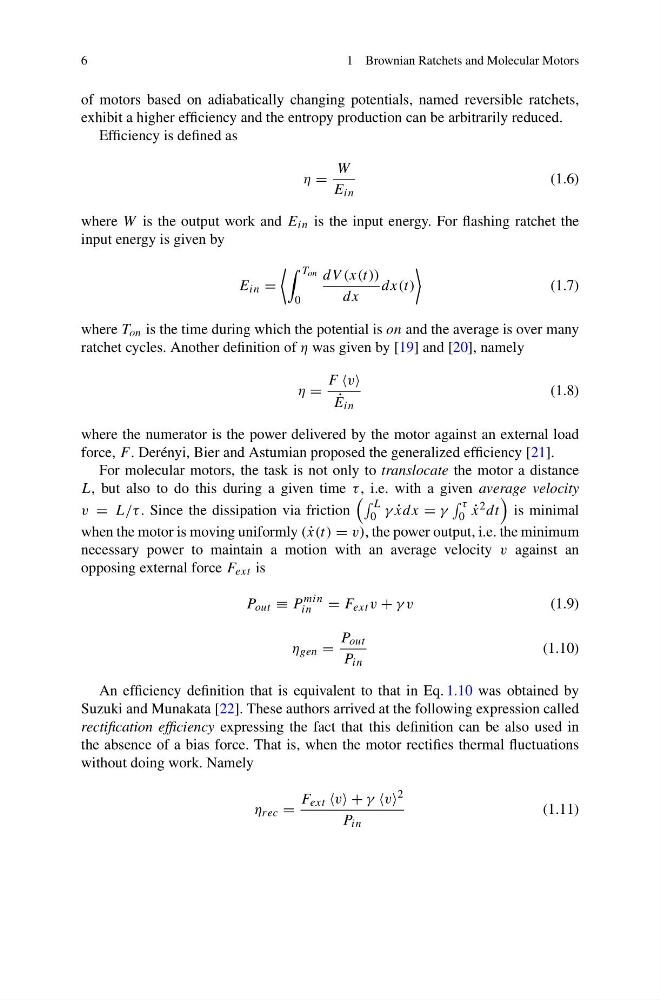
Efficiency is defined as
η =
W
E in
(1.6)
where W is the output work and E in is the input energy. For flashing ratchet the
input energy is given by
E in =
T on
0
dV (x(t))
dx
dx(t)
(1.7)
where T on is the time during which the potential is on and the average is over many
ratchet cycles. Another definition of η was given by [19] and [20], namely
η =
F v
˙
E in
(1.8)
where the numerator is the power delivered by the motor against an external load
force, F . Derényi, Bier and Astumian proposed the generalized efficiency [21].
For molecular motors, the task is not only to translocate the motor a distance
L, but also to do this during a given time τ , i.e. with a given average velocity
v = L/τ . Since the dissipation via friction
L
0 γ ˙
xdx = γ
τ
0 ˙
x 2 dt
is minimal
when the motor is moving uniformly ( ˙
x(t) = v), the power output, i.e. the minimum
necessary power to maintain a motion with an average velocity v against an
opposing external force F ext is
P out ≡ P
min
in = F ext v + γ v
(1.9)
η gen =
P out
P in
(1.10)
An efficiency definition that is equivalent to that in Eq. 1.10 was obtained by
Suzuki and Munakata [22]. These authors arrived at the following expression called
rectification efficiency expressing the fact that this definition can be also used in
the absence of a bias force. That is, when the motor rectifies thermal fluctuations
without doing work. Namely
η rec =
F ext v + γ v 2
P in
(1.11)
1 Brownian Ratchets and Molecular Motors
of motors based on adiabatically changing potentials, named reversible ratchets,
exhibit a higher efficiency and the entropy production can be arbitrarily reduced.
Efficiency is defined as
η =
W
E in
(1.6)
where W is the output work and E in is the input energy. For flashing ratchet the
input energy is given by
E in =
T on
0
dV (x(t))
dx
dx(t)
(1.7)
where T on is the time during which the potential is on and the average is over many
ratchet cycles. Another definition of η was given by [19] and [20], namely
η =
F v
˙
E in
(1.8)
where the numerator is the power delivered by the motor against an external load
force, F . Derényi, Bier and Astumian proposed the generalized efficiency [21].
For molecular motors, the task is not only to translocate the motor a distance
L, but also to do this during a given time τ , i.e. with a given average velocity
v = L/τ . Since the dissipation via friction
L
0 γ ˙
xdx = γ
τ
0 ˙
x 2 dt
is minimal
when the motor is moving uniformly ( ˙
x(t) = v), the power output, i.e. the minimum
necessary power to maintain a motion with an average velocity v against an
opposing external force F ext is
P out ≡ P
min
in = F ext v + γ v
(1.9)
η gen =
P out
P in
(1.10)
An efficiency definition that is equivalent to that in Eq. 1.10 was obtained by
Suzuki and Munakata [22]. These authors arrived at the following expression called
rectification efficiency expressing the fact that this definition can be also used in
the absence of a bias force. That is, when the motor rectifies thermal fluctuations
without doing work. Namely
η rec =
F ext v + γ v 2
P in
(1.11)