

1.5 First Passage Time
9
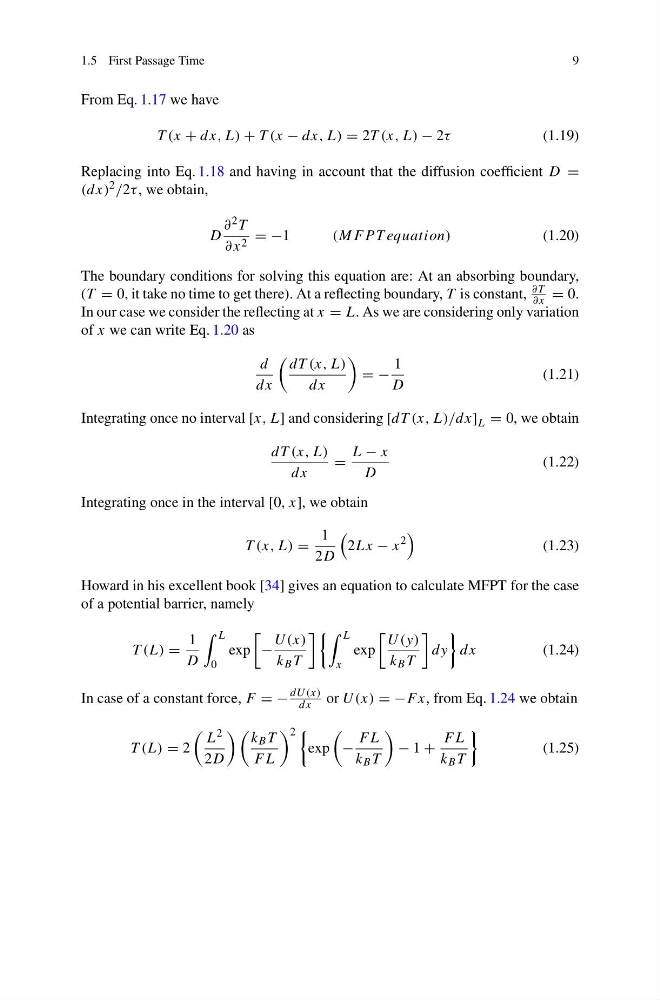
From Eq. 1.17 we have
T (x + dx, L) + T (x − dx, L) = 2T (x, L) − 2τ
(1.19)
Replacing into Eq. 1.18 and having in account that the diffusion coefficient D =
(dx) 2 /2τ , we obtain,
D
∂ 2 T
∂x 2 = −1
(MF P T equation)
(1.20)
The boundary conditions for solving this equation are: At an absorbing boundary,
(T = 0, it take no time to get there). At a reflecting boundary, T is constant,
∂T
∂x = 0.
In our case we consider the reflecting at x = L. As we are considering only variation
of x we can write Eq. 1.20 as
d
dx
dT (x, L)
dx
= −
1
D
(1.21)
Integrating once no interval [x, L] and considering [dT (x, L)/dx] L = 0, we obtain
dT (x, L)
dx
=
L − x
D
(1.22)
Integrating once in the interval [0, x], we obtain
T (x, L) =
1
2D
2Lx − x
2
(1.23)
Howard in his excellent book [34] gives an equation to calculate MFPT for the case
of a potential barrier, namely
T (L) =
1
D
L
0
exp
−
U(x)
k B T
L
x
exp
U(y)
k B T
dy
dx
(1.24)
In case of a constant force, F = −
dU (x)
dx or U(x) = −F x, from Eq. 1.24 we obtain
T (L) = 2
L 2
2D
k B T
F L
2
exp
−
F L
k B T
− 1 +
F L
k B T
(1.25)
9
From Eq. 1.17 we have
T (x + dx, L) + T (x − dx, L) = 2T (x, L) − 2τ
(1.19)
Replacing into Eq. 1.18 and having in account that the diffusion coefficient D =
(dx) 2 /2τ , we obtain,
D
∂ 2 T
∂x 2 = −1
(MF P T equation)
(1.20)
The boundary conditions for solving this equation are: At an absorbing boundary,
(T = 0, it take no time to get there). At a reflecting boundary, T is constant,
∂T
∂x = 0.
In our case we consider the reflecting at x = L. As we are considering only variation
of x we can write Eq. 1.20 as
d
dx
dT (x, L)
dx
= −
1
D
(1.21)
Integrating once no interval [x, L] and considering [dT (x, L)/dx] L = 0, we obtain
dT (x, L)
dx
=
L − x
D
(1.22)
Integrating once in the interval [0, x], we obtain
T (x, L) =
1
2D
2Lx − x
2
(1.23)
Howard in his excellent book [34] gives an equation to calculate MFPT for the case
of a potential barrier, namely
T (L) =
1
D
L
0
exp
−
U(x)
k B T
L
x
exp
U(y)
k B T
dy
dx
(1.24)
In case of a constant force, F = −
dU (x)
dx or U(x) = −F x, from Eq. 1.24 we obtain
T (L) = 2
L 2
2D
k B T
F L
2
exp
−
F L
k B T
− 1 +
F L
k B T
(1.25)