

162
Appendix D
The probability to hit the origin at any time, is obtained integrating the former
Eq. D.3, namely
J =
∞
0
j (t)dt = 1
( D . 4 )
And the mean return time will be
t =
∞
0 tj (t)dt
∞
0 j (t)dt
= ∞
(D.5)
The Eq. D.4 means that the return is certain and the Eq. D.5 means that the return
time is infinity. This is an intriguing property of diffusion in spatial dimensions d 2 is
that a diffusing particle is certain to reach any finite-size target, but the average time
for this event is infinite. This property of eventually reaching any target is known as
recurrence, [3].
D.1.2 Application to Chemical Kinetics
This topic is based on a Lecture proffered by Sidney Redner in YouTube [4]
We ask the question: How efficiently diffusion reactants actually undergo
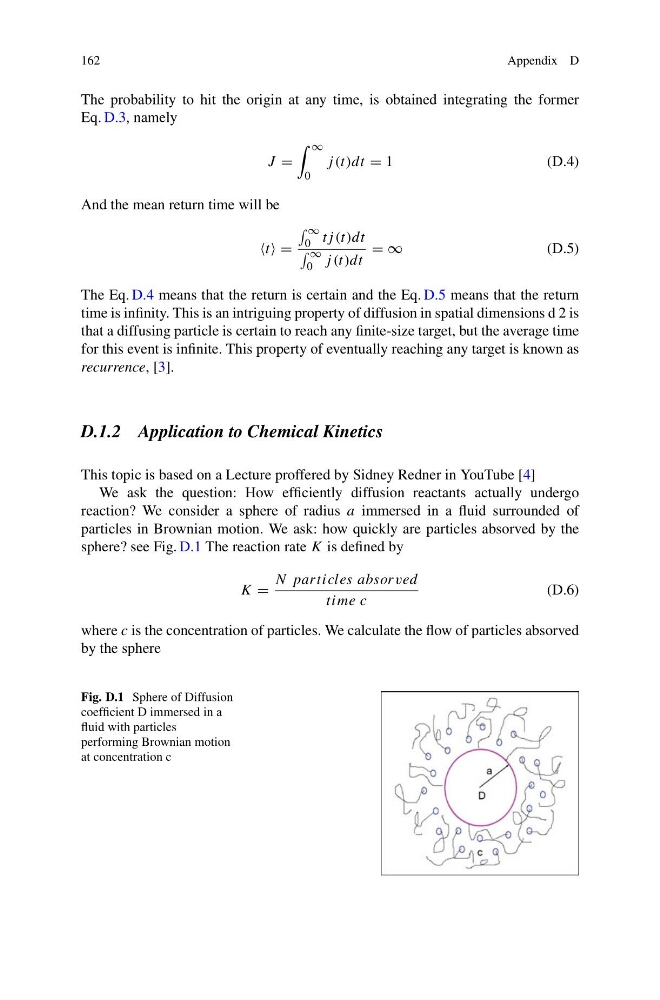
reaction? We consider a sphere of radius a immersed in a fluid surrounded of
particles in Brownian motion. We ask: how quickly are particles absorved by the
sphere? see Fig. D.1 The reaction rate K is defined by
K =
N particles absorved
time c
(D.6)
where c is the concentration of particles. We calculate the flow of particles absorved
by the sphere
Fig. D.1 Sphere of Diffusion
coefficient D immersed in a
fluid with particles
performing Brownian motion
at concentration c
Appendix D
The probability to hit the origin at any time, is obtained integrating the former
Eq. D.3, namely
J =
∞
0
j (t)dt = 1
( D . 4 )
And the mean return time will be
t =
∞
0 tj (t)dt
∞
0 j (t)dt
= ∞
(D.5)
The Eq. D.4 means that the return is certain and the Eq. D.5 means that the return
time is infinity. This is an intriguing property of diffusion in spatial dimensions d 2 is
that a diffusing particle is certain to reach any finite-size target, but the average time
for this event is infinite. This property of eventually reaching any target is known as
recurrence, [3].
D.1.2 Application to Chemical Kinetics
This topic is based on a Lecture proffered by Sidney Redner in YouTube [4]
We ask the question: How efficiently diffusion reactants actually undergo
reaction? We consider a sphere of radius a immersed in a fluid surrounded of
particles in Brownian motion. We ask: how quickly are particles absorved by the
sphere? see Fig. D.1 The reaction rate K is defined by
K =
N particles absorved
time c
(D.6)
where c is the concentration of particles. We calculate the flow of particles absorved
by the sphere
Fig. D.1 Sphere of Diffusion
coefficient D immersed in a
fluid with particles
performing Brownian motion
at concentration c