

Appendix D
D.1 First Passage Phenomena
D.1.1 Properties of First Passage Time
This topic is based on a Lecture proffered by Sidney Redner in YouTube [1]
We ask the following questions:
(1) What is the probability of eventually hitting the origin starting at x?
(2) What is the time to hit the origin.?
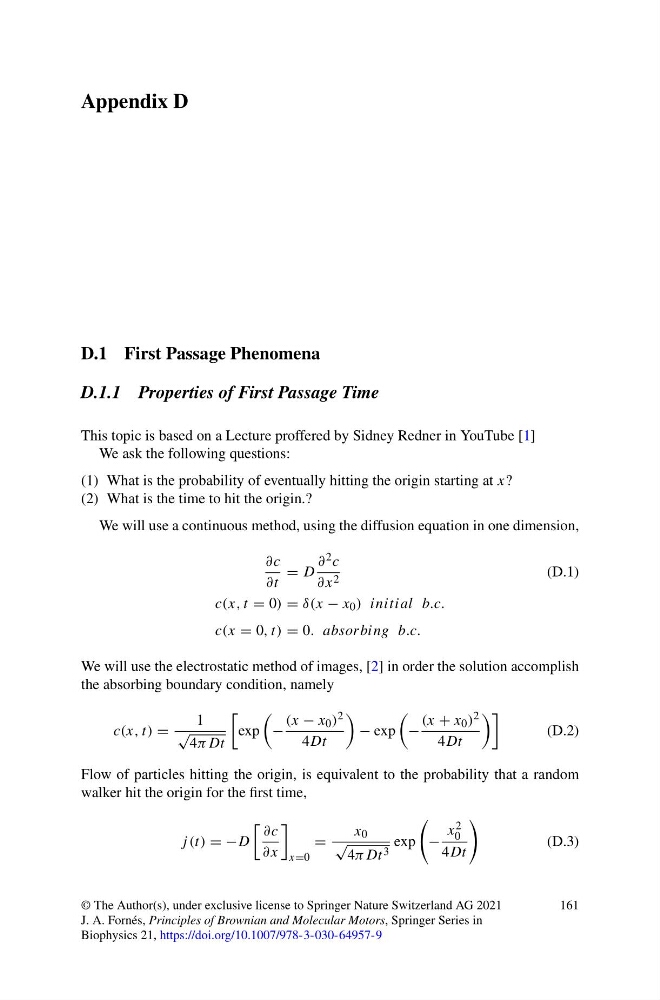
We will use a continuous method, using the diffusion equation in one dimension,
∂c
∂t
= D
∂ 2 c
∂x 2
(D.1)
c(x, t = 0) = δ(x − x 0 ) initial b.c.
c(x = 0, t) = 0. absorbing b.c.
We will use the electrostatic method of images, [2] in order the solution accomplish
the absorbing boundary condition, namely
c(x, t) =
1
√
4πDt
exp
−
(x − x 0 ) 2
4Dt
− exp
−
(x + x 0 ) 2
4Dt
(D.2)
Flow of particles hitting the origin, is equivalent to the probability that a random
walker hit the origin for the first time,
j (t) = −D
∂c
∂x
x=0
=
x 0
√
4πDt 3
exp
−
x 2
0
4Dt
(D.3)
© The Author(s), under exclusive license to Springer Nature Switzerland AG 2021
J. A. Fornés, Principles of Brownian and Molecular Motors, Springer Series in
Biophysics 21, https://doi.org/10.1007/978-3-030-64957-9
161
D.1 First Passage Phenomena
D.1.1 Properties of First Passage Time
This topic is based on a Lecture proffered by Sidney Redner in YouTube [1]
We ask the following questions:
(1) What is the probability of eventually hitting the origin starting at x?
(2) What is the time to hit the origin.?
We will use a continuous method, using the diffusion equation in one dimension,
∂c
∂t
= D
∂ 2 c
∂x 2
(D.1)
c(x, t = 0) = δ(x − x 0 ) initial b.c.
c(x = 0, t) = 0. absorbing b.c.
We will use the electrostatic method of images, [2] in order the solution accomplish
the absorbing boundary condition, namely
c(x, t) =
1
√
4πDt
exp
−
(x − x 0 ) 2
4Dt
− exp
−
(x + x 0 ) 2
4Dt
(D.2)
Flow of particles hitting the origin, is equivalent to the probability that a random
walker hit the origin for the first time,
j (t) = −D
∂c
∂x
x=0
=
x 0
√
4πDt 3
exp
−
x 2
0
4Dt
(D.3)
© The Author(s), under exclusive license to Springer Nature Switzerland AG 2021
J. A. Fornés, Principles of Brownian and Molecular Motors, Springer Series in
Biophysics 21, https://doi.org/10.1007/978-3-030-64957-9
161