

Bibliography
163
∂c
∂t
= D∇
2 c
(D.7)
c(r > a, t = 0) = 1
( D . 8 )
c(r = a, t > 0) = 0
( D . 9 )
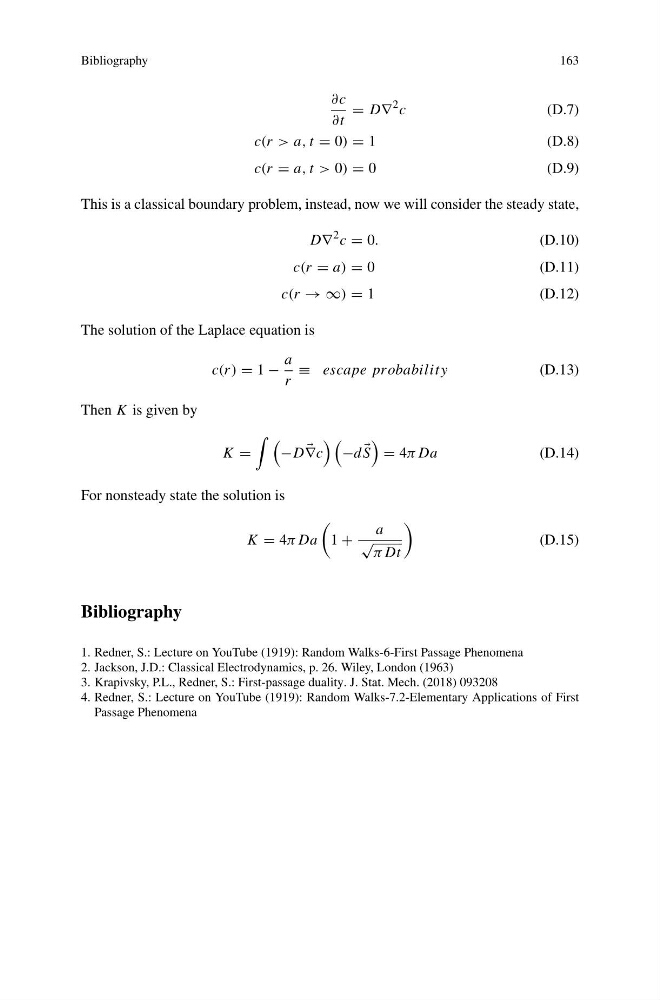
This is a classical boundary problem, instead, now we will consider the steady state,
D∇
2 c = 0.
(D.10)
c(r = a) = 0
(D.11)
c(r → ∞) = 1
(D.12)
The solution of the Laplace equation is
c(r) = 1 −
a
r
≡ escape probability
(D.13)
Then K is given by
K =
−D
∇c
−d
S
= 4πDa
(D.14)
For nonsteady state the solution is
K = 4πDa
1 +
a
√
πDt
(D.15)
Bibliography
1. Redner, S.: Lecture on YouTube (1919): Random Walks-6-First Passage Phenomena
2. Jackson, J.D.: Classical Electrodynamics, p. 26. Wiley, London (1963)
3. Krapivsky, P.L., Redner, S.: First-passage duality. J. Stat. Mech. (2018) 093208
4. Redner, S.: Lecture on YouTube (1919): Random Walks-7.2-Elementary Applications of First
Passage Phenomena
163
∂c
∂t
= D∇
2 c
(D.7)
c(r > a, t = 0) = 1
( D . 8 )
c(r = a, t > 0) = 0
( D . 9 )
This is a classical boundary problem, instead, now we will consider the steady state,
D∇
2 c = 0.
(D.10)
c(r = a) = 0
(D.11)
c(r → ∞) = 1
(D.12)
The solution of the Laplace equation is
c(r) = 1 −
a
r
≡ escape probability
(D.13)
Then K is given by
K =
−D
∇c
−d
S
= 4πDa
(D.14)
For nonsteady state the solution is
K = 4πDa
1 +
a
√
πDt
(D.15)
Bibliography
1. Redner, S.: Lecture on YouTube (1919): Random Walks-6-First Passage Phenomena
2. Jackson, J.D.: Classical Electrodynamics, p. 26. Wiley, London (1963)
3. Krapivsky, P.L., Redner, S.: First-passage duality. J. Stat. Mech. (2018) 093208
4. Redner, S.: Lecture on YouTube (1919): Random Walks-7.2-Elementary Applications of First
Passage Phenomena