

B.1 Information Flow
155
where c a is the concentration in moles/m 3 , N A is the Avogadro number, ν a is the
number of ions of type a in one molecule of the electrolyte, z a is its corresponding
valence, m is the dielectric constant of the medium, e is the elementary charge
(esu), T the absolute temperature and k is the Boltzmann constant, R is the gas
constant and M a is the atomic weight of the ion a, and τ 0 is the initial relaxation
time of the fluctuation, D a is the diffusion coefficient, and = δc a /c a is the
relative amplitude of the fluctuation. For a symmetrical monovalent electrolite of
concentration c, Eq. B.3 transforms in:
K a = 1 −
e 3 (N A π) 1/2
(2 m kT ) 3/2 c
−1/2
(B.4)
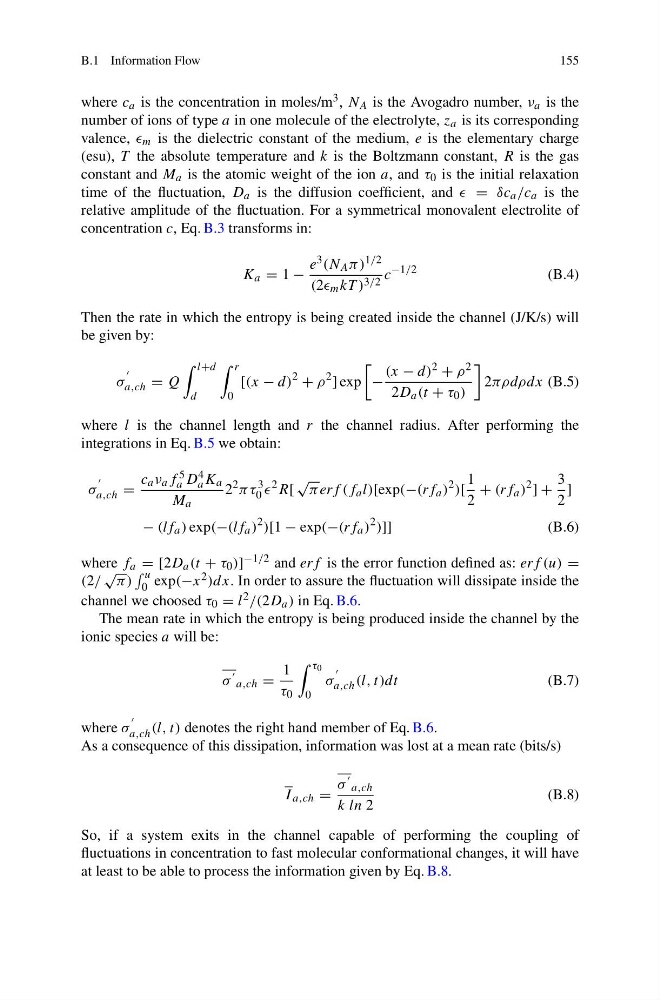
Then the rate in which the entropy is being created inside the channel (J/K/s) will
be given by:
σ
a,ch = Q
l+d
d
r
0
[(x − d)
2
+ ρ
2
] exp
−
(x − d) 2 + ρ 2
2D a (t + τ 0 )
2πρdρdx (B.5)
where l is the channel length and r the channel radius. After performing the
integrations in Eq. B.5 we obtain:
σ
a,ch =
c a ν a f 5
a D 4
a K a
M a
2
2 πτ
3
0
2 R[
√
πerf (f a l)[exp(−(rf a )
2 )[
1
2
+ (rf a )
2
] +
3
2
]
− (lf a ) exp(−(lf a )
2 )[1 − exp(−(rf a )
2 )]]
(B.6)
where f a = [2D a (t + τ 0 )] −1/2 and erf is the error function defined as: erf (u) =
(2/
√
π)
u
0 exp(−x 2 )dx. In order to assure the fluctuation will dissipate inside the
channel we choosed τ 0 = l 2 /(2D a ) in Eq. B.6.
The mean rate in which the entropy is being produced inside the channel by the
ionic species a will be:
σ
a,ch =
1
τ 0
τ 0
0
σ
a,ch (l, t)dt
(B.7)
where σ
a,ch (l, t) denotes the right hand member of Eq. B.6.
As a consequence of this dissipation, information was lost at a mean rate (bits/s)
I a,ch =
σ
a,ch
k ln 2
(B.8)
So, if a system exits in the channel capable of performing the coupling of
fluctuations in concentration to fast molecular conformational changes, it will have
at least to be able to process the information given by Eq. B.8.
155
where c a is the concentration in moles/m 3 , N A is the Avogadro number, ν a is the
number of ions of type a in one molecule of the electrolyte, z a is its corresponding
valence, m is the dielectric constant of the medium, e is the elementary charge
(esu), T the absolute temperature and k is the Boltzmann constant, R is the gas
constant and M a is the atomic weight of the ion a, and τ 0 is the initial relaxation
time of the fluctuation, D a is the diffusion coefficient, and = δc a /c a is the
relative amplitude of the fluctuation. For a symmetrical monovalent electrolite of
concentration c, Eq. B.3 transforms in:
K a = 1 −
e 3 (N A π) 1/2
(2 m kT ) 3/2 c
−1/2
(B.4)
Then the rate in which the entropy is being created inside the channel (J/K/s) will
be given by:
σ
a,ch = Q
l+d
d
r
0
[(x − d)
2
+ ρ
2
] exp
−
(x − d) 2 + ρ 2
2D a (t + τ 0 )
2πρdρdx (B.5)
where l is the channel length and r the channel radius. After performing the
integrations in Eq. B.5 we obtain:
σ
a,ch =
c a ν a f 5
a D 4
a K a
M a
2
2 πτ
3
0
2 R[
√
πerf (f a l)[exp(−(rf a )
2 )[
1
2
+ (rf a )
2
] +
3
2
]
− (lf a ) exp(−(lf a )
2 )[1 − exp(−(rf a )
2 )]]
(B.6)
where f a = [2D a (t + τ 0 )] −1/2 and erf is the error function defined as: erf (u) =
(2/
√
π)
u
0 exp(−x 2 )dx. In order to assure the fluctuation will dissipate inside the
channel we choosed τ 0 = l 2 /(2D a ) in Eq. B.6.
The mean rate in which the entropy is being produced inside the channel by the
ionic species a will be:
σ
a,ch =
1
τ 0
τ 0
0
σ
a,ch (l, t)dt
(B.7)
where σ
a,ch (l, t) denotes the right hand member of Eq. B.6.
As a consequence of this dissipation, information was lost at a mean rate (bits/s)
I a,ch =
σ
a,ch
k ln 2
(B.8)
So, if a system exits in the channel capable of performing the coupling of
fluctuations in concentration to fast molecular conformational changes, it will have
at least to be able to process the information given by Eq. B.8.