

126
8 Quantum Ratchets
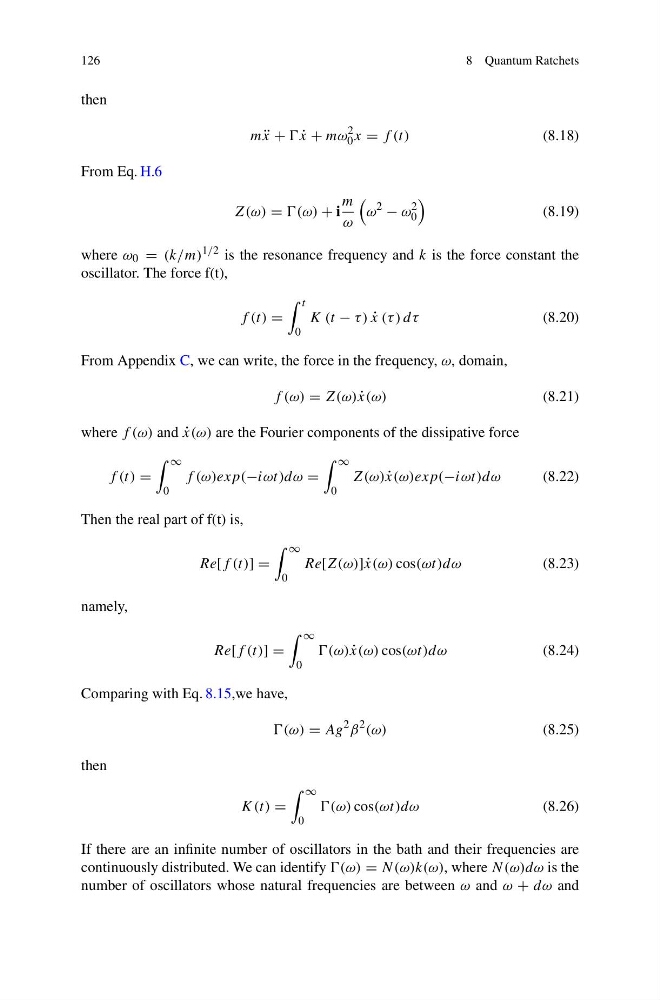
then
m ¨
x + ˙
x + mω
2
0 x = f (t)
(8.18)
From Eq. H.6
Z(ω) = + i
m
ω
ω
2
− ω
2
0
(8.19)
where ω 0 = (k/m)
1/2 is the resonance frequency and k is the force constant the
oscillator. The force f(t),
f (t) =
t
0
K (t − τ ) ˙
x (τ ) dτ
(8.20)
From Appendix C, we can write, the force in the frequency, ω, domain,
f (ω) = Z(ω) ˙
x(ω)
(8.21)
where f (ω) and ˙
x(ω) are the Fourier components of the dissipative force
f (t) =
∞
0
f (ω)exp(−iωt)dω =
∞
0
Z(ω) ˙
x(ω)exp(−iωt)dω
(8.22)
Then the real part of f(t) is,
Re[f (t)] =
∞
0
Re[Z(ω)] ˙
x(ω) cos(ωt)dω
(8.23)
namely,
Re[f (t)] =
∞
0
(ω) ˙
x(ω) cos(ωt)dω
(8.24)
Comparing with Eq. 8.15,we have,
= Ag
2 β
2 (ω)
(8.25)
then
K(t) =
∞
0
(ω) cos(ωt)dω
(8.26)
If there are an infinite number of oscillators in the bath and their frequencies are
continuously distributed. We can identify = N(ω)k(ω), where N(ω)dω is the
number of oscillators whose natural frequencies are between ω and ω + dω and
8 Quantum Ratchets
then
m ¨
x + ˙
x + mω
2
0 x = f (t)
(8.18)
From Eq. H.6
Z(ω) = + i
m
ω
ω
2
− ω
2
0
(8.19)
where ω 0 = (k/m)
1/2 is the resonance frequency and k is the force constant the
oscillator. The force f(t),
f (t) =
t
0
K (t − τ ) ˙
x (τ ) dτ
(8.20)
From Appendix C, we can write, the force in the frequency, ω, domain,
f (ω) = Z(ω) ˙
x(ω)
(8.21)
where f (ω) and ˙
x(ω) are the Fourier components of the dissipative force
f (t) =
∞
0
f (ω)exp(−iωt)dω =
∞
0
Z(ω) ˙
x(ω)exp(−iωt)dω
(8.22)
Then the real part of f(t) is,
Re[f (t)] =
∞
0
Re[Z(ω)] ˙
x(ω) cos(ωt)dω
(8.23)
namely,
Re[f (t)] =
∞
0
(ω) ˙
x(ω) cos(ωt)dω
(8.24)
Comparing with Eq. 8.15,we have,
= Ag
2 β
2 (ω)
(8.25)
then
K(t) =
∞
0
(ω) cos(ωt)dω
(8.26)
If there are an infinite number of oscillators in the bath and their frequencies are
continuously distributed. We can identify = N(ω)k(ω), where N(ω)dω is the
number of oscillators whose natural frequencies are between ω and ω + dω and