

8.1 The Quantum Langevin Equation
125
m ¨
x + mω
2
0 x +
t
0
K (t − τ ) ˙
x (τ ) dτ − xK (0) + q 0 K (t) = f (t)
(8.11)
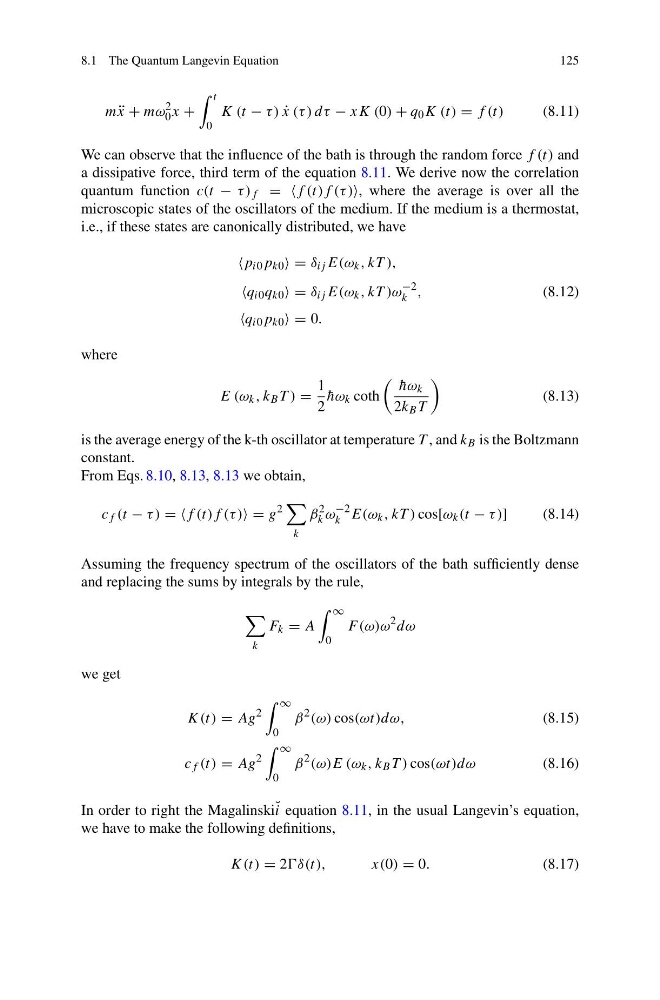
We can observe that the influence of the bath is through the random force f (t) and
a dissipative force, third term of the equation 8.11. We derive now the correlation
quantum function c(t − τ ) f = f (t)f (τ ), where the average is over all the
microscopic states of the oscillators of the medium. If the medium is a thermostat,
i.e., if these states are canonically distributed, we have
p i0 p k0 = δ ij E(ω k , kT ),
q i0 q k0 = δ ij E(ω k , kT )ω
−2
k ,
(8.12)
q i0 p k0 = 0.
where
E (ω k , k B T ) =
1
2
¯
hω k coth
¯
hω k
2k B T
(8.13)
is the average energy of the k-th oscillator at temperature T , and k B is the Boltzmann
constant.
From Eqs. 8.10, 8.13, 8.13 we obtain,
c f (t − τ ) = f (t)f (τ ) = g
2
k
β
2
k ω
−2
k E(ω k , kT ) cos[ω k (t − τ )]
(8.14)
Assuming the frequency spectrum of the oscillators of the bath sufficiently dense
and replacing the sums by integrals by the rule,
k
F k = A
∞
0
F (ω)ω
2 dω
we get
K(t) = Ag
2
∞
0
β
2 (ω) cos(ωt)dω,
(8.15)
c f (t) = Ag
2
∞
0
β
2 (ω)E (ω k , k B T ) cos(ωt)dω
(8.16)
In order to right the Magalinski ˘
i equation 8.11, in the usual Langevin’s equation,
we have to make the following definitions,
K(t) = 2
x(0) = 0.
(8.17)
125
m ¨
x + mω
2
0 x +
t
0
K (t − τ ) ˙
x (τ ) dτ − xK (0) + q 0 K (t) = f (t)
(8.11)
We can observe that the influence of the bath is through the random force f (t) and
a dissipative force, third term of the equation 8.11. We derive now the correlation
quantum function c(t − τ ) f = f (t)f (τ ), where the average is over all the
microscopic states of the oscillators of the medium. If the medium is a thermostat,
i.e., if these states are canonically distributed, we have
p i0 p k0 = δ ij E(ω k , kT ),
q i0 q k0 = δ ij E(ω k , kT )ω
−2
k ,
(8.12)
q i0 p k0 = 0.
where
E (ω k , k B T ) =
1
2
¯
hω k coth
¯
hω k
2k B T
(8.13)
is the average energy of the k-th oscillator at temperature T , and k B is the Boltzmann
constant.
From Eqs. 8.10, 8.13, 8.13 we obtain,
c f (t − τ ) = f (t)f (τ ) = g
2
k
β
2
k ω
−2
k E(ω k , kT ) cos[ω k (t − τ )]
(8.14)
Assuming the frequency spectrum of the oscillators of the bath sufficiently dense
and replacing the sums by integrals by the rule,
k
F k = A
∞
0
F (ω)ω
2 dω
we get
K(t) = Ag
2
∞
0
β
2 (ω) cos(ωt)dω,
(8.15)
c f (t) = Ag
2
∞
0
β
2 (ω)E (ω k , k B T ) cos(ωt)dω
(8.16)
In order to right the Magalinski ˘
i equation 8.11, in the usual Langevin’s equation,
we have to make the following definitions,
K(t) = 2
x(0) = 0.
(8.17)