

8.1 The Quantum Langevin Equation
127
k(ω) is the average force constant of the oscillators whose frequency is ω. Finally,
from Eq. 8.16, we obtain the general formula that connects the correlation of the
fluctuation force with the dissipative properties of the system:
c f (t) =
∞
0
N(ω)k(ω)E (ω k , k B T ) cos(ωt)dω
(8.27)
8.1.1 The Correlation Quantum Function
The correlation function c f (t − t ) =
f (t)f (t )
S
, where f (t) is the c-number
quantum noise for the force, in the continuum limit is [5]
c f (t − t
) =
1
2
∞
0
N(ω)k(ω) ¯
hω. coth
¯
hω
2k B T
cos[ω(t − t
)]dω
(8.28)
where k B denotes the Boltzmann constant and T the absolute temperature. For a
Lorentzian distribution of bath modes characterized by a density function N(ω),
=
0
1 + (ωτ c ) 2 ,
(8.29)
where 0 is the dissipation constant and τ c refers to the correlation time and τ s is
the system characteristic time, namely:
τ c =
¯
h
2k B T
,
τ =
τ c
τ s
,
y = ωτ c τ s ,
t = (t − t
)/τ τ s
(8.30)
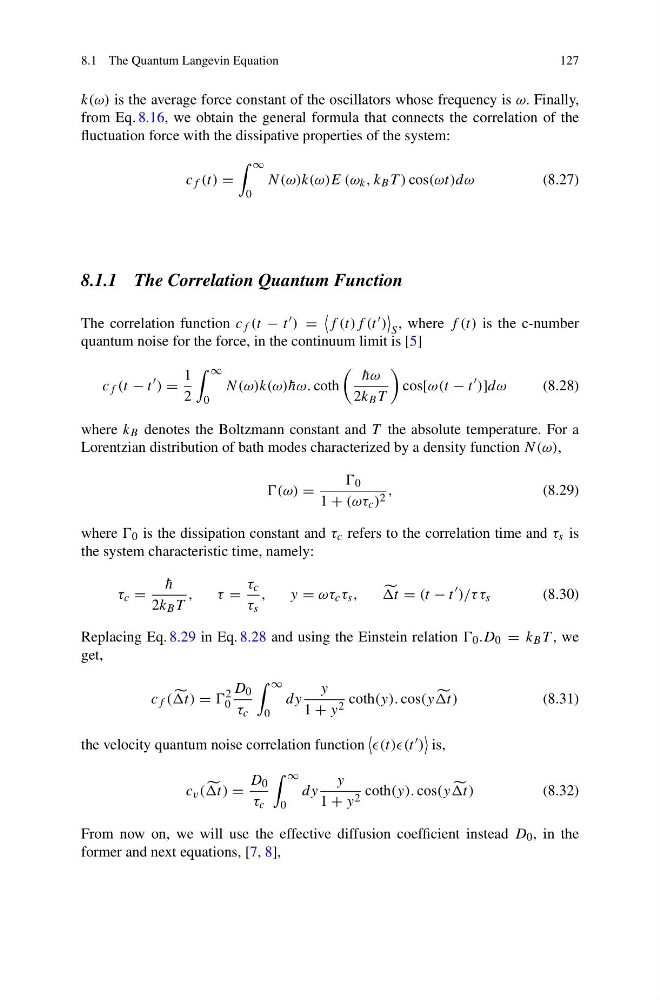
Replacing Eq. 8.29 in Eq. 8.28 and using the Einstein relation 0 .D 0 = k B T , we
get,
c f (
t) =
2
0
D 0
τ c
∞
0
dy
y
1 + y 2 coth(y). cos(y
t)
(8.31)
the velocity quantum noise correlation function
(t))(t )
is,
c v (
t) =
D 0
τ c
∞
0
dy
y
1 + y 2 coth(y). cos(y
t)
(8.32)
From now on, we will use the effective diffusion coefficient instead D 0 , in the
former and next equations, [7, 8],
127
k(ω) is the average force constant of the oscillators whose frequency is ω. Finally,
from Eq. 8.16, we obtain the general formula that connects the correlation of the
fluctuation force with the dissipative properties of the system:
c f (t) =
∞
0
N(ω)k(ω)E (ω k , k B T ) cos(ωt)dω
(8.27)
8.1.1 The Correlation Quantum Function
The correlation function c f (t − t ) =
f (t)f (t )
S
, where f (t) is the c-number
quantum noise for the force, in the continuum limit is [5]
c f (t − t
) =
1
2
∞
0
N(ω)k(ω) ¯
hω. coth
¯
hω
2k B T
cos[ω(t − t
)]dω
(8.28)
where k B denotes the Boltzmann constant and T the absolute temperature. For a
Lorentzian distribution of bath modes characterized by a density function N(ω),
=
0
1 + (ωτ c ) 2 ,
(8.29)
where 0 is the dissipation constant and τ c refers to the correlation time and τ s is
the system characteristic time, namely:
τ c =
¯
h
2k B T
,
τ =
τ c
τ s
,
y = ωτ c τ s ,
t = (t − t
)/τ τ s
(8.30)
Replacing Eq. 8.29 in Eq. 8.28 and using the Einstein relation 0 .D 0 = k B T , we
get,
c f (
t) =
2
0
D 0
τ c
∞
0
dy
y
1 + y 2 coth(y). cos(y
t)
(8.31)
the velocity quantum noise correlation function
(t))(t )
is,
c v (
t) =
D 0
τ c
∞
0
dy
y
1 + y 2 coth(y). cos(y
t)
(8.32)
From now on, we will use the effective diffusion coefficient instead D 0 , in the
former and next equations, [7, 8],