

132
framework as such should be applied uniformly, the bearing idea is to differentiate
among actors depending on individual behaviour. Preferred behaviour should be
awarded, while unwanted choices should be penalised. To make such a scheme
effective, it is imperative to know the main drivers of key actors.
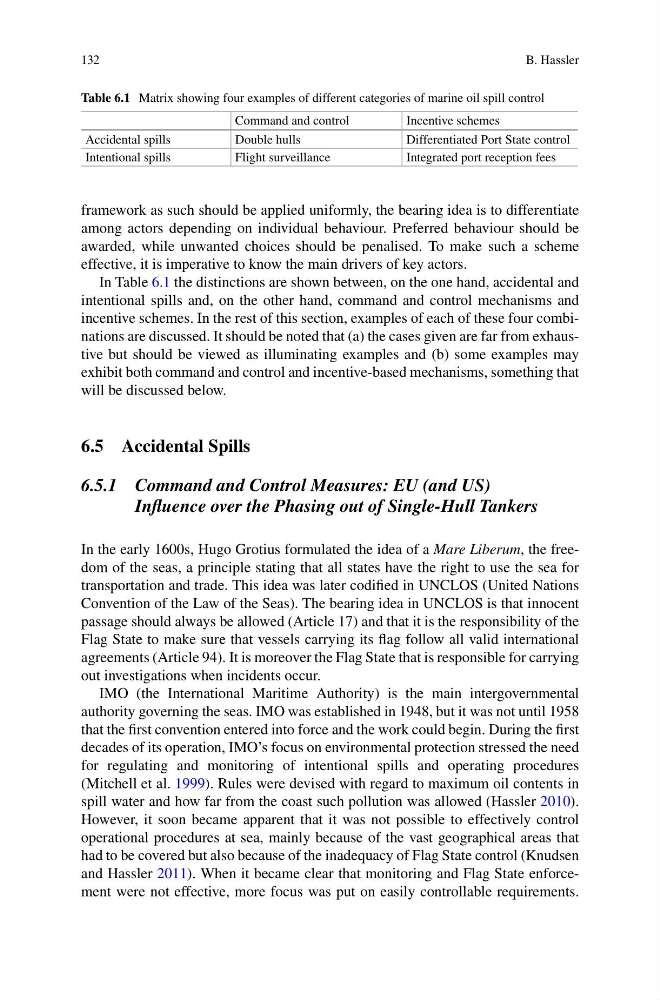
In Table 6.1 the distinctions are shown between, on the one hand, accidental and
intentional spills and, on the other hand, command and control mechanisms and
incentive schemes. In the rest of this section, examples of each of these four combinations are discussed. It should be noted that (a) the cases given are far from exhaustive but should be viewed as illuminating examples and (b) some examples may
exhibit both command and control and incentive-based mechanisms, something that
will be discussed below.
6.5 Accidental Spills
6.5.1 Command and Control Measures: EU (and US)
Infl uence over the Phasing out of Single-Hull Tankers
In the early 1600s, Hugo Grotius formulated the idea of a Mare Liberum , the freedom of the seas, a principle stating that all states have the right to use the sea for
transportation and trade. This idea was later codifi ed in UNCLOS (United Nations
Convention of the Law of the Seas). The bearing idea in UNCLOS is that innocent
passage should always be allowed (Article 17) and that it is the responsibility of the
Flag State to make sure that vessels carrying its fl ag follow all valid international
agreements (Article 94). It is moreover the Flag State that is responsible for carrying
out investigations when incidents occur.
IMO (the International Maritime Authority) is the main intergovernmental
authority governing the seas. IMO was established in 1948, but it was not until 1958
that the fi rst convention entered into force and the work could begin. During the fi rst
decades of its operation, IMO’s focus on environmental protection stressed the need
for regulating and monitoring of intentional spills and operating procedures
(Mitchell et al. 1999 ). Rules were devised with regard to maximum oil contents in
spill water and how far from the coast such pollution was allowed (Hassler 2010 ).
However, it soon became apparent that it was not possible to effectively control
operational procedures at sea, mainly because of the vast geographical areas that
had to be covered but also because of the inadequacy of Flag State control (Knudsen
and Hassler 2011 ). When it became clear that monitoring and Flag State enforcement were not effective, more focus was put on easily controllable requirements.
Table 6.1 Matrix showing four examples of different categories of marine oil spill control
Command and control
Incentive schemes
Accidental spills
Double hulls
Differentiated Port State control
Intentional spills
Flight surveillance
Integrated port reception fees
B. Hassler
framework as such should be applied uniformly, the bearing idea is to differentiate
among actors depending on individual behaviour. Preferred behaviour should be
awarded, while unwanted choices should be penalised. To make such a scheme
effective, it is imperative to know the main drivers of key actors.
In Table 6.1 the distinctions are shown between, on the one hand, accidental and
intentional spills and, on the other hand, command and control mechanisms and
incentive schemes. In the rest of this section, examples of each of these four combinations are discussed. It should be noted that (a) the cases given are far from exhaustive but should be viewed as illuminating examples and (b) some examples may
exhibit both command and control and incentive-based mechanisms, something that
will be discussed below.
6.5 Accidental Spills
6.5.1 Command and Control Measures: EU (and US)
Infl uence over the Phasing out of Single-Hull Tankers
In the early 1600s, Hugo Grotius formulated the idea of a Mare Liberum , the freedom of the seas, a principle stating that all states have the right to use the sea for
transportation and trade. This idea was later codifi ed in UNCLOS (United Nations
Convention of the Law of the Seas). The bearing idea in UNCLOS is that innocent
passage should always be allowed (Article 17) and that it is the responsibility of the
Flag State to make sure that vessels carrying its fl ag follow all valid international
agreements (Article 94). It is moreover the Flag State that is responsible for carrying
out investigations when incidents occur.
IMO (the International Maritime Authority) is the main intergovernmental
authority governing the seas. IMO was established in 1948, but it was not until 1958
that the fi rst convention entered into force and the work could begin. During the fi rst
decades of its operation, IMO’s focus on environmental protection stressed the need
for regulating and monitoring of intentional spills and operating procedures
(Mitchell et al. 1999 ). Rules were devised with regard to maximum oil contents in
spill water and how far from the coast such pollution was allowed (Hassler 2010 ).
However, it soon became apparent that it was not possible to effectively control
operational procedures at sea, mainly because of the vast geographical areas that
had to be covered but also because of the inadequacy of Flag State control (Knudsen
and Hassler 2011 ). When it became clear that monitoring and Flag State enforcement were not effective, more focus was put on easily controllable requirements.
Table 6.1 Matrix showing four examples of different categories of marine oil spill control
Command and control
Incentive schemes
Accidental spills
Double hulls
Differentiated Port State control
Intentional spills
Flight surveillance
Integrated port reception fees
B. Hassler