

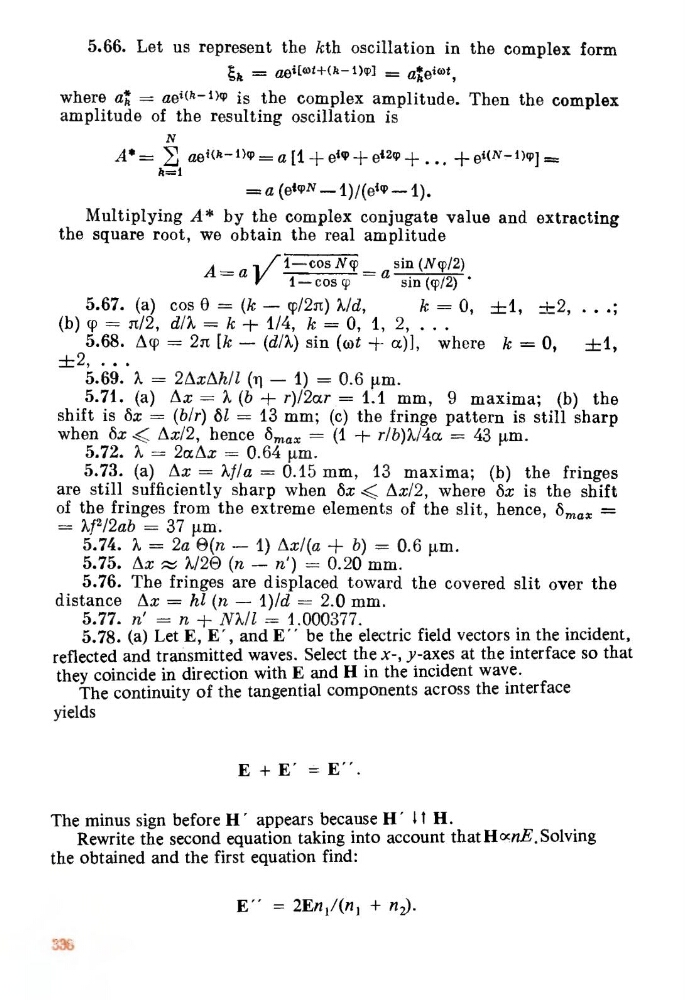
5.66. Let us represent the kth oscillation in the complex form
Eh = aei(4)t+(k-1)(pi = ateixot,
where a: = aei(4-1)9 is the complex amplitude. Then the complex
amplitude of the resulting oscillation is
N
A* . E
IA) = a [1 +
+ 029
ei(N-1)cpi
k=1
= a (eiTN —1)1(elq) —1).
Multiplying A* by the complex conjugate value and extracting
the square root, we obtain the real amplitude
al
71—cos Arcp a
sin (Ny/2)
—
1— cos
sin (T/2) •
5.67. (a) cos 0 = (k — cp1231) XI d,
k = 0, ±1, ±2, . . .;
(b) cp = It/2, d/X, = k
1/4, k = 0, 1, 2, . . .
5.68. AT = 231 [k — (d/k) sin (cot + a)], where k = 0, ±1,
±2, . . .
5.69. X = 2AxAh/l — 1) = 0.6 Rm.
5.71. (a) Ax = X (b
r)I2ar = 1.1 mm, 9 maxima; (b) the
shift is ox = (blr) 61 = 13 mm; (c) the fringe pattern is still sharp
when Ox < Ax/2, hence 6„,,„x = (1 + r/b)X14a = 43 p.m.
5.72. X. = 2ccAx = 0.64 fan.
5.73. (a) Ax = kfla = 0.15 mm, 13 maxima; (b) the fringes
are still sufficiently sharp when Ox < Ax/2, where Ox is the shift
of the fringes from the extreme elements of the slit, hence, 6„,ax =
= ?f2/2ab = 37 Rm.
5.74. X = 2a e(n — 1) Axl (a
b) = 0.6 p.m.
5.75. Ax X/28 (n — n') = 0.20 mm.
5.76. The fringes are displaced toward the covered slit over the
distance Ax = hl (n — 1)/d = 2.0 mm.
5.77. n' = n
Nkl 1 = 1.000377.
5.78. (a) Let E, E', and E" be the electric field vectors in the incident,
reflected and transmitted waves. Select the x-, y-axes at the interface so that
they coincide in direction with E and H in the incident wave.
i
The continuity of the tangential components across the interface
yields
E + E' = E".
The minus sign before H' appears because H' It H.
Rewrite the second equation taking into account that HocnE.Solving
the obtained and the first equation find:
E" = 2En1/(n1 + n2).
Eh = aei(4)t+(k-1)(pi = ateixot,
where a: = aei(4-1)9 is the complex amplitude. Then the complex
amplitude of the resulting oscillation is
N
A* . E
IA) = a [1 +
+ 029
ei(N-1)cpi
k=1
= a (eiTN —1)1(elq) —1).
Multiplying A* by the complex conjugate value and extracting
the square root, we obtain the real amplitude
al
71—cos Arcp a
sin (Ny/2)
—
1— cos
sin (T/2) •
5.67. (a) cos 0 = (k — cp1231) XI d,
k = 0, ±1, ±2, . . .;
(b) cp = It/2, d/X, = k
1/4, k = 0, 1, 2, . . .
5.68. AT = 231 [k — (d/k) sin (cot + a)], where k = 0, ±1,
±2, . . .
5.69. X = 2AxAh/l — 1) = 0.6 Rm.
5.71. (a) Ax = X (b
r)I2ar = 1.1 mm, 9 maxima; (b) the
shift is ox = (blr) 61 = 13 mm; (c) the fringe pattern is still sharp
when Ox < Ax/2, hence 6„,,„x = (1 + r/b)X14a = 43 p.m.
5.72. X. = 2ccAx = 0.64 fan.
5.73. (a) Ax = kfla = 0.15 mm, 13 maxima; (b) the fringes
are still sufficiently sharp when Ox < Ax/2, where Ox is the shift
of the fringes from the extreme elements of the slit, hence, 6„,ax =
= ?f2/2ab = 37 Rm.
5.74. X = 2a e(n — 1) Axl (a
b) = 0.6 p.m.
5.75. Ax X/28 (n — n') = 0.20 mm.
5.76. The fringes are displaced toward the covered slit over the
distance Ax = hl (n — 1)/d = 2.0 mm.
5.77. n' = n
Nkl 1 = 1.000377.
5.78. (a) Let E, E', and E" be the electric field vectors in the incident,
reflected and transmitted waves. Select the x-, y-axes at the interface so that
they coincide in direction with E and H in the incident wave.
i
The continuity of the tangential components across the interface
yields
E + E' = E".
The minus sign before H' appears because H' It H.
Rewrite the second equation taking into account that HocnE.Solving
the obtained and the first equation find:
E" = 2En1/(n1 + n2).