

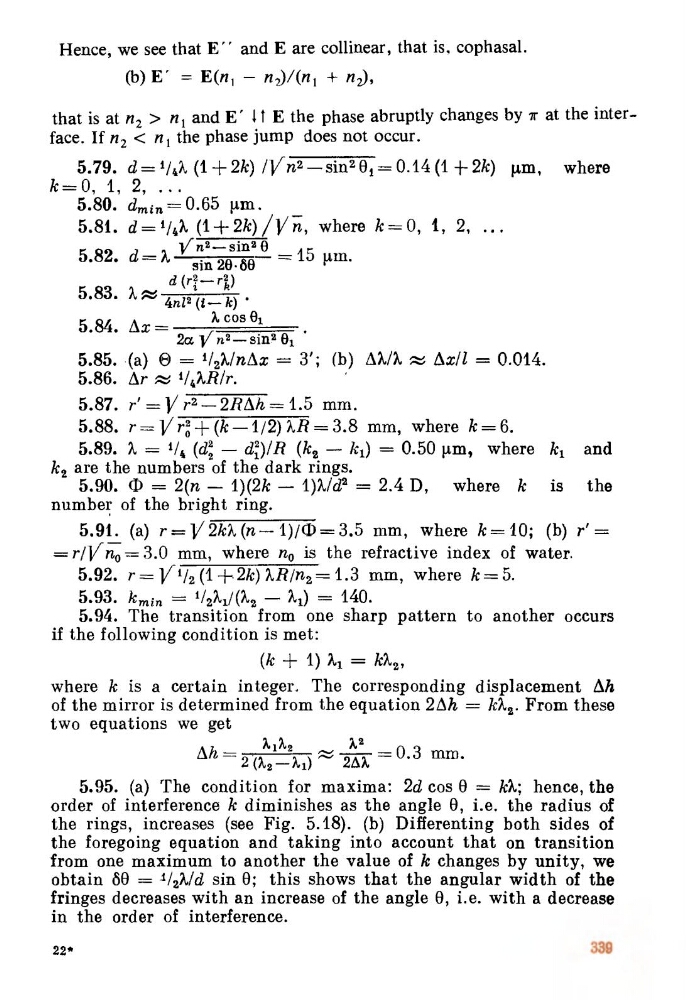
Hence, we see that E" and E are collinear, that is. cophasal.
(b) E' = E(n, — n 2)/(n 1 + n7),
that is at n2 > n 1 and E' 11 E the phase abruptly changes by Ir at the interface. If n2 < n 1 the phase jump does not occur.
5.79. d = 114X (1+2k)
sin2 01 = 0.14 (1 -I-- 2k) [ma, where
k= 0, 1,
5.80. dmin — 0.65 1.1m.
5.81. d= 114 X (1+ 2k) /j/ n, where k= 0, 1, 2, ...
5.82. d—
.1( 712 — sin2 0
15 pin.
sin 20.80
d (71— r1)
5.85. (a) 0 = 1/2X/nAx = 3'; (b) Aka
Ax/1 = 0.014.
5.86. Ar
1/4XR/r.
5.87. r' =- y r2 — 2RAh = 1.5 mm.
5.88. r =1/ r:+ (k —112) XR = 3.8 mm, where k = 6.
5.89. 2t. = 1/4 (d: — dDIR (k2 — k1) = 0.50 Rm, where k1 and
k2 are the numbers of the dark rings.
5.90. €1) = 2(n — 1)(2k — 1)?./d2 = 2.4 D, where k is the
number of the bright ring.
5.91. (a) r 1/ 210, (n — 1)/0= 3.5 mm, where k = 10; (b) r' =
= VW; = 3.0 mm, where no is the refractive index of water.
5.92. r =
(1 + 2k) XR/n2 =-- 1.3 mm, where k = 5.
5.93. kmi n = 112211(X2 — 21) = 140.
5.94. The transition from one sharp pattern to another occurs
if the following condition is met:
(k
1)
= kX2,
where k is a certain integer. The corresponding displacement Ah
of the mirror is determined from the equation 2Ah = kk2. From these
two equations we get
2
Ah = 2 (%2 —
26.26
o
i 2
. 3 mm.
5.95. (a) The condition for maxima: 2d cos 0 = kX; hence, the
order of interference k diminishes as the angle 0, i.e. the radius of
the rings, increases (see Fig. 5.18). (b) Differenting both sides of
the foregoing equation and taking into account that on transition
from one maximum to another the value of k changes by unity, we
obtain 60 = 112kld sin 0; this shows that the angular width of the
fringes decreases with an increase of the angle 0, i.e. with a decrease
in the order of interference.
5.83. X 4n12 (i— k) '
5.84. Ax —
?. cos 01
2cx, 1/ n2 — sin20,
22*
(b) E' = E(n, — n 2)/(n 1 + n7),
that is at n2 > n 1 and E' 11 E the phase abruptly changes by Ir at the interface. If n2 < n 1 the phase jump does not occur.
5.79. d = 114X (1+2k)
sin2 01 = 0.14 (1 -I-- 2k) [ma, where
k= 0, 1,
5.80. dmin — 0.65 1.1m.
5.81. d= 114 X (1+ 2k) /j/ n, where k= 0, 1, 2, ...
5.82. d—
.1( 712 — sin2 0
15 pin.
sin 20.80
d (71— r1)
5.85. (a) 0 = 1/2X/nAx = 3'; (b) Aka
Ax/1 = 0.014.
5.86. Ar
1/4XR/r.
5.87. r' =- y r2 — 2RAh = 1.5 mm.
5.88. r =1/ r:+ (k —112) XR = 3.8 mm, where k = 6.
5.89. 2t. = 1/4 (d: — dDIR (k2 — k1) = 0.50 Rm, where k1 and
k2 are the numbers of the dark rings.
5.90. €1) = 2(n — 1)(2k — 1)?./d2 = 2.4 D, where k is the
number of the bright ring.
5.91. (a) r 1/ 210, (n — 1)/0= 3.5 mm, where k = 10; (b) r' =
= VW; = 3.0 mm, where no is the refractive index of water.
5.92. r =
(1 + 2k) XR/n2 =-- 1.3 mm, where k = 5.
5.93. kmi n = 112211(X2 — 21) = 140.
5.94. The transition from one sharp pattern to another occurs
if the following condition is met:
(k
1)
= kX2,
where k is a certain integer. The corresponding displacement Ah
of the mirror is determined from the equation 2Ah = kk2. From these
two equations we get
2
Ah = 2 (%2 —
26.26
o
i 2
. 3 mm.
5.95. (a) The condition for maxima: 2d cos 0 = kX; hence, the
order of interference k diminishes as the angle 0, i.e. the radius of
the rings, increases (see Fig. 5.18). (b) Differenting both sides of
the foregoing equation and taking into account that on transition
from one maximum to another the value of k changes by unity, we
obtain 60 = 112kld sin 0; this shows that the angular width of the
fringes decreases with an increase of the angle 0, i.e. with a decrease
in the order of interference.
5.83. X 4n12 (i— k) '
5.84. Ax —
?. cos 01
2cx, 1/ n2 — sin20,
22*