

5.47. F < D/do = 20.
5.48. F= 60.
5.49. (a) F = 2a/o/do = 15, where /0 is the distance of the best
vision (25 cm); (b) r < 2a/o/do.
5.50. The principal planes coincide with the centre of the lens.
The focal lengths in air and water: f = —110 = —11 cm, f'
= noleo = +15 cm. Here cl) = (2n — no — 1)1 R, where n and no
are the refractive indices of glass and water. The nodal points coincide
and are located in water at the distance x = f'
f = 3.7 cm from
the lens.
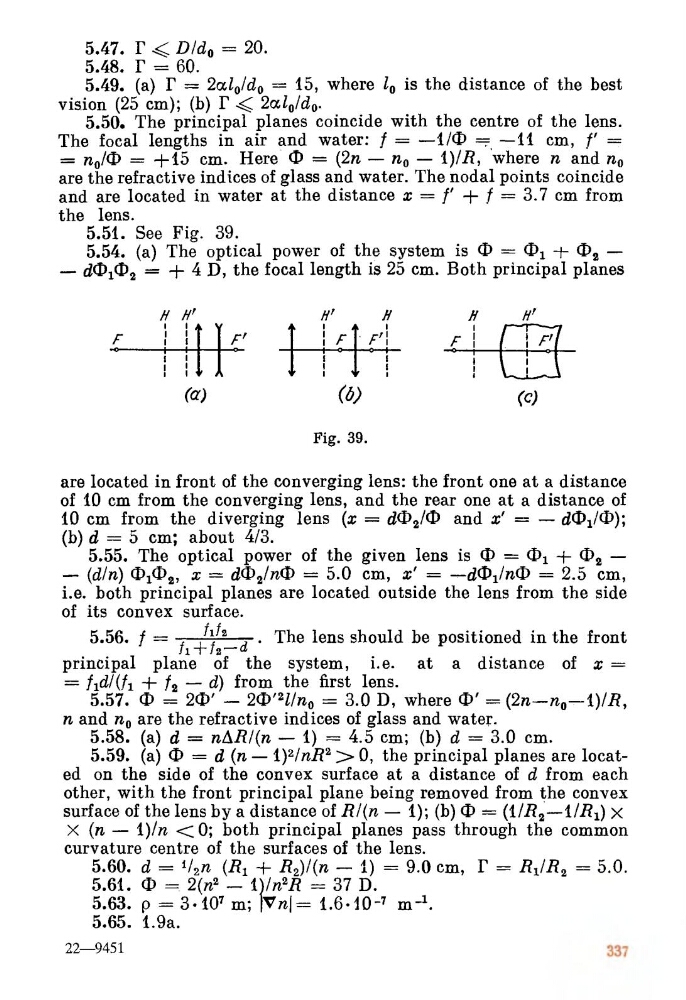
5.51. See Fig. 39.
5.54. (a) The optical power of the system is cb =cD 2 -
- d(1)02 = + 4 D, the focal length is 25 cm. Both principal planes
H H'
(a)
H'
H
F
Fig. 39.
(c)
are located in front of the converging lens: the front one at a distance
of 10 cm from the converging lens, and the rear one at a distance of
10 cm from the diverging lens (x = d(1)2/0 and x' = — dcloin);
(b) d = 5 cm; about 4/3.
5.55. The optical power of the given lens is cD = clpi + cD2 -
- (dln) c1302, x = d021 = 5.0 cm, x' —4011 nal = 2.5 cm,
i.e. both principal planes are located outside the lens from the side
of its convex surface.
5.56. f = tltz
. The lens should be positioned in the front
fly-
d
principal plane of the system, i.e. at a distance of x =
=
-1- f 2 — d) from the first lens.
5.57. 4 :13 = 2c13' — 20'2//no = 3.0 D, where cD' = (2n —no —1)/R,
n and no are the refractive indices of glass and water.
5.58. (a) d = nARI (n — 1) = 4.5 cm; (b) d = 3.0 cm.
5.59. (a) cD = d (n-1)21nR2 > 0, the principal planes are located on the side of the convex surface at a distance of d from each
other, with the front principal plane being removed from the convex
surface of the lens by a distance of RI (n — 1); (b) cb = (1/R2-1/R1) X
X (n — 1)/n < 0; both principal planes pass through the common
curvature centre of the surfaces of the lens.
5.60. d = 1/2 n (R1
R2)I (n — 1) = 9.0 cm, F = R1/R2 = 5.0.
5.61. (1) = 2(n2 — 1)/n2R = 37 D.
5.63. p = 3.107 m; Oni= 1.6-10 m-1.
5.65. 1.9a.
22-9451
5.48. F= 60.
5.49. (a) F = 2a/o/do = 15, where /0 is the distance of the best
vision (25 cm); (b) r < 2a/o/do.
5.50. The principal planes coincide with the centre of the lens.
The focal lengths in air and water: f = —110 = —11 cm, f'
= noleo = +15 cm. Here cl) = (2n — no — 1)1 R, where n and no
are the refractive indices of glass and water. The nodal points coincide
and are located in water at the distance x = f'
f = 3.7 cm from
the lens.
5.51. See Fig. 39.
5.54. (a) The optical power of the system is cb =cD 2 -
- d(1)02 = + 4 D, the focal length is 25 cm. Both principal planes
H H'
(a)
H'
H
F
Fig. 39.
(c)
are located in front of the converging lens: the front one at a distance
of 10 cm from the converging lens, and the rear one at a distance of
10 cm from the diverging lens (x = d(1)2/0 and x' = — dcloin);
(b) d = 5 cm; about 4/3.
5.55. The optical power of the given lens is cD = clpi + cD2 -
- (dln) c1302, x = d021 = 5.0 cm, x' —4011 nal = 2.5 cm,
i.e. both principal planes are located outside the lens from the side
of its convex surface.
5.56. f = tltz
. The lens should be positioned in the front
fly-
d
principal plane of the system, i.e. at a distance of x =
=
-1- f 2 — d) from the first lens.
5.57. 4 :13 = 2c13' — 20'2//no = 3.0 D, where cD' = (2n —no —1)/R,
n and no are the refractive indices of glass and water.
5.58. (a) d = nARI (n — 1) = 4.5 cm; (b) d = 3.0 cm.
5.59. (a) cD = d (n-1)21nR2 > 0, the principal planes are located on the side of the convex surface at a distance of d from each
other, with the front principal plane being removed from the convex
surface of the lens by a distance of RI (n — 1); (b) cb = (1/R2-1/R1) X
X (n — 1)/n < 0; both principal planes pass through the common
curvature centre of the surfaces of the lens.
5.60. d = 1/2 n (R1
R2)I (n — 1) = 9.0 cm, F = R1/R2 = 5.0.
5.61. (1) = 2(n2 — 1)/n2R = 37 D.
5.63. p = 3.107 m; Oni= 1.6-10 m-1.
5.65. 1.9a.
22-9451