

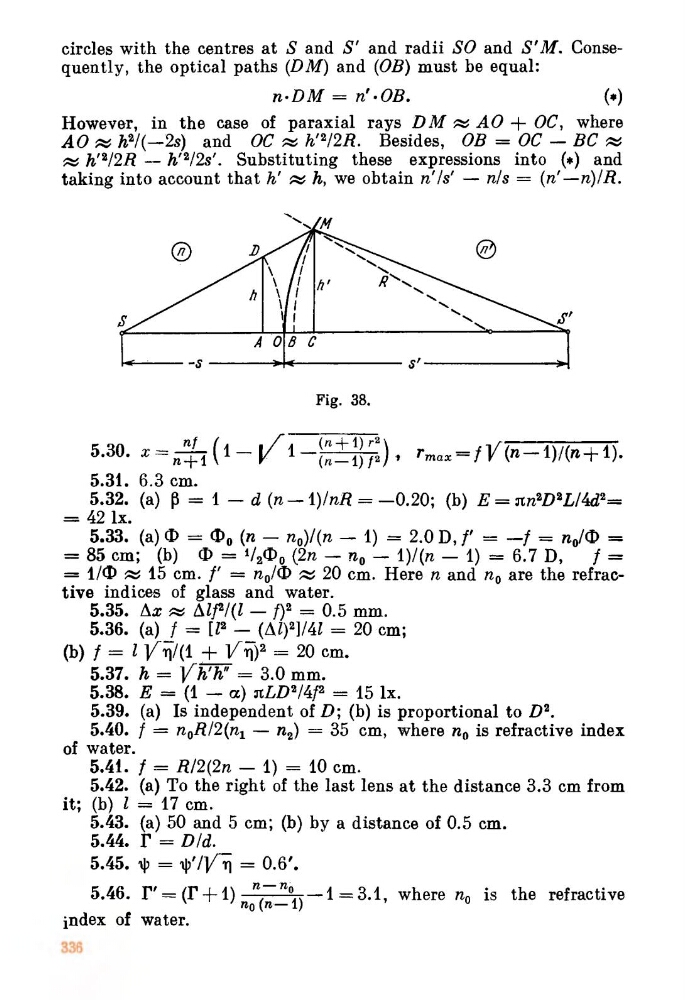
circles with the centres at S and S' and radii SO and S'M. Consequently, the optical paths (DM) and (OB) must be equal:
n•DM = n'• OB.
(*)
However, in the case of paraxial rays DM x AO + OC, where
AO z h2/(-2s) and OC
h'2/2R. Besides, OB = OC — BC
74.1 h' 2/2R — h' 2/2s'. Substituting these expressions into (*) and
taking into account that h'
h, we obtain n' Is' — n/s = (n'—n)/R.
Fig. 38.
5.30. x n+i(1
(n + 1) r 2
(n _i) /2)
rmax
f
— 1)/(n+ 1)•
5.31. 6.3 cm.
5.32. (a) 13 = 1 — d (n-1)1nR = —0.20; (b) E = an2D2L/4d2=
= 42 lx.
5.33. (a) cI) = (1:00 (n — no)/(n — 1) = 2.0 D, f' = —f = nolcb =
= 85 cm; (b) i/200 (2n — no — 1)/(n — 1.) = 6.7 D,
f =
= 114) 7.e. 15 cm. f' = no/0
20 cm. Here n and no are the refractive indices of glass and water.
5.35. Ax
A1f 2/(/ — f)2 = 0.5 mm.
5.36. (a) f = [12 — (A1)9141 = 20 cm;
(b) f = 1 Vi,/(1
1/1)2 = 20 cm.
5.37. h = jih'h" = 3.0 mm.
5.38. E = (1 — a) 3-ELD214f 2 = 15 lx.
5.39. (a) Is independent of D; (b) is proportional to D2.
5.40. f = noR/2(ni — n2) = 35 cm, where no is refractive index
of water.
5.41. f = R/2(2n — 1) = 10 cm.
5.42. (a) To the right of the last lens at the distance 3.3 cm from
it; (b) 1 = 17 cm.
5.43. (a) 50 and 5 cm; (b) by a distance of 0.5 cm.
5.44. r = Did.
5.45. ip =11)'/I/Ti = 0.6'.
5.46. r (r + 1)
n
no ( n
n—' 1) 1= 3.1, where no is the refractive
index of water.
n•DM = n'• OB.
(*)
However, in the case of paraxial rays DM x AO + OC, where
AO z h2/(-2s) and OC
h'2/2R. Besides, OB = OC — BC
74.1 h' 2/2R — h' 2/2s'. Substituting these expressions into (*) and
taking into account that h'
h, we obtain n' Is' — n/s = (n'—n)/R.
Fig. 38.
5.30. x n+i(1
(n + 1) r 2
(n _i) /2)
rmax
f
— 1)/(n+ 1)•
5.31. 6.3 cm.
5.32. (a) 13 = 1 — d (n-1)1nR = —0.20; (b) E = an2D2L/4d2=
= 42 lx.
5.33. (a) cI) = (1:00 (n — no)/(n — 1) = 2.0 D, f' = —f = nolcb =
= 85 cm; (b) i/200 (2n — no — 1)/(n — 1.) = 6.7 D,
f =
= 114) 7.e. 15 cm. f' = no/0
20 cm. Here n and no are the refractive indices of glass and water.
5.35. Ax
A1f 2/(/ — f)2 = 0.5 mm.
5.36. (a) f = [12 — (A1)9141 = 20 cm;
(b) f = 1 Vi,/(1
1/1)2 = 20 cm.
5.37. h = jih'h" = 3.0 mm.
5.38. E = (1 — a) 3-ELD214f 2 = 15 lx.
5.39. (a) Is independent of D; (b) is proportional to D2.
5.40. f = noR/2(ni — n2) = 35 cm, where no is refractive index
of water.
5.41. f = R/2(2n — 1) = 10 cm.
5.42. (a) To the right of the last lens at the distance 3.3 cm from
it; (b) 1 = 17 cm.
5.43. (a) 50 and 5 cm; (b) by a distance of 0.5 cm.
5.44. r = Did.
5.45. ip =11)'/I/Ti = 0.6'.
5.46. r (r + 1)
n
no ( n
n—' 1) 1= 3.1, where no is the refractive
index of water.