

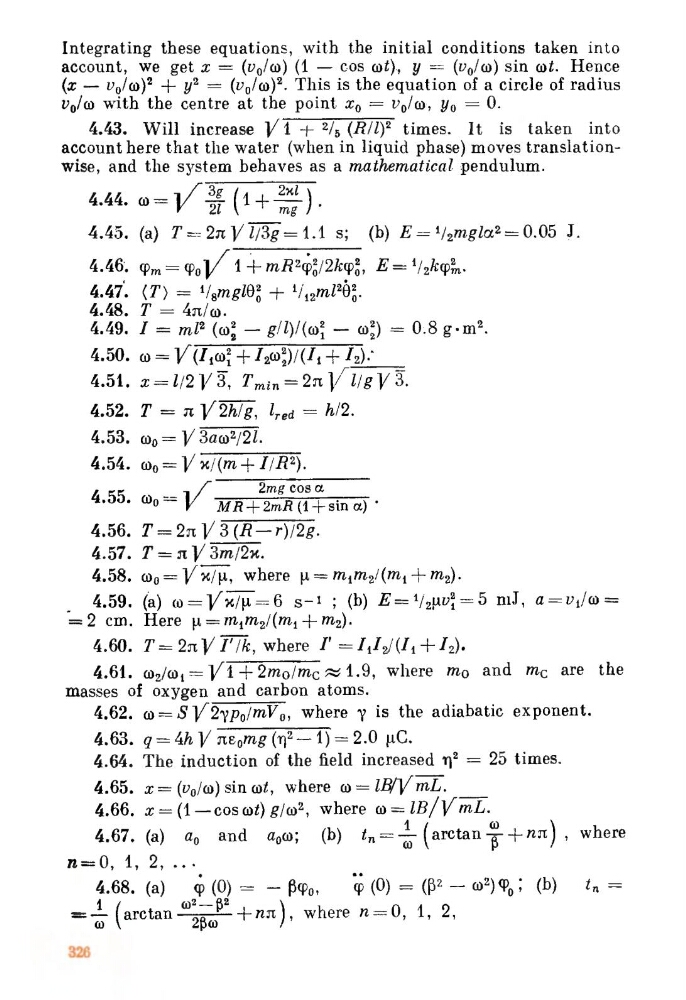
Integrating these equations, with the initial conditions taken into
account, we get x =--- (volco) (1 — cos cot), y = (vo/o)) sin cot. Hence
vo/ (.0)2 + y2
(v0/(10. ) This is the equation of a circle of radius
vo/co with the centre at the point xo = vo/o), yo = 0.
4.43. Will increase V 1 + 2/5 (R//)2 times. It is taken into
account here that the water (when in liquid phase) moves translationwise, and the system behaves as a mathematical pendulum.
4.44. co =
2/ (1+ —
mg ) •
2x/
4.45. (a) T == 2n y 113g =1.1 s; (b) E = il2mg/a2 = 0.05 J.
4.46. (pm = cpo l/ 1 + mR2cp/2kcp:, E= 1/2ken.
4.47. (T) = 118mg10:
V12702620.
4.48. 7' = 4n/a).
4.49. I = m12 (co:— g11)1(0, — 04) 0.8 g m2.
4.50. co = I/(Iico; + /2o)2 2)/(/1 + /2).•
4.51. x= 112V, T min = 2n 1/11gVS.
4.52. T = n V 2h/g, 1„d =
4.53. coo = / 3(1102/2/.
4.54. coo = - 1/ x/(m //R2).
2mg cos a
4.55. coo =
MR +2mR (1+ sin a) '
4.56. T 2n1/ 3 (R—r)12g.
4.57. T = ni/ 3m/2x.
4.58. co, = V x/R, where IA = m1m2/(m1 ± m2).
4.59. (a) = 1/ x/p, = 6 s-i ; (b) E= 112p.v2 i = 5 mJ, a=vileo- -=
2 cm. Here p, = m1m2/(m1 + m2).
4.60. T = 2n y rk, where I' =11121(11 + /2).
4.61. co2/co1 V1 2mo/mc 1.9, where mo and me are the
masses of oxygen and carbon atoms.
4.62. co = 81/21,,po/mVo, where Y is the adiabatic exponent.
4.63. q= 4h1/ acomg (i2 — 1) = 2.0 p,C.
4.64. The induction of the field increased 112 = 25 times.
4.65. x = (vo/co) sin cot, where w = 1B/V mL.
4.66. x —(1—cos wt) g/w2, where w = /B/VmL.
4.67. (a) cto and now; (b) to = w (arctan (3
+ nn) , where
n=0, 1, 2, ...
4.68. (a)
ip (0) = — 13cpo,
cp (0) = (32 — (1)2)% (b)
t r, =
0,2_ R2
= o.)
(arctan 2p(o
r -Frin), where n = 0, 1, 2,
h/2.
account, we get x =--- (volco) (1 — cos cot), y = (vo/o)) sin cot. Hence
vo/ (.0)2 + y2
(v0/(10. ) This is the equation of a circle of radius
vo/co with the centre at the point xo = vo/o), yo = 0.
4.43. Will increase V 1 + 2/5 (R//)2 times. It is taken into
account here that the water (when in liquid phase) moves translationwise, and the system behaves as a mathematical pendulum.
4.44. co =
2/ (1+ —
mg ) •
2x/
4.45. (a) T == 2n y 113g =1.1 s; (b) E = il2mg/a2 = 0.05 J.
4.46. (pm = cpo l/ 1 + mR2cp/2kcp:, E= 1/2ken.
4.47. (T) = 118mg10:
V12702620.
4.48. 7' = 4n/a).
4.49. I = m12 (co:— g11)1(0, — 04) 0.8 g m2.
4.50. co = I/(Iico; + /2o)2 2)/(/1 + /2).•
4.51. x= 112V, T min = 2n 1/11gVS.
4.52. T = n V 2h/g, 1„d =
4.53. coo = / 3(1102/2/.
4.54. coo = - 1/ x/(m //R2).
2mg cos a
4.55. coo =
MR +2mR (1+ sin a) '
4.56. T 2n1/ 3 (R—r)12g.
4.57. T = ni/ 3m/2x.
4.58. co, = V x/R, where IA = m1m2/(m1 ± m2).
4.59. (a) = 1/ x/p, = 6 s-i ; (b) E= 112p.v2 i = 5 mJ, a=vileo- -=
2 cm. Here p, = m1m2/(m1 + m2).
4.60. T = 2n y rk, where I' =11121(11 + /2).
4.61. co2/co1 V1 2mo/mc 1.9, where mo and me are the
masses of oxygen and carbon atoms.
4.62. co = 81/21,,po/mVo, where Y is the adiabatic exponent.
4.63. q= 4h1/ acomg (i2 — 1) = 2.0 p,C.
4.64. The induction of the field increased 112 = 25 times.
4.65. x = (vo/co) sin cot, where w = 1B/V mL.
4.66. x —(1—cos wt) g/w2, where w = /B/VmL.
4.67. (a) cto and now; (b) to = w (arctan (3
+ nn) , where
n=0, 1, 2, ...
4.68. (a)
ip (0) = — 13cpo,
cp (0) = (32 — (1)2)% (b)
t r, =
0,2_ R2
= o.)
(arctan 2p(o
r -Frin), where n = 0, 1, 2,
h/2.