

4.18. T =n1/ mlIF = 0.2 s.
4.19. T =2:t y
(1-1)=1.1 s.
4.20. T = 2 1/ llg[3112+arcsin(a/13)].
17 2
—
where =
4.21. t
u'
h
1— 1/-1 —
4.22. T = 4rcm/pgr2 = 2.5 s.
4.23. T =2n1/ ri (1 — 11) mix 0.13 s.
4.24. T = 2n V m/(xi ± x2).
4.25. T = 2aV mix, where x = x1x2/(t1 x2)4.26. co = 1/ 2To/m/.
4.27. T = 2n V m/Spg (1 + cos 0) = 0.8 s.
4.28. T =n1/ 211kg = 1.5 s.
4.29. (a) x
(gIR) x = 0, where x is the displacement of the
body relative to the centre of the Earth, R is its radius, g is the
standard free-fall acceleration; (b) i = IG VRIg = 42 min,
(c) v = 1/ gR = 7.9 km/s.
4.30. T = 25tV 111 g — w = 0.8 s,
where
jg— wl =
=1/ g2 ± W 2 - 2gtv cos [3.
4.31. T —27t/V xlm — (02 = 0.7 s, co> xim 10 rad/s.
4.32. k = 4n2a/gT2 = 0.4.
4.33. (a) 0 = 3.0° cos 3.5t; fring
(b) 0 = 4.5° sin 3.5t; (c) 0 =
15
= 5.4° cos (3.5t + 1.0). Here t
is expressed in seconds.
W -
4.34.
F = (m1 ± m2) g
miaco2 = 60 and 40 N.
0.5 -
4.35.
(a)
F =mg (1+
)
w
cioi2
a
22"4
t
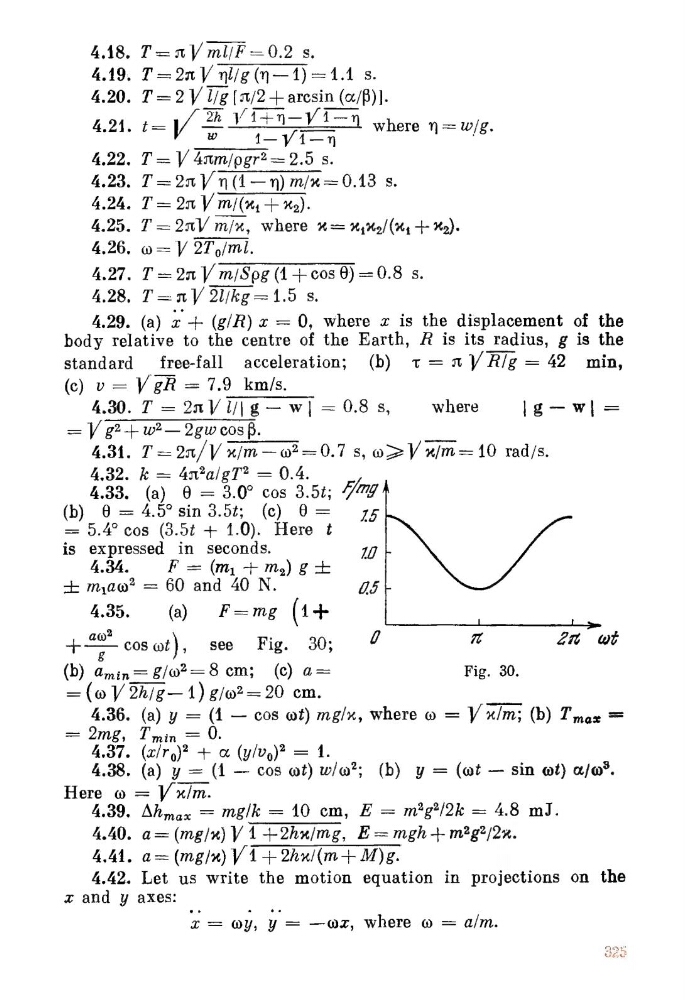
±- g— cos cot), see Fig. 30;
(b) a
m in
= g/w2 = 8 cm; (c) a =
Fig. 30.
co
= l/2h/g— 1) g/co2 = 20 cm.
4.36. (a) y = (1 — cos tot) mglx, where co = Vx/m; (b) T max --=
= 2mg, Tmin = O.
4.37. (xlro)2 + a (y/v0)2 = 1.
4.38. (a) y = (1 — cos cot) who2; (b) y = (cot — sin (et) We.
Here co
4.39. Ahmo. = mglk = 10 cm, E = m2g2/2k = 4.8 mJ.
4.40. a = (mg/x) V 1 +2hxlmg, E = mgh + m2g2/2x.
4.41. a= (mglx)1/1 +2hx1(m+ M)g.
4.42. Let us write the motion equation in projections on the
x and y axes:
x = coy, y = —cox, where co = alm.
325
4.19. T =2:t y
(1-1)=1.1 s.
4.20. T = 2 1/ llg[3112+arcsin(a/13)].
17 2
—
where =
4.21. t
u'
h
1— 1/-1 —
4.22. T = 4rcm/pgr2 = 2.5 s.
4.23. T =2n1/ ri (1 — 11) mix 0.13 s.
4.24. T = 2n V m/(xi ± x2).
4.25. T = 2aV mix, where x = x1x2/(t1 x2)4.26. co = 1/ 2To/m/.
4.27. T = 2n V m/Spg (1 + cos 0) = 0.8 s.
4.28. T =n1/ 211kg = 1.5 s.
4.29. (a) x
(gIR) x = 0, where x is the displacement of the
body relative to the centre of the Earth, R is its radius, g is the
standard free-fall acceleration; (b) i = IG VRIg = 42 min,
(c) v = 1/ gR = 7.9 km/s.
4.30. T = 25tV 111 g — w = 0.8 s,
where
jg— wl =
=1/ g2 ± W 2 - 2gtv cos [3.
4.31. T —27t/V xlm — (02 = 0.7 s, co> xim 10 rad/s.
4.32. k = 4n2a/gT2 = 0.4.
4.33. (a) 0 = 3.0° cos 3.5t; fring
(b) 0 = 4.5° sin 3.5t; (c) 0 =
15
= 5.4° cos (3.5t + 1.0). Here t
is expressed in seconds.
W -
4.34.
F = (m1 ± m2) g
miaco2 = 60 and 40 N.
0.5 -
4.35.
(a)
F =mg (1+
)
w
cioi2
a
22"4
t
±- g— cos cot), see Fig. 30;
(b) a
m in
= g/w2 = 8 cm; (c) a =
Fig. 30.
co
= l/2h/g— 1) g/co2 = 20 cm.
4.36. (a) y = (1 — cos tot) mglx, where co = Vx/m; (b) T max --=
= 2mg, Tmin = O.
4.37. (xlro)2 + a (y/v0)2 = 1.
4.38. (a) y = (1 — cos cot) who2; (b) y = (cot — sin (et) We.
Here co
4.39. Ahmo. = mglk = 10 cm, E = m2g2/2k = 4.8 mJ.
4.40. a = (mg/x) V 1 +2hxlmg, E = mgh + m2g2/2x.
4.41. a= (mglx)1/1 +2hx1(m+ M)g.
4.42. Let us write the motion equation in projections on the
x and y axes:
x = coy, y = —cox, where co = alm.
325